
St. Louis Cardinals seeking an edge in pitching. Here’s how they’re going about it
Sometimes inspiration strikes while playing catch. Sometimes a player is watching video, either of his own team or another. Sometimes a teammate or coach wanders by and asks a player if he’s ever considered placing his fingers here, or spinning the ball off there.
Tinkering with grips and adding to a repertoire has been an essential part of developing as a pitcher for as long as pitchers have existed, but modern diagnostic tools and a better understanding of the biomechanics behind arm action have made pitch design one of the industry’s most desired skills. It’s one from which the Cardinals are seeking an enhanced edge under the tutelage of new pitching coach Dusty Blake.
“There’s really two pieces to it,” Blake explained Thursday outside the team’s Florida clubhouse. “We can see what the rest of the league does, and characteristics that match this pitch characteristic play well.
“The other side of that is how hitters respond to what’s coming out of your hands. There can be pieces to where, well, the rest of the league throws a pitch that moves like this that’s mostly effective. But if we’re throwing it from a different side of the rubber, or a different angle, or a different release, it can impact that.”
Upon one instance of his being sent down to Triple-A Memphis in 2022, Jake Woodford’s slider was widely detected. The Cardinals, as manager Oliver Marmol explained at the time, were concerned about the shape of the pitch losing its effectiveness over time, eventually getting to a place where hitters would feel comfortable dismissing it as a concern entirely.
Woodford stood at his locker Thursday holding a ball, demonstrating a grip which puts pointer finger pressure on the outside of one seam and middle finger pressure on the blank leather hide of the ball. When he pulls his fingers down and across the surface on release, the pitch moves with sharper action and greater velocity, differentiating it from his larger, slower curveball.
It’s a grip, he said, that’s common throughout baseball, and he learned it from watching video of Milwaukee’s Freddy Peralta, who Woodford said he’s never met.
“It’s small tweaks,” Woodford said. “Not reinventing the pitch or anything. Changing the (vertical release point) a couple inches, adding a little bit of ‘velo,’ just small stuff like that. It’s a good pitch, but just trying to optimize it the best way you can.”
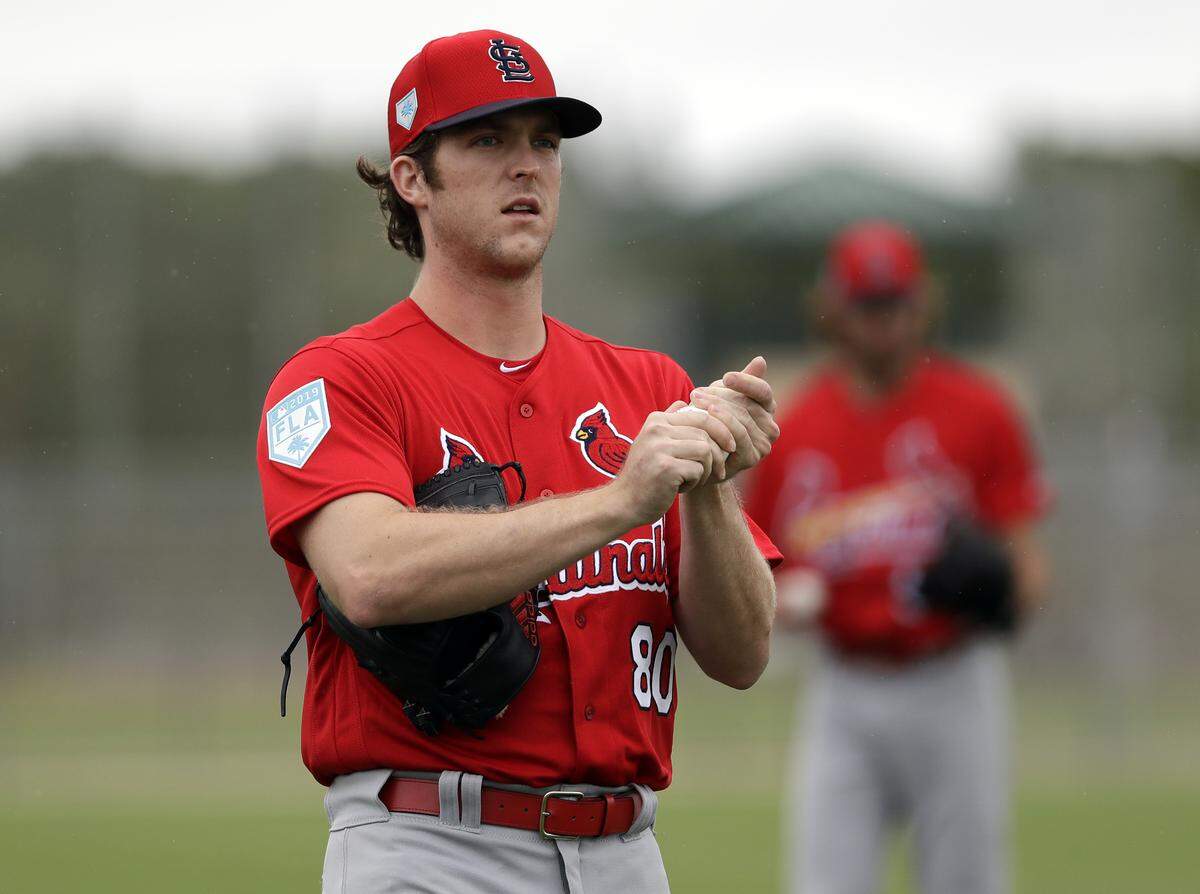
Connor Thomas
Connor Thomas, on the other hand, did reinvent one of his pitches. After an up-and-down season at Memphis, Thomas was sent to the Arizona Fall League at a career crossroads. Requiring protection from the Rule 5 draft this past winter, a stint in the AFL would be one of Thomas’s last chances to show the organization he was worth the investment inherent in a roster spot.
Acting on a suggestion from Cardinals Hall of Famer Jason Isringhausen, the lefty utilized a right-handed cutter grip, biting the pitch in tight cuts across the strike zone rather than the sweeping movements typical for his own breaking ball.
Cutter in tow, Thomas’s strikeout rate exploded from 7.3 per nine innings in Triple-A to 11.9 in the fall league. In taking that grip — and verifying its effectiveness and differentiation from his repertoire using a Trackman radar system and various high speed cameras — Thomas went from fringe candidate for the roster to rising candidate to debut in the majors.
“I’m not really into the numbers of it,” Thomas admitted. “If I see a pitch do something I like, OK, I like that. Let’s see how hitters react to it. And if the hitters are saying I can see it out of your hand, or I can hit that easily, or if I throw it in a game and they start hitting it, then we’ll adjust it.”
Thomas may not be into the numbers, but the Cardinals are. One reason the tally of tripods has exploded in recent years around camp is so portable radar can measure the release point of a pitch, its spin, and other relative vectors of movement. That’s important in determining whether pitches are distinct enough from each other, whether they’ve been successfully repeated, and in identifying whether an underlying medical issue could be creeping up.
‘You’re looking now at a recovery audit day to day’
Dramatic incidents of dropping velocity or misbehaving pitches are easy to catch. The gradual declines which precede those are more difficult to discern, but if caught early, they can stop bad habits from becoming serious damage.
“You’re looking now at a recovery audit day to day,” Blake explained, “to see if we throw this [pitch] more, are we seeing lower recovery? It’s not just, like, soreness now. It’s how does your (central nervous system) recover based on a couple assessments we can do, to see how guys are bouncing back.”
The investment in the new technology has been ongoing and is substantial, but in the right hands, has the potential to pay back dividends in health and performance many times over. The older methods, of course, remain popular; Blake said the Cardinals have a repository of videos of pitch grips from throughout baseball similar to that which Woodford sought out on YouTube.
And, of course, having legends hanging around to offer hands-on advice will always get the attention of current day players.
They’re simply entering a new era of having their work double checked.