Tim McCarver, catcher for Cardinals’ famed ‘El Birdos’, dies at age 81
Tim McCarver, the square-jawed catcher who anchored the St. Louis Cardinals famed “El Birdos” through three pennants and two World Series championships in the 1960s, then went onto a lengthy career as a broadcaster, died Thursday morning.
The National Baseball Hall of Fame made the announcement with Major League Baseball later confirming that heart failure was the cause of death. McCarver was 81 years old.
“Tim McCarver was an All-Star, a World Series Champion, a respected teammate, and one of the most influential voices our game has known,” Commissioner Rob Manfred said in a statement. “As a player, Tim was a key part of great Cardinals and Phillies teams in his 21-year career. In the booth, his analysis and attention to detail brought fans closer to our game and how it is played and managed. Tim’s approach enhanced the fan experience on our biggest stages and on the broadcasts of the Mets, the Yankees and the Cardinals.
“All of us at Major League Baseball are grateful for Tim’s impact on sports broadcasting and his distinguished career in our National Pastime. I extend my deepest condolences to Tim’s family, friends and the generations of fans who learned about our great game from him.”
As a senior at Christian Brothers High School in Memphis, McCarver was a heavily recruited linebacker from the Purple Wave football team. He could have played at the University of Tennessee, just down the road in Knoxville, or at Notre Dame. But the St. Louis Cardinals outbid them both — as well as the New York Yankees — with a $75,000 signing bonus.
In the summer of 1959, he proceeded to shoot through the Cardinals’ minor league system faster than Johnny Horton shot up the Billboard Hot 100 with “The Battle of New Orleans.”
After 65 games at Class D Keokuk and 17 more in triple-A Rochester, the Cardinals determined that the 17-year-old catcher was ready to make his major league debut. He made just 104 big-league plate appearances over the next three seasons and batted .218, but such was the faith the Cardinals had in their young bonus baby.
In the spring of 1963, they traded starting catcher Gene Oliver and handed the job the McCarver, who hit .289 with 51 RBIs as a rookie. His regular season numbers were almost identical the following year, but the post-season of 1964 made McCarver a household name long before his days as a television personality.
On Sept. 21, St. Louis sat 6 ½ games behind first-place Philadelphia in the National League standings, but as the Phillies dropped 10 in a row, the Cardinals rallied to nine of their next 10. They defeated the Mets on the last day of the season to clinch the pennant.
McCarver batted .478 in the World Series and reached base on 16 of his 29 plate appearances, knocking in five runs and scoring another four along the way. His three-run home run in the top of the 10th inning won Game 5 and sparked the Redbirds to a seven-game triumph over the heavily-favored Yankees.
Still just 22 years old, McCarver became one of a handful to have a hit in all seven games of a World Series.
McCarver was candid about his early career, sharing a racially integrated major league locker room as a teenager from the Jim Crow South.
In spring training of 1962, the Cardinals’ were invited to an invitation-only breakfast at the St. Petersburg Yacht Club. Only white players were on the invitation list. The Cardinals newly acquired first baseman Bill White took the slight to the press and lobbied Cardinals management to stand up on its players’ behalf.
Moved either by outrage or the beer boycott threatened back in St. Louis, team owner August Busch rallied other business investors to purchase two hotels where his players would stay together. Cardinals stars Stan Musial and Ken Boyer, who typically stayed with their families in private beach-side cottages, sacrificed those comforts in a show of team solidarity.
The gestures left an impression on McCarver, who developed life-long friendships with White and pitcher Bob Gibson. He credited them both for his adopting a more mature and worldly view.
“I loved him more than a brother,” he said after Gibson died in 2020.
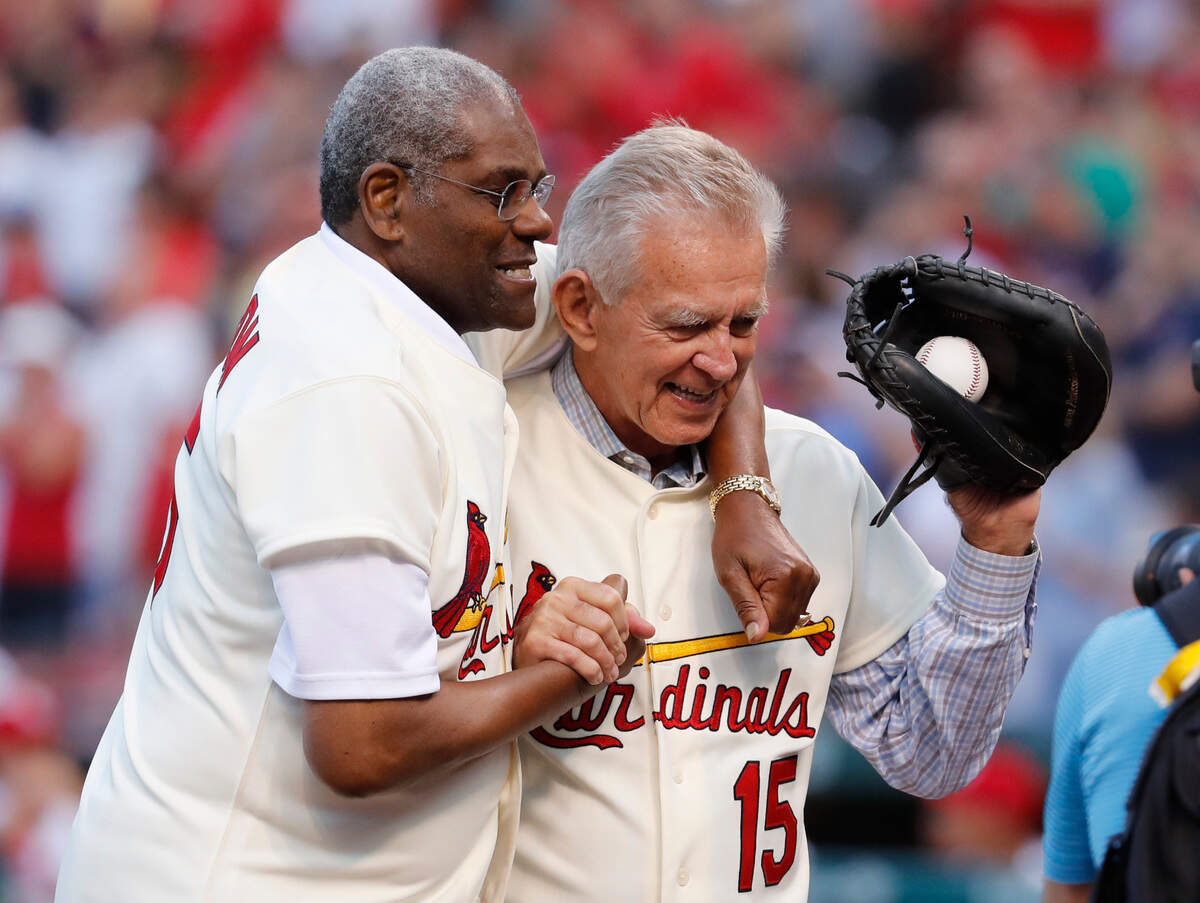
Not the stereotypical heavy-footed catcher, McCarver was known for his baserunning. His 13 triples in 1966 led the NL and he hit an inside-the-park grand slam against the Mets at the New York Polo Grounds in 1963.
The brand-new Busch Stadium II was the site of McCarver’s first All-Star Game appearance. In front of the home fans, he slid home safely with the game-winning run on a 10th-inning single by Maury Wills.
McCarver’s best season was 1967 when he posted career bests in batting average (.295), doubles (26), home runs (14), RBIs (69), on-base percentage (.369) and slugging (.452).
At 25, he was elected to his second straight All-Star Game, finished second to teammate Orlando Cepeda in NL MVP voting, and collected his second World Series ring when the Cardinals beat the Boston Red Sox in seven games.
After 12 seasons in St. Louis, the Cardinals traded him to Philadelphia for Dick Allen and Cookie Rojas. That trade also was to include Cardinals’ outfielder Curt Flood, who refused to report to the Phillies, thus challenging baseball’s infamous reserve clause and, eventually, paving the way for free agency.
He went onto a lengthy career in the broadcast booth, anchoring both radio and television broadcasts for the Phillies, New York Mets, New York Yankees and San Francisco Giants from 1980 to 2019. He returned to St. Louis at the end of his career to broadcast Cardinals’ home games for Fox Sports Midwest.
He also provided color analysis for a national network audience, working 23 World Series and 20 All-Star Games.
In 2012, he received the Ford C. Frick Award for broadcasting at the Baseball Hall of Fame in Cooperstown. Six years later, In 2018, McCarver was inducted to the Cardinals Hall of Fame.
“We were saddened to learn today of the passing of Tim McCarver,” said Bill DeWitt, the Cardinals’ principal owner and chief executive officer, through a release. “Tim was a very popular player with the Cardinals and a key member of our World Series Championship teams in 1964 and 1967. He remained a fixture in the game following his playing career, earning Hall of Fame recognition as a national broadcaster, and in later years as a Cardinals television analyst and a member of the Cardinals Hall of Fame.
“On behalf of the entire Cardinals organization, I would like to express our deepest condolences to the McCarver family.”
This story was originally published February 16, 2023 at 1:56 PM.