Liberatore has big-league talent, but Cardinals need him to find consistency
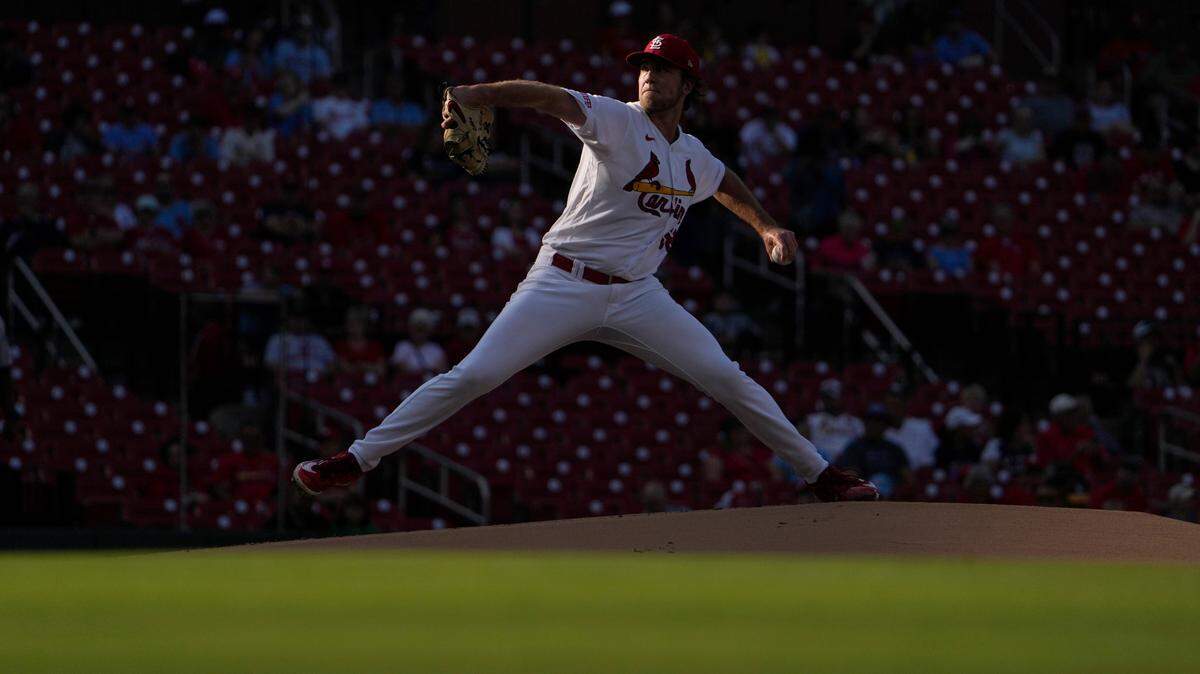
Matt Liberatore has a lot of levers.
The rookie Cardinals starter is listed at 6-feet 4-inches but may be a touch taller, and with long arms and legs, it takes a lot of mechanical focus to make sure all of his moving parts are in sync.
When they are, he’s capable of delivering the career-best eight shutout innings he provided last week against the Tampa Bay Rays, one of the best teams in baseball.
When they’re not, as they weren’t on Wednesday night, he looks instead like the pitcher who needed 35 pitches to get through a four-run first against the Oakland Athletics, one of the worst teams in the majors, perhaps ever.
Consistency is a skill. Repeatability is a skill. He knows it, his coaches know it, and there’s not much left to do in his development than demonstrate the ability to access that consistency on a nightly basis. It’s that, or it’s not going to work out.
The road has forked.
“There’s no guarantee there. That’s the whole thing about being a big leaguer,” manager Oliver Marmol said following his team’s 8-0 loss to the putrid A’s on Wednesday. “You have to show that you have the ability to do that. You get opportunities to show that, and that’s all you can do.
“You put a program together, you follow it, you make adjustments along the way. You grant him the opportunity to show what he’s capable of doing. Then he has to show what he’s capable of doing.”
“Long first inning, get a little fatigued, and those bad habits kind of kick back in,” Liberatore said. “That’s something we’re still working through and something I intend on cleaning up.”
The manager has spoken of a need to sort through the lanky lefty’s routine in and out of season in order to guarantee he’s maximizing his strength potential in the weight room.
Liberatore, for his part, added that there are quantifiable mechanical markers in his delivery that jump out to him when things are right, and equally when things are wrong.
He declined to delve deeply into what those are out of an understandable competitive concern. Watch enough video – and there is no team that doesn’t – and a trained eye will be able to spot the hitch in his step before the ball leaves his hand.
The results speak for themselves.
In St. Petersburg, even as he breezed through the seventh and eighth inning, his fastball was brushing up against 96 and 97 miles per hour. Wednesday, even on an unseasonably pleasant evening, he was pushing and exerting to sit at 91 and 92.
The higher velocity is lethal because it requires respect and keeps hitters from sitting on his best pitch, a biting curveball. Adjusting between those two pitches prevents batters from being uncomfortable, and a hitter who’s out of sync is no more likely to be successful than a pitcher who’s the same.
At five fewer miles per hour, even an average major leaguer can adjust easily enough and sit on the curveball to their bat’s content. The fastball at that velocity is, by any measure, a well below average pitch that requires and receives little to no respect.
So, Liberatore has to reach higher. And he has to do it every time out.
“I felt like I turned the corner a little bit in Tampa and felt great in the first inning again today,” Liberatore said. “[Velocity] was there, stuff was there, and just kind of wasn’t able to find it after that. So I’d say pretty frustrating.”
The stakes are clear. President of Baseball Operations John Mozeliak met with the media on Monday and was unequivocal that his club would be looking for three reliable Major League starting pitchers this winter in an attempt to avoid a repeat of this season’s innings debacle. With two spots in the rotation earmarked for Steven Matz and Miles Mikolas, that leaves Liberatore and others needing to pitch well through the close of this season simply to guarantee that they remain in the conversation.
The Cardinals would desperately like him to do so, and quietly, would even strongly prefer that he gives them reason to eat their words and weight a spring competition in his favor.
He hasn’t earned that consideration yet, and every start like the one he turned in Wednesday is a step in the other direction from that goal. Aside from his strikeouts per nine innings, each of his rate statistics in the Majors is better in 2023 than it was in 2022. The improvements, though, are incremental, and they vacillate with his uneven starts.
Liberatore is getting better. He has to be better, faster, or the Cardinals will be forced into a conclusion about his future place in the organization that they are positively yearning to avoid.
“If you’re going to develop at this level, you’re going to have ups and downs,” Marmol said. “Go right back to work, and see what the next outing looks like.”
There’s not much else to say. It needs to look better.