Former Cardinals catcher Ted Simmons elected to Hall of Fame. But what took so long?
Stan Musial was elected to the Baseball Hall of Famer in 1969 when 317 of 340 sports writers cast their ballots in favor of his induction.
This begs a question: Who were the 23 voters that didn’t think three Most Valuable Player awards, seven batting championships and the most hits in National League history were Cooperstown worthy?
Slightly less remarkable, but a mystery nonetheless, is the Hall of Fame vote of 1994.
Ted Simmons, the fiery switch-hitting catcher who spent 13 of his 21 big league seasons in St. Louis, got just 17 votes from a pool of 456 balloteers. That was well short of the 5% total vote required to stay on the ballot.
Who were those 439, who didn’t think 2,472 career hits — at the time, the most by any catcher ever — was even worthy of further consideration?
And why? Why did it take 31 years for the Hall of Fame’s Modern Era Committee to at long last recognize Simmons remarkable career?
It couldn’t have been the numbers.
When Simmons retired from the Atlanta Braves in 1988, his 1,389 RBI were second only to the legendary Yogi Berra among catchers all-time, and his .285 batting average was identical. His 483 doubles also were most among catchers and his 1,074 runs ranked fourth.
When he retired, Simba was the National League’s switch-hitting home run king at any position.
A postseason hero?
Was Simmons overlooked because of that tired old baseball axiom that says a player needs to have that “signature moment” to be so recognized? As if 21 years of drumbeat consistency isn’t the better measure of a career?
Carlton Fisk had his moment when he walked off Game 6 of the 1975 World Series, his arms waiving wildly as his towering home run hit off the foul poll on Boston’s Green Monster. The writers justly voted him into the Hall of Fame in 2000, even though he batted 16 points lower than Simmons during his career, has fewer RBI despite four more seasons and has exactly the same number of World Series rings — zero.
Maybe that’s it. Could it be that Simmons was shut out of Cooperstown for three decades because, not only was he not a postseason hero, he was never a champion?
Gary Carter collected his World Series ring when Bill Buckner let a Mookie Wilson ground ball split his wickets in Game 6 of the 1986 World Series (talk about your signature moments).
Carter also batted more than 20 points lower than Simmons and had more than 100 fewer RBI. Yeah, he slugged a little higher because of his 324 home runs but, if you’re into advanced metrics, Carter didn’t have Simmons’ OPS of OPS-plus.
But the writer’s welcomed Carter to the Hall of Fame in 2003.
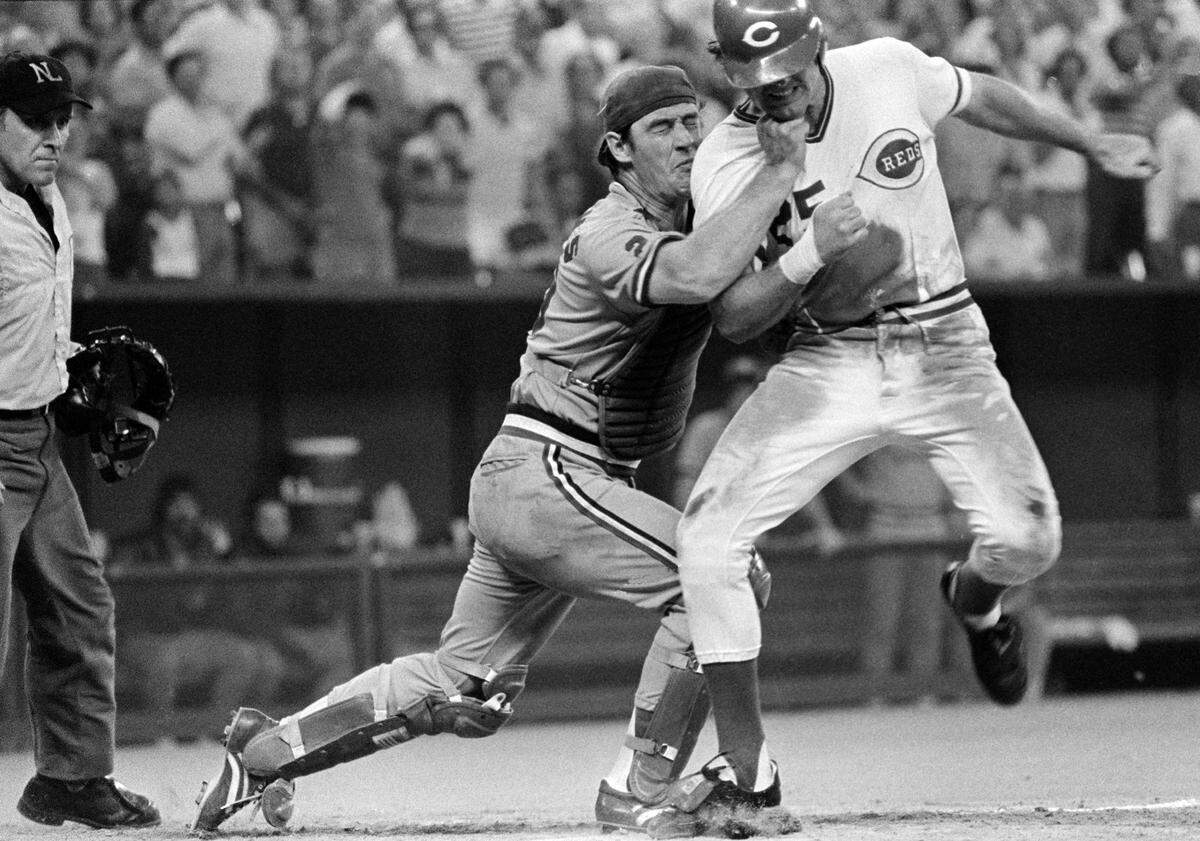
In the shadows of Johnny Bench?
Was it Simmons’ defensive skills that kept him out?
That’s been the more recent knock on his Hall of Fame credentials thanks to Whitey Herzog, who traded traded Simmons to Milwaukee during the wheeling and dealing of the 1980 offseason. Herzog went instead with free agent Darrell Porter — his old catcher in Kansas City — because he said he wanted stronger defense behind the plate than Simmons could provide.
Simmons did, in fact, lead the National League in passed balls in 1972, but his glove evolved enough that, by 1978, he was the league leader in assists and putouts while also posting a .991 fielding average. For his career, Simmons has career defensive WAR of plus-5.2. In his prime years with the Cardinals, his dWAR was plus-8.3, which means his defense probably won the Redbirds 8.3 games more than if they had a catcher of average defensive statistics.
And — get this— Simmons’ career .987 fielding percentage behind the plate is identical to 10-time Gold Glover Johnny Bench’s.
Speaking of Bench, it’s been proposed that Simmons’ Hall of Fame resume was simply overshadowed by his nearest contemporary, who some regard as the greatest catcher of all time.
Bench was, after all, twice the league MVP as a member of Cincinnati’s storied Big Red Machine, which won consecutive World Series championships in 1975 and ‘76. Simmons was an eight-time All-Star, but often as the National League’s backup to Bench. And Simmons’ Cardinals never finished better than second during his tenure.
That’s a long, cold shadow.
But I have been told by someone who was in the room, that when Simmons was a Modern Era Committee finalist in 2017 he had no bigger backer than Bench himself.
And why not? Statistically, Simmons is in the ballpark with Bench, Carter, Fisk and others.
Hall of Fame worthy
According to Jaffe WAR Scoring System (JAWS) — one of those sabermetric formulas that are both impossibly complicated and amazingly accurate — Simmons is the 10th best catcher of all time and better than at least five others already with plaques in Cooperstown.
His power numbers might be even better, some have argued, had Simmons not spent most of his career playing in the cavernous confines of Busch Stadium II.
“If he played in Cincinnati, where the ball really carries, he’d hit from 30 to 35 home runs, the way Bench does,” another catcher, Tim McCarver, told Sports Illustrated in 1978. “He plays in Death Valley and still hits more than 20.”
Yet Simmons missed out by a single vote in 2017, even with Bench-backed credentials.
I suppose that continuing to guess why Simmons was shut out of the Hall for so long is pointless now that his overdue invitation has finally arrived. The 16-member Modern Era — which included fellow Cardinals alum Ozzie Smith and former Milwaukee teammate Robin Yount — voted him in along with former Players Union chief Marvin Miller. They’ll be inducted in July of 2020.
But it was fans both in St. Louis and Milwaukee, where he was the catcher on the Brewers’ only American League pennant winner, that recognized all along that Simmons’ candidacy was legitimate. Fans in both cities elected him to their franchise halls of fame.
It’s their persistence more than anyone’s that have corrected a grave baseball injustice. Come July, Simmons will finally be remembered in the hallowed halls where he has long belonged.
And it’s about time.
This story was originally published December 8, 2019 at 7:22 PM.