
COVID keeps spreading, so some southwest IL cities could fine you for not wearing mask
Leaders in some metro-east communities are discussing the possibility of punishing residents who do not wear face masks as coronavirus spread continues in the region.
Face coverings such as masks have been required in public places in Illinois since May 1. But officials at the local and state levels are now proposing consequences for violating the mask mandate because some people are not complying voluntarily.
The virus can spread when an infected person talks, sneezes or coughs, especially in close proximity to others. It causes the COVID-19 respiratory disease.
Gov. J.B. Pritzker announced Friday his administration has filed an emergency rule that allows local authorities to enforce the mask mandate at schools, businesses and child-care facilities first through education, then a warning and finally a fine. The guideline will be considered by the bipartisan committee that regulates emergency rules as soon as Tuesday, said one of its members, Sen. Paul Schimpf, R-Waterloo.
Meanwhile, mask ordinances are on cities’ radar because the Illinois Municipal League drafted and shared a template with its membership last week.
East St. Louis is planning to bring the ordinance to a vote at an upcoming City Council meeting, according to the mayor. Possible mask requirements are still at the discussion level in Fairview Heights, O’Fallon, Edwardsville and Cahokia.
Cahokia Mayor Curtis McCall Jr. called an emergency staff meeting Friday afternoon to discuss possible village action in light of the governor’s proposed rule. He also planned to consult with other metro-east mayors in hopes of reaching a decision by Monday.
“It’s not going to be effective if one community does something and it’s not being done in other communities,” McCall said. “We want to make sure we’re all on the same page. ... One thing about it, masks have been proven to be effective. We just have to be consistent.”
Conversations about mask mandates and other possible restrictions in the metro-east come after the governor called on county and local officials to address the rising rate of new COVID-19 diagnoses in the region.
On July 20, Pritzker started asking for “action” before the metro-east’s numbers would reach the threshold for the state to reimpose restrictions that were previously lifted as part of Illinois’ reopening plan. The restrictions could include closing bars again or limiting capacity inside restaurants.
That same week, 7.8% of the tests performed in the region were positive, which was more than double the statewide average at the time. It is the highest that number has been for the metro-east to date. The threshold for restrictions is 8% or more for three consecutive days.
In response to the governor’s call for action, several metro-east officials said last month they planned to educate residents and business owners about the threat of state-imposed restrictions and ask their communities to follow Illinois’ rules. The state requires at least 6 feet of distance between people in public and prohibits crowds of more than 50 people. Masks are required in most public settings when people cannot stay 6 feet apart.
The metro-east region still had one of the highest rates of new diagnoses in the state this week at 6.9% as of Monday.
Illinois leaders define the metro-east as St. Clair, Madison, Randolph, Clinton, Monroe, Washington and Bond counties.
St. Clair County leads the region in diagnoses. It has had a “dramatic recent increase” in cases of the virus, according to Marynia Kolak, leader of a University of Chicago team that created a tool to find hotspots. But she said there is still time to change the trajectory.
“St. Clair County is not (yet) a hotspot if I adjust for population, which usually means this is an emerging potential hotspot that could still be contained before getting worse,” Kolak wrote in an email to the Belleville News-Democrat.
What southwestern Illinois mayors say they plan to do
Local officials have the power to pass their own, stricter rules, to issue cease-and-desist orders or to revoke a liquor or business license, but some said they did not want to use those measures in interviews two weeks ago.
East St. Louis was an exception. Officials there ordered businesses to close to foot traffic by 10 p.m. each night as both a precaution against coronavirus spread and against nighttime gun violence. Now, the city is planning to implement a mask mandate “in the weeks to come,” according to East St. Louis Mayor Robert Eastern III.
Eastern said catching the virus himself has motivated him to act. The mayor is one of 12 city employees to test positive for COVID-19.
“I was already trying to do the necessary things to keep our city and citizens safe, but after contracting the disease or this virus, it made me feel like we need to do something else,” Eastern said.
Some local officials have questioned whether they could legally enact regulations, especially those limiting businesses’ capacity for customers or operating hours. Pritzker has faced multiple lawsuits over his executive orders restricting crowds and activity.
“We’re looking right now to see if we can legally impose such a mandate,” Fairview Heights Mayor Mark Kupsky said Monday of a possible mask requirement. “But the question is, ‘How is it enforced?’ That’s the bigger question.”
Illinois Municipal League Executive Director Brad Cole noted in a recent memo to members, including mayors and city clerks, that the group’s legal staff wrote the mask ordinance template it shared with them.
The template states that people who do not wear masks when they are required to can be punished according to a city’s or village’s municipal code. In Carbondale, where an ordinance was recently approved, punishment could include a fine.
Some examples of when and where masks are mandated are also spelled out in the Illinois Municipal League’s template, including:
Shopping or working at retail businesses, like grocery stores or pharmacies.
Picking up food from a drive thru or curbside pickup.
Visiting a health care provider.
Traveling on public transportation, taxis or rideshare.
Interacting with customers, clients or coworkers at a place of business or worship that is open to the general public.
Performing services for state and local government agencies, where close interactions with other people are unavoidable.
When feeling sick, coughing or sneezing or otherwise ill.
People do not have to wear masks when they go for a walk outside or eat in public as long as they keep their distance from others.
Highland City Manager Mark Latham thinks an obstacle for southern Illinois is that some residents resent government regulations being imposed on them. A few restaurants in the area still are not requiring servers to wear masks, according to Latham.
He said city employees try to set an example when they are in public, and they are working with Highland’s Chamber of Commerce to encourage mask usage at businesses.
“I was in a place the other day, I was the loner in there, and people were kind of looking at me like I was nuts, because I was wearing a mask,” Latham said.
But Highland is not considering a mask ordinance, according to Latham. He does not believe the city has the staffing to enforce it.
“We only have two or three officers on duty,” he said. “How are they going to enforce a mask ordinance in a city of over 10,000 people? I don’t know how you do it. Then what are you going to do, fine them $50? Then the court system would be overwhelmed with ordinance violations.
“It’s great to pass something, but it’s gotta be enforceable.”
In Edwardsville, City Administrator Kevin Head said City Council members would like to see evidence that the ordinance works based on any success in other communities before they formally consider it.
Belleville Mayor Mark Eckert said Monday that he planned to get tougher on mask enforcement specifically for restaurant servers. The consequence for servers not wearing masks could range from a warning to loss of privilege to serve liquor in expanded outdoor dining areas, according to Eckert.
“Most of our businesses are good about cooperating, but we have a couple who don’t seem to get it, and we’ve got to get their attention,” he said. “We’re serious. This is a serious situation.”
Eckert said Monday he had not yet seen the Illinois Municipal League’s mask ordinance template.
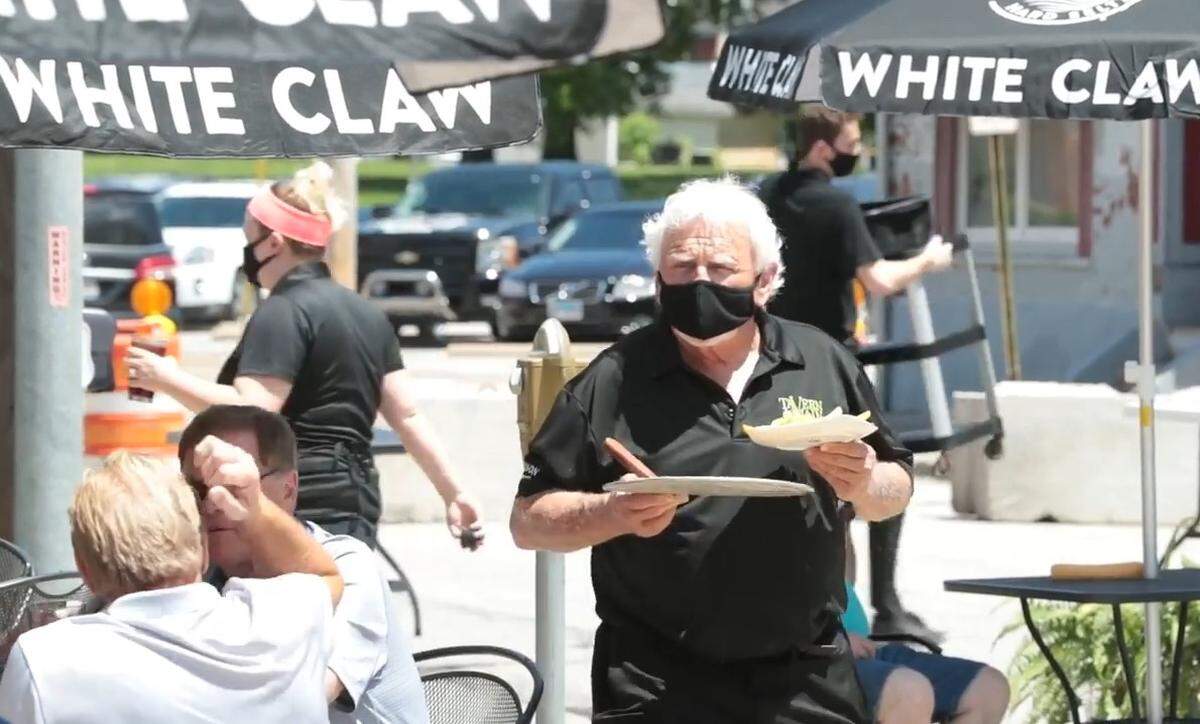
A possible change in mask enforcement is what metro-east communities have in common at the moment, but officials are taking other approaches to slow the spread of the virus as well.
Belleville is also prohibiting restaurants and bars from hosting concerts or promoting events that would draw large crowds or create a “festival-like” atmosphere.
O’Fallon Mayor Herb Roach, Mayor Kupsky in Fairview Heights and City Manager Latham in Highland all said officials in their communities are not allowing large, public gatherings either.
The state has made more testing sites available in the metro-east, and community leaders are distributing masks and other personal protective equipment.
McCall, the Cahokia mayor, said earlier this week that leaders there may consider more limits on when and where people could gather if the trend in diagnoses continues.
“I’m kind of keeping my eye on everything,” McCall said. “We may be restricting some hours of businesses and stores or even on some of the restaurants that have dine-in options. Even our local taverns, I may make some guidelines for them as well.”
Collinsville Mayor John Miller, City Manager Mitch Bair and city spokesman Mark Ahlbers did not return calls for comment from the BND. Officials temporarily closed Collinsville City Hall on Monday due to an employee contracting the coronavirus.
‘Nobody wants to take action’
Leaders of the metro-east’s two largest counties have said that they are not planning to take any action beyond the continued campaign to educate their communities in order to avoid state-imposed restrictions.
“We’re keeping an eye on things, but our game plan is to encourage everyone and businesses to be responsible,” said Madison County Board Chairman Kurt Prenzler. “We’re watching the numbers every day.”
In St. Clair County, residents questioned officials about mask usage and the possibility of restrictions during a county briefing on COVID-19 last Sunday. St. Clair County officials have provided updates on developments in the county almost every day since the first cases were announced in March in virtual briefings through Facebook.
At the Sunday briefing, a resident submitted a question about whether the county would put changes in place because cases are increasing now. Other citizens commented that they see people wearing masks improperly or not at all even though face coverings are required.
“Enforcing the rules and the regulations that are currently on the books are, I think, enough to keep us from having to go back (to more restrictions),” St. Clair County Board Chairman Mark Kern said on Sunday. “... Let’s hope that we continue to do what we need to do to stay where we are as far as being open.”
Herb Simmons, director of St. Clair County Emergency Management Agency, said two weeks ago in an interview that “each individual community is responsible for the enforcement of those guidelines.”
Simmons ends the briefings on the agency’s Facebook page with a familiar refrain about the rules each day.
“Wear your mask, wash your hands, watch your social distancing, and we will get through this,” he said Tuesday. “I promise you we will get through this. We just have to have everybody working together.”
The governor’s office did not respond to requests for comment on the metro-east’s education campaign. But state leaders have publicly praised tougher action in other areas of the state, which they touted as good examples.
A recent Illinois Department of Public Health announcement warning several counties that their numbers were increasing also stated that leaders were “taking swift action” to address it in the Southern and West Central regions.
During public appearances in those areas this past week, Pritzker specifically lauded Carbondale for enforcing masks and Springfield for enforcing bar and restaurant capacity limits.
Mayor Roach, of O’Fallon, said he thinks it is “disappointing” that decisions about whether or not to take action come down to cities.
Higher levels of government have more resources, according to Roach. They can analyze what is driving the spread of the virus. Counties, for example, have employees to ask infected citizens where they have been and who they might have exposed, a process known as contact tracing. The goal is to prevent the virus from spreading by asking people who are exposed to quarantine before they can infect others. Contact tracers also find sources of outbreaks.
“This is where they all want to pass the buck,” Roach said. “The state wants to pass it down. The county wants to pass it down. Nobody wants to take action.”
What would trigger new coronavirus restrictions?
Here are the criteria for the state to bring tighter restrictions back to the metro-east or other regions of Illinois:
Three consecutive days averaging at or above an 8% positivity rate. The positivity rate is the percentage of coronavirus tests that were positive. This alone will trigger restrictions.
Or increase in the seven-day rolling average of the region’s positivity rate for seven out of 10 days.
Plus one of the following:
An increase in hospital admissions for a COVID-19-like illness for seven days.
Intensive care unit capacity or medical/surgical bed capacity below 20%. In other words, a reduction in hospitals’ ability to handle a surge in patients.
The public can track the metro-east’s numbers at dph.illinois.gov/regionmetrics.
This story was originally published August 6, 2020 at 12:05 PM.