Battle lines drawn as COVID threatens to stop indoor dining again in southwest IL
Illinois officials faced a mutiny of sorts in September, when some metro-east restaurants and bars continued to serve customers indoors, defying an order by Gov. J.B. Pritzker to stop because of an upward trend in COVID-19 cases and the inability of people to wear masks while eating.
Tension seemed to subside on Oct. 9, when the average positivity rate on Region 4 coronavirus tests dropped to the point that tighter restrictions were removed, allowing indoor dining to resume.
But battle lines were being redrawn last week as the positivity rate started moving close to a threshold that now has Pritzker preparing officials for a likely return to tighter restrictions, also known as “resurgence mitigations,” as early as Wednesday.
“The indoor-dining issue is a joke,” said Jon Roderick, owner of Jerry’s Cafeteria in Granite City, on Friday. “Whenever they want to get really serious about this, they’ll close Walmart. ... More people go through Walmart in an hour than go through my restaurant in a day. It’s a far more dangerous place.”
Roderick kept his restaurant open last month, even after Illinois State Police responded to a complaint Sept. 17 and gave him a warning ticket for not complying with the ban on indoor dining. He said he’d rather pay a fine than destroy his livelihood.
Roderick said business at Jerry’s has been “fantastic” this fall and that many customers have praised him for “doing the right thing” and standing up against what they consider unfair and unnecessary restrictions.
When asked Friday what he would do if mitigations were reinstated, Roderick said, “I’m going to do what my customers dictate. ... If they’re going to be here, then I’m going to be here.”
But Pritzker expressed similar firmness on his position at a COVID-19 news briefing in Belleville on Thursday, addressing the possibility of non-compliance with tighter restrictions.
The governor said he would instruct Illinois State Police to issue more citations to Illinois restaurants and bars that violate restrictions and urge county state’s attorneys to prosecute cases so violators would have to pay fines. He also threatened for the first time to revoke liquor and gaming licenses.
“This is not something I have wanted to do before,” Pritzker told reporters. “I think you know I’ve been reluctant to do this before because it has a very serious implication for the future of a business. I want businesses to stay in business. I want them to survive.
“That’s why we have these (Illinois Department of Commerce and Economic Opportunity) grants that we’re offering. It’s why we’ve tried to be careful about the types of mitigations we’ve put in place.”
The mitigations are essentially Illinois Department of Public Health regulations, and violators can be charged with a Class A misdemeanor, which carries a fine of $75 to $2,500.
City police departments, county sheriff’s departments and Illinois State Police are all authorized to issue citations, but state’s attorneys determine what ultimately happens with them, as they do in any misdemeanor cases.
The local controversy comes amid a nationwide surge in new coronavirus cases. States reported 83,757 on Friday, passing the last record of about 77,300 on July 16, and 83,718 on Saturday. Illinois officials reported 3,874 new cases on Friday and 6,161 on Saturday; 31 new deaths on Friday and 63 on Saturday.
Positivity rate hits threshold
Seven counties are part of Metro East Region 4 under the Restore Illinois plan that the Pritzker administration created in June to safely restart the economy after a three-month COVID-19 shutdown. They are St. Clair, Madison, Bond, Monroe, Randolph, Clinton and Washington.
The region’s seven-day rolling average positivity rate on coronavirus tests hit 8.1% on Friday, 8.2% on Saturday and 8.2% on Sunday. The Restore Illinois plan calls for resurgence mitigations to be put in place after three days in a row at or above 8%.
The metro-east had reached 10.5% by Sept. 2, when the first set of mitigations took effect, then dropped to 6.5% by early October before gradually rising every day since.
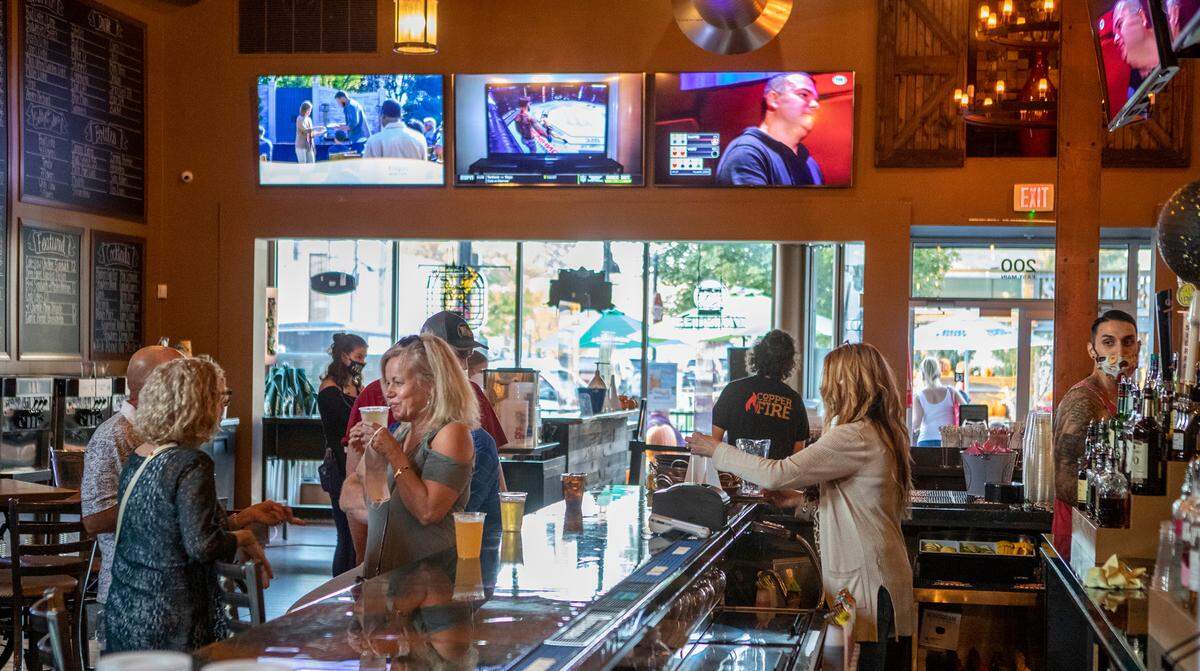
“I’m 99% sure that (an indoor-dining ban is) going to happen next week,” said Renae Eichholz, owner of Copper Fire restaurant and bar in downtown Belleville, on Friday. “The numbers aren’t going down. They’re not even holding. So we’re bracing for that.
“I’m trying to do everything I can to save our staff. I feel like I’ve got tone of the best teams in Belleville now, and I can’t afford to lose them. I’m trying to keep them employed.”
St. Clair County officials announced Saturday that the governor’s office had told them to prepare for the likelihood of tighter restrictions, including a ban on indoor dining, on Wednesday in Region 4 if its positivity rate topped the three-day 8% threshold on Sunday.
Eichholz said she wouldn’t risk losing her liquor license to defy a state order and serve food indoors. She’s exploring other options, such as converting part of her space into retail so customers could shop and enjoy drinks while waiting for carryout food orders.
Eichholz got an estimate on the cost of removing her storefront windows to create an open-air atmosphere, but such a project would take months and be expensive. She ordered a portable heater to help customers brave temperatures in the 40s and 50s over the weekend while listening to live music outside.
“I follow the rules, but this yo-yo effect is killing us,” Eichholz said, referring to state orders that prohibited all on-site dining on March 17; allowed the return of outdoor dining on May 29 and indoor dining on June 26; banned indoor dining on Sept. 2 and brought it back on Oct. 9.
“The other thing I’m really upset about,” Eichholz said, “(is that) Southwest Airlines announced that they are opening up their middle seats Dec. 1. They’re going back to full flights.
“I guess I just don’t understand how you can get on a plane, take off your mask and eat and drink .. You can go to a bowling alley, eat and drink at a bowling alley, but you cannot go into a restaurant that abides by the highest safety measures. It just blows my mind.”
At the governor’s news briefing on Thursday, Illinois Department of Public Health Director Dr. Ngozi Ezike was asked why restaurants and bars are singled out for the toughest mitigations when they’re rarely identified as places where COVID-19 outbreaks occur.
Ezike said the term “outbreak” is used only when health officials can directly trace infections to a specific location, such as a workplace, and that this can’t be done in most cases. People who test positive are asked to list places they’ve been in the past two weeks to help identify possible exposure sites.
“Time after time, bars and restaurants come up as the No. 2 or the No. 3 place that all of these cases frequented,” Ezike said. “And so that’s why we put it as a high (risk) because it consistently comes up as a place that people who are infected listed as one of their exposure sites.”
Pritzker followed Ezike’s statement by noting that people can’t wear masks while eating and drinking and that the vast majority of studies and scientists agree that face coverings help slow the coronavirus spread.
The governor warned that Illinois is entering a dangerous period with cold weather forcing people indoors and COVID-19 infections, hospitalizations, ventilator use and deaths on the rise. He implored residents to wear masks and follow restrictions to help protect the elderly and others with immune deficiencies.
“We’re working very hard, but we need everybody, we need the public, we need the restaurant owners and bar owners to follow the mitigations and to stop fighting and trying to find some flaw in the data, trying to find somebody who will say that a bar or a restaurant is not a spreading location,” Pritzker said.
Pushback from restaurants
Bond County attorney Tom DeVore has long argued that gubernatorial executive orders that ban indoor dining aren’t legally binding, and that laws would need to be passed by the Illinois General Assembly to make such COVID-19 restrictions enforceable.
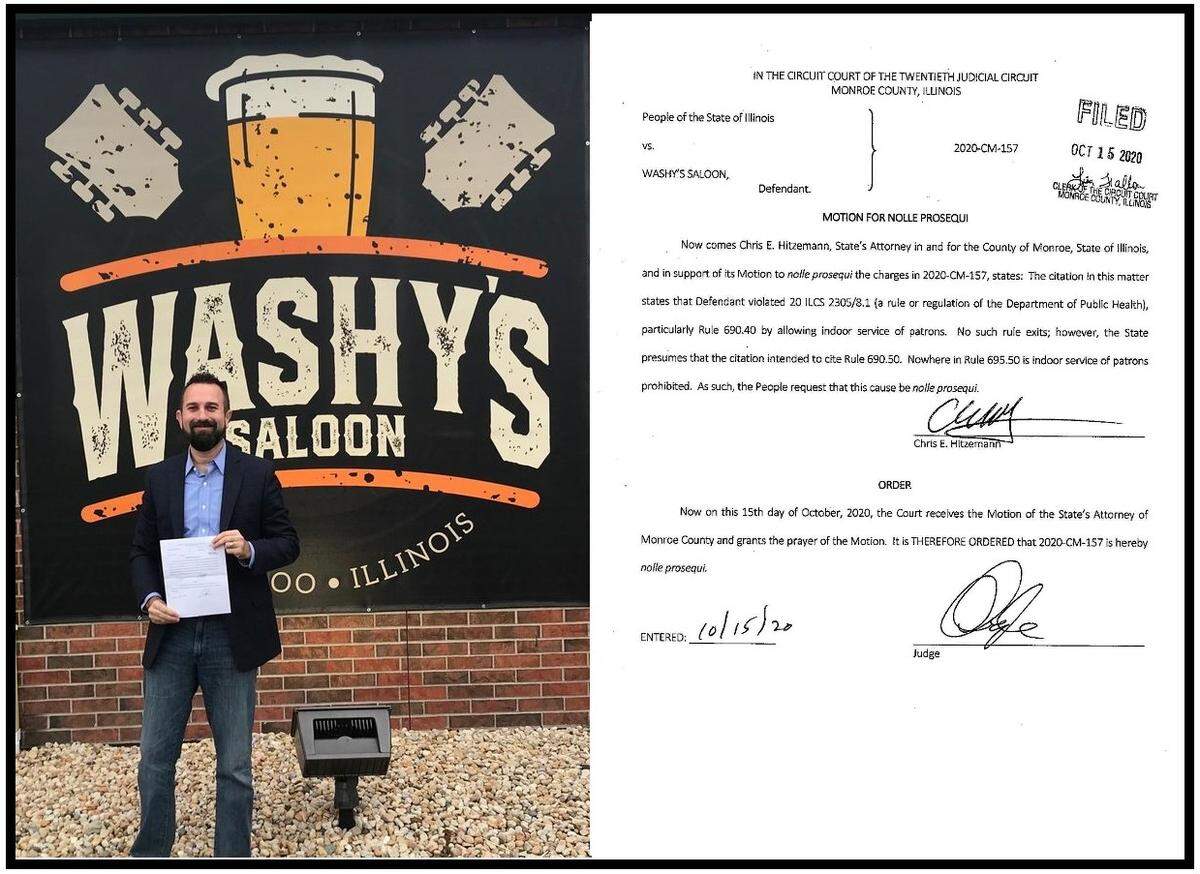
DeVore has had some success with this argument. He represented Washy’s Saloon in Waterloo, which was issued a citation by Illinois State Police on Sept. 17 for serving customers indoors.
Monroe County State’s Attorney Chris Hitzemann formally declined to prosecute the case, and it was dismissed on Oct. 15. Washy’s owner Rod Washhausen posted a copy of the order on Facebook.
“What the state’s attorney said is that, ‘This business staying open is not violating any law, so there’s nothing for me to prosecute. I don’t know what they want me to do with this. There’s nothing being done wrong,’” said DeVore, who has offices in Greenville, Edwardsville and Highland.
In Washhausen’s Facebook post, he thanked John Wagner, administrator of Monroe County Health Department, who Washhausen said advised him that he didn’t need to close the restaurant and bar.
General Manager Lori Schutzenhofer said Friday she doubted if new restrictions would change Washy’s stance and noted that revoking gaming licenses would cause the state to lose money, too.
“Honestly, I don’t see what the difference is between going to a bar or sitting at a poker machine and drinking a beer and going to Walmart, and there’s 300 people inside the store. ... The same goes with church,” she said. “People take off their masks when they sit down in the pews.”
DeVore also represented owners of The Fainting Goat restaurant and bar locations in Pocahontas and Breese. He said Bond County State’s Attorney Dora Mann didn’t even ask the court to consider a citation that Illinois State Police issued them in mid-September for serving customers inside.
DeVore also maintains that the Pritzker administration doesn’t have the authority to revoke liquor licenses over indoor dining and accused him of using intimidation tactics that “border on criminality.”
“The license holder has to be violating the (Illinois Liquor Control Act) or a local liquor ordinance or something,” DeVore said. “There is no authority to take someone’s liquor license because they’re not following his executive order. It’s impossible. The governor’s lying.”
Mike Zanger, co-manager of Taqueria Z in Edwardsville, said a tightening of restrictions will change his plans to open its dining room with limited capacity. He didn’t do it this summer, partly because the Mexican restaurant and bar only seats 25 people inside, and it hardly seemed worth it.
But cold weather will end business on Taqueria Z’s small outdoor patio, Zanger said, and indoor dining could supplement revenue from carryouts and help keep the place going. He also has considered expanding outdoor seating with a partially-enclosed tent-like structure.
“Everybody’s in a tough spot,” Zanger said. “But if people are getting sick, I don’t want to contribute to that, really. I guess maybe I’m a little more cautious because I have (a family member with health problems).
“I don’t know, everybody seems to believe something different about what’s right and what’s wrong. I don’t have the answer. It’s very confusing. I just don’t want to risk (spreading the coronavirus), but if some people don’t risk it, they’re going to go out of business. I don’t blame anyone for doing what they think they have to do.”
This story was originally published October 26, 2020 at 5:00 AM with the headline "Battle lines drawn as COVID threatens to stop indoor dining again in southwest IL."