2020 divided Illinois unlike any other year. People aren’t sure if the wounds can heal
This is southern Illinois, at the end of a year like no other in living memory.
A Belleville emergency room nurse despairs at what she’s seen, from both the living and the dying. An immigrant restaurant owner in Marion clings to her business, determined to stay open no matter what. A lifelong Carterville Republican has to silence herself when she is with family because she voted for Joe Biden. A Black Army veteran in O’Fallon watches resentment grow as aggrieved whites react to the pandemic and Black Lives Matter.
COVID-19 didn’t create the divisions and disillusion that seem to be everywhere. But it left them wider and deeper: Chicago versus the south, rich and poor, Black Lives Matter and white anger, partisan passions, the virtual silos people build to get the information that only affirms their beliefs.
“The days of agreeing to disagree seem to be gone,” said Angel Miller-Seger, 58, the emergency room nurse at Memorial Hospital Belleville. “I don’t know if people have the ability to do that anymore.”
Nationwide polling by the Pew Research Center shows found 77% of Americans feel the country is more divided now than it was before the pandemic. The presidential election wrenched people further apart, with roughly 90% of voters on either side saying the opposing candidate would cause long-lasting harm to the country, according to another Pew poll.
It leaves people such as Miller-Seger wondering if the country can ever heal, especially after so much loss of life, business and health.
She wept during a recent shift at the hospital. That never happens.
“I’m the strong one. I’m the general,” she said. “I’ve seen awful things. I put up walls so it doesn’t hit you so hard. I think that wall is down to our knees now. It isn’t up to our eyes where it used to be. It’s down to our knees and it’s hitting us hard.”
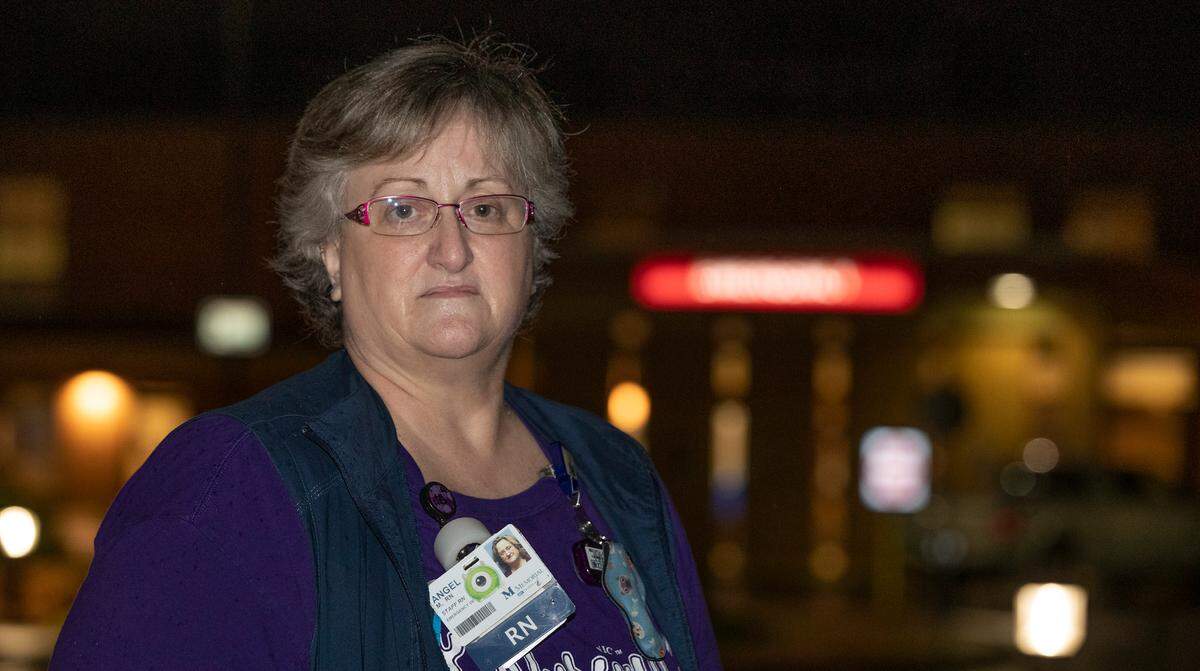
It’s more than the horrors of the virus that continue to consume southern Illinois. Anger and denial swirl around her every day — from the desperately ill who still deny COVID’s existence, even as it’s taking theirs, to those who stalk out of the hospital because they refuse to wear a mask.
“They just chose sides and that’s where they’re entrenched,” she said.
Southern Illinoisans, she knows, are “a very sturdy stock.” They’re tough and they do well enough for themselves without distant politicians interfering. But it also means they don’t like to be told ‘no,’” Miller-Seger said.
“They have such a rich love of their community. They don’t like to be told what they can’t do or what they can do because they’ve done for themselves for years,” she said. “They think it’s not going to happen to them, and if it does happen to them then I’ll be fine because I’ve lived through this or that, I’ve lived through a war, and I’m good.”
Illinois restaurants, bars suffer
Laura Chairez poured her soul into her restaurant in Marion, serving up the handmade tamales and Mexican dishes she grew up on.
After years of sacrifice, the 35-year-old daughter of immigrants almost lost La Galeria to COVID-19 and the restrictions it triggered. Facing the abyss, the single mother decided she couldn’t and wouldn’t close, losing the only way she knows to support her two young boys.
People on the other side, the professional class that can work from home, don’t understand that, she says. Those who wag their fingers and lecture about health forget that health and livelihood are intertwined.
“It’s easier for people to judge the ones who are staying open if they have a job from their home, if their job has not been affected,” Chairez said. “If they had been in our shoes, they would think so differently.”
The high school graduate followed her ex-husband into the restaurant industry in her early 20s, abandoning a nursing education to work with him and, later, to open La Galeria with him.
When she went from making up to $3,000 a day to as little as $200, Chairez almost lost the business. Federal stimulus money helped her avoid that, but now she feels indoor dining is the only option to support herself and the few employees she has still working.
“The hardest thing of all was having to tell my employees, like, ‘Guys, I have no job for you.’ That was the hardest. I had tears in my eyes and it was heartbreaking,” Chairez said.
Defying the governor’s orders wasn’t on the table for Sue Johnson. A bartender and bar owner in Granite City for 57 of her 77 years, she takes no guff from her loyal patrons.
So when she told them she was shutting down voluntarily to slow the spread of coronavirus, they accepted it without question. Three people she knows have died and more have been hospitalized and put on ventilators.
“It’s hard being an owner of something. I agree that how, being a bar owner, it can spread,” Johnson said. “You can have it set up for 50% (capacity). We’ve tried it that way and it’s still spreading like crazy.”
Johnson was fortunate. She set aside money earned over the years from the video gambling terminals at Sue’s Corner. It helped her avoid losing the bar, but her savings are almost gone.
“It’s hard because you know it’s bad out there,” Johnson said. “We were lucky we had some money backed up because we saved, but if it went on months more, we couldn’t do it.”
Family politics
Carol Iaccino is a lifelong Republican who owns Hoarder Heaven, a Carterville resale shop. She has watched the toxicity of the Trump era reach down into the community where she’s lived for the last 14 years.
Trump’s management of the pandemic, telling the country that his political opponents were overblowing the crisis, forced her to vote for Joe Biden. So far as Iaccino knows, she’s the only member of her family who did. She feels she must silence herself when politics comes up and loved ones defend the president.
“It just infuriates me that people would put their health behind their politics,” she said. “Why wouldn’t health be the most important?”
Iaccino said she hopes she can find common ground with her community again someday. Whether that can happen or not, she said, remains unclear.
“That’s the whole thing the country needs to do: We need to be able to talk about it,” Iaccino said. “If we remain on the right and the left and we don’t find a place in the middle, can you imagine how long this is going to be before we recover? Bottom line, that’s what has to happen. We have to meet in the middle.”
Protests and the rural-urban divide
Two things about 2020 rubbed southern Illinoisans the wrong way: overreaching government and being told they were complicit in perpetuating a racist society. Between the pandemic and Black Lives Matter protests, many felt the problems of the world had been rubbed in their faces.
Encountering both at once violated their perceptions of freedom, said Annetta Works Salley, a 58-year-old Army veteran who lives in O’Fallon.
“These things were happening before the pandemic, they were just brought to light,” said Works Salley, who is Black. “All of this is entwined in something that reveals who you really are and how you feel about these issues.”
People are now having “necessary conversations” about race thanks to the protests, Works Salley said. She believes healing can now begin after years of brushing racism under the rug.
The historic mistrust between Chicago and southern Illinois is so entrenched that the city’s name alone is shorthand for corruption and greed. Images of looting in the city following Floyd’s death sparked a sense of injustice downstate.
While overreaching government restrictions strangled their businesses, others were able to loot with impunity, or so they believed.
“Only in America in 2020 can you get arrested for opening your business, but not for looting one,” one recent post in an anti-restrictions Facebook group falsely suggested.
But the protests didn’t stay in the city. Peaceful Black Lives Matter demonstrations came to some of the smallest downstate corners, including the former “sundown town” of Anna.
Rachael Reuss, a junior and high school English teacher from Marissa, said southern Illinoisans’ defenses go up when they’re told they need to change their way of living.
“If you look at any movement that is happening in 2020, southern Illinois responds in a way that protects their perceived rights,” she said. “If we look at the Black Lives Matter movement or the overall view of police brutality, people don’t like hearing that they need to change.”
Southern Illinois’ digital silos
Thomas DeVore, a Bond County attorney who has made a name for himself during the pandemic representing defiant restaurants, runs a Facebook group where members call for Pritzker to be removed. As many as 60% of Illinois restaurants could close because of the pandemic if the federal government doesn’t step in to help, according to the Illinois Restaurant Association.
But it’s a sensitive topic, and people have little patience for hearing the opposite opinion. When reporters asked to talk to people in the group, members called their efforts “fear-mongering” and their reporting “propaganda.”
“These keyboard lawyers don’t think about how other people feel,” said Javawn Morris, a 38-year-old workforce education specialist for the U.S. Department of Veterans Affairs. Morris lives in Belleville with her 2-year-old daughter.
“They’re harsher than they normally would be.”
Social media became a poor substitute for the outlet people normally find in their communities, and it degraded the discussion in a way that might not happen face-to-face.
“You’re just not having that emotional connection with anything,” said Miller-Seger, the ER nurse, “and I think as human beings we need that connection.”
COVID deaths and hospitals full
Lack of awareness or recognition of the pandemic’s deadliness costs lives, and not just those who are sick with COVID-19, said Dr. Jeff Ripperda, a family medicine doctor at Shawnee Healthcare in Murphysboro.
He had to send a terminally ill cancer patient to a hospital more than a hundred miles away because all the local intensive care units were taken by COVID-19 patients. She needed intensive care to help her die a peaceful death.
“The problem that she ran into? There were no beds available for her. She wasn’t able to stay in Murphysboro because she was too sick. Carbondale, no ICU beds. Herrin, no ICU beds. Marion, no ICU beds. Cape Girardeau, no ICU beds. The metro-east, no ICU beds.
“Someone who wants to go to a bar on Friday night might say ‘that has nothing to do with me’ but they’re wrong, it has everything to do with them.”
It angers him that some people don’t care that the virus mostly kills people who were old anyway.
“I lost one of my favorite patients about a week and a half ago to COVID. Lovely woman, 90-year-old, who was actually in very good health and lived in an assisted facility, got it and just did not do well at all,” he said. “That’s very frustrating to me.”
Iaccino hopes the country — health care workers and defiant business owners alike — finds a way to move forward.
“We all need to heal right now.”
This story was written as part of a partnership between the Belleville News-Democrat and The Southern Illinoisan.
This story was originally published December 18, 2020 at 5:00 AM.