Inmates say St. Clair County Jail is ‘full of COVID.’ Sheriff says he’s doing his best.
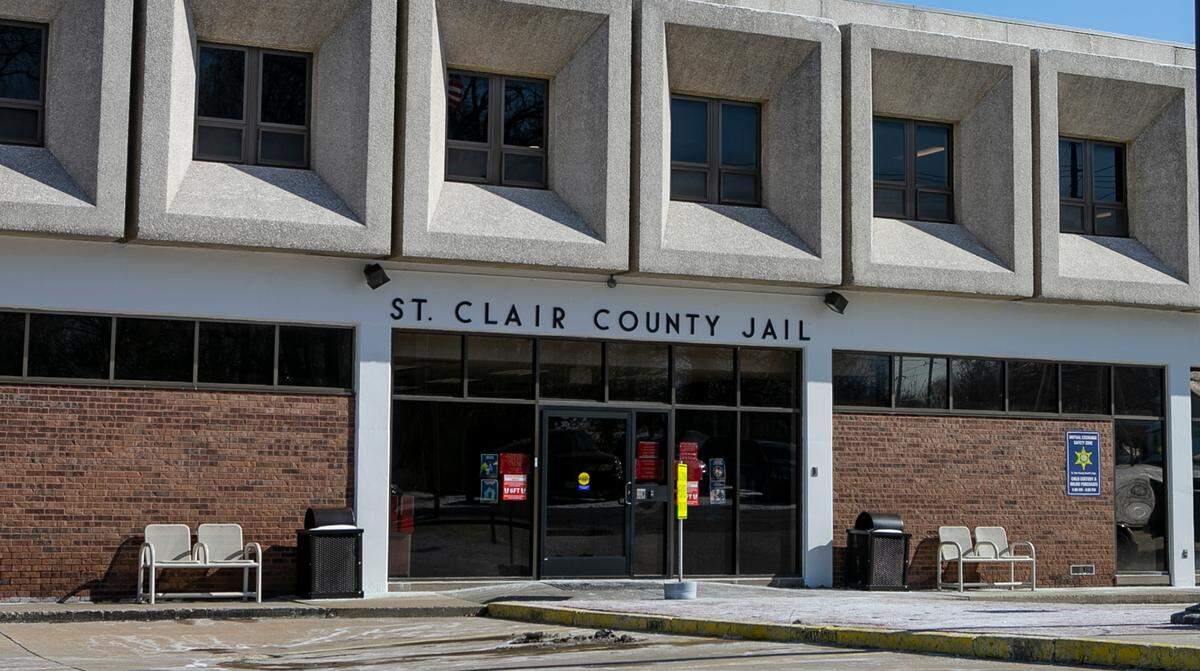
Inmates say nine months without personal protective devices, inconsistent disinfecting efforts, spotty testing, and chronic overcrowding has allowed COVID-19 to spread nearly unchecked throughout the St. Clair County Jail.
At least three detainees have died from the virus, the inmates say, because their complaints have been ignored by jail staff.
Preston Thomas, 57, a federal detainee awaiting trial on charges of enticing a minor, died Jan. 26, two weeks after being transferred by ambulance to the Memorial Hospital Intensive Care Unit, his family confirmed.
On Feb. 3, a Sheriff’s Department press release confirmed the death of another 63-year-old inmate, whose identity has not been released, from complications of COVID-19.
Then, on Feb. 19, Samuel L. Johnson, 55, accused of murder in the stabbing deaths of a west Belleville hairdresser and two elderly clients in 2005, died from the effects of the respiratory disease in a hospital.
“I fear for my life in here,” said Roderick Whittaker, 29, who has been held at the jail since November 20 on sex crime charges. “There is so much COVID going around and no one has come to talk to me about my complaint.”
Sgt. James Hendricks, the jail’s public affairs officer, acknowledged the staff had been limited in its ability to supply face coverings and hand sanitizer. And though he said they do their best to sequester infected inmates, quarantine is difficult in a jail that has had to accommodate an average daily head count that’s nearly 100 inmates above capacity.
“If we had the capacity, we’d like to isolate everybody, but with the overcrowding we have here, sometimes we can’t,” Hendricks said.
But under the circumstances, said Sheriff Rick Watson, the jail’s staff and administration have done all they can to protect the inmates and stem the spread of COVID-19.
He points specifically to an investment in electrostatic sprayers similar to those used to disinfect hospitals, efforts to upgrade the jail’s twice-daily sanitizing routine and a stringent screening of people as they enter and leave the building.
“We’re doing a great job around here,” Watson said. “‘We’re cleaning this place the right way and we’ve kept this COVID to a minimum.”
It’s a rosy assessment that’s in stark contrast to what inmates and family members told the BND.
More than 30 current and former detainees and relatives have contacted the Belleville News-Democrat over the last 11 months, each echoing complaints about jail conditions, the inadequate response of those in charge, and how those two factors have led to what they believe has been a persistent and under-reported spread of the virus within the facility’s walls.
Twenty-four of them have added their names as plaintiffs in a federal lawsuit against county officials that include Watson, Board Chairman Mark Kern, State’s Attorney Jim Gomric, multiple jail guards and contracted nurses.
“They are inmates, but they are human beings, too,” said Cortez King, whose uncle, Cameron Belk, 51, is being held at the jail as he awaits trial. “They deserve to be treated humanely. They are innocent until proven guilty and, even then — even if they are proven guilty — they have a right to be protected from viruses and other medical diseases they can get from being housed in a jail setting.”
Overcrowding at jail
Chronic overcrowding at the jail makes social distancing next to impossible and the spread of illnesses not only likely, but inevitable.
The jail has capacity for 418 inmates, according to the Illinois Department of Corrections. As of Feb. 3, the St. Clair County Sheriff’s Department reported that the jail’s average daily population since the pandemic began is 493. In recent months, the population has, at times, surged above 500 inmates.
At least 275 of those currently detained are Black or Hispanic, both ethnic groups that have been disproportionately affected by COVID infections. Many that spoke to the BND said they have pre-existing conditions, which also makes them vulnerable to the virus, according to the CDC. Most have not been convicted and are being held as they await trial.
According to an inspection report filed by the IDOC Office of Jail and Detention Standards on October 1, 2020, the most recent available, the jail population allowed at least 50 square feet of floor space per detainee in the dormitories and 35 square feet in common areas. Both standards leave room for the recommended 6-feet of social distancing.
But social distancing as a means of slowing the spread of COVID isn’t practical in the cell block areas, the detainees say.
“It’s overpopulated. People are sleeping on floors, in the gym,” said Jovi Anderson, 31, a former inmate who had been detained at the jail while awaiting sentencing on charges of aggravated battery with a firearm. “We can’t just stay 6 feet apart from each other at all. If I take my hand out of my bed, I’m touching the next person who’s sleeping next to me.”
According to the Sheriff’s Department, 10,863 inmates have been processed through jail doors between March 11, 2020, and Feb. 3, 2021, a daily churn of about 33 detainees who could potentially carry the virus from the outside.
BEHIND THE STORY
MOREHow we did this story
Calls from the St. Clair County Jail began coming to BND reporters by May of 2020. One after another, inmates and their families complained that they and others they knew were sick and that requests for medical attention were being ignored by jail staff. Public records reporting and more than 40 interviews with inmates and jail staff revealed widely differing perspectives on the jail’s efforts to protect those awaiting trial until three inmates died from complications of COVID-19.
Illinois Department of Corrections hasn’t helped
The overcrowding has been further exacerbated by the pandemic, which has, at times, halted the transfer of convicted detainees to Illinois Department of Corrections facilities. The St. Clair County Jail currently houses 45 convicted criminals and parole violators who would otherwise have been transferred to state prisons.
In March, Gov. J.B. Pritzker issued a ban halting the transfer of new prisoners to the Illinois Department of Corrections to further prevent the spread of COVID-19. The ban received such staunch pushback from the Illinois Sheriff’s Association that it filed a lawsuit against Pritzker and the Department of Corrections in May.
In the lawsuit, the association says the governor and Department of Corrections refused all transfers to state facilities and failed to work with sheriffs to install proper intake procedures to reduce the spread of the virus as promised.
In July, one day before the court hearing for the lawsuit, Pritzker signed a new executive order that allowed for the admission of prisoners into state custody at the discretion of the Department of Corrections, encouraging the agency to take safety protocols into account. The intake protocols include administering COVID-19 tests 72 hours before an inmate is transferred, temperature checks and having inmates quarantine for two weeks in a designated area upon arrival to a state facility.
The latest action in the suit came in August, when a state appellate court temporarily reversed the decision of a Logan County court, where the lawsuit was filed, to mandate transfers. Appellate justices ruled that it was within the governor’s authority to issue the most recent executive order.
None of that helps inmates at the St. Clair County Jail, which has long had issues with overcrowding.
Watson says there are only two ways to ease jail crowding, including a public tax referendum to enlarge and renovate facilities. St. Clair County voters shot down such an effort in 2017.
“People could stop committing crime is one,” he said. “Two, I asked taxpayers to raise their taxes a little bit to increase the size of the jail and to renovate the jail. ... We can only work with what the taxpayers provide us and the taxpayers said no. They’re my boss.”
In a letter sent last spring to area police chiefs, Watson also has asked that only violent offenders be arrested in order to keep those accused of non-violent crimes off the jail’s bloated census.
Keeping inmates safe from COVID?
According to guidance from the Illinois Department of Public Health, inmates held by both the state Department of Corrections and county jails are eligible to receive the COVID-19 vaccine as part of Group 1B of the state’s vaccination plan. Even so, it’s not certain that guards and detainees at the St. Clair County Jail are anywhere near the front of the line due to persistent vaccine shortages.
As of Thursday, Feb. 26, only 725,464 of the more than 4 million Illinoisans eligible for vaccination had been administered both of their shots.
“We don’t make up the vaccines nor do we make the rules about who gets vaccinated,” Watson said. “But we follow the rules.”
In the meantime, Hendricks said the administration is working within the jail’s tight confines to keep detainees safe from COVID. He also defends staff members against repeated complaints that they have been lax in sanitation efforts and in their concern for the inmates’ health.
“For months we had zero cases, but we knew it definitely would change and we would see some cases because we have a population of people,” Hendricks said.
Besides belated distribution of masks and attempts to keep non-violent offenders out of the already crowded jail, other steps have been taken to minimize the risks associated with the coronavirus, Hendricks said.
All new inmates are given a health screening to alert jail staff of any COVID symptoms or pre-existing conditions. They may be quarantined if a nurse has concerns (All medical staff are contracted through Wexford Health Sources Inc.)
Rapid testing of new inmates began in mid-January.
In addition to normal daily cleaning, the jail is sanitized twice daily with electrostatic sprayers that mist surfaces with a bleach-based solution.
Disinfectant wipes are distributed so inmates can sanitize their personal spaces.
Anyone entering the jail is temperature checked and screened for other symptoms.
In addition, Hendricks said in-person visitations have been canceled, as have group meetings like chapel and Alcoholics Anonymous meetings.
“But inmates still have access to these things through Zoom,” he said. “Inmates are still getting to their court appearances through Zoom, too.”
According to the Illinois Department of Corrections inspection report from last October, St. Clair County met all the requirements for daily sanitation, garbage collection and available medical care.
Testing is the jail administration’s other primary measure for controlling the spread of COVID-19, Hendricks said, though a comparatively low percentage of the total population has had the nasal swab since the pandemic began.
By its own account, the jail has administered 1,248 COVID-19 tests to inmates since March 11, 2020, and only 200 came back positive, for a positivity rate of 16.59%. All cases are reported to the county health department and IDHP, Hendricks said.
“Once an inmate tests positive for the coronavirus, they are moved to a special block reserved for quarantine,” Hendricks said. “If we can’t quarantine that individual, we leave them in a housing unit and everybody in that unit is quarantined for 14 days. There is no movement in or out of the block during the quarantine period.”
Fewer tests, more coronavirus
But based on the Sheriff’s Department’s figures, only 11% of the 10,863 detainees processed through jail doors between March 11, 2020, and Feb. 3, 2021, were tested for COVID-19. Watson said that’s adequate for tracking the virus.
“That’s enough testing,” Watson said. “People don’t get tested if they don’t have symptoms.”
But inmates who spoke to the BND were consistent in their complaint that their attempts to report symptoms to the guards were roundly ignored and that they couldn’t get a COVID test even when they begged for one.
Those who did get tested and subsequently quarantined, the jail’s testing rate lags well behind the spread of infections.
Terence Wright, 38, said he first reported to staff that he had lost his sense of taste and smell — both common symptoms of COVID-19 — on Dec. 10. He said he wasn’t tested until six days later. By that time, he said, others among the 18 inmates that shared his crowded block were showing symptoms.
“I got COVID on Dec. 16 and 10 minutes later they put us all in quarantine,” said Wright, who’s facing felony counts of failure to register as a sex offender. “... I complained to them for a week that I didn’t have any taste or smell. They said I didn’t have a fever.”
Leon Warren, 56, who is awaiting trial on charges of residential burglary and disorderly conduct, said he complained about chest pain, difficulty breathing and a loss of energy anticipating that he would be tested for coronavirus. By the time his complaint was acknowledged, he said his symptoms had passed.
Inmates who spoke to the News-Democrat dispute Hendricks on the jail’s cleaning efforts and insist they have never been provided disinfectant wipes.
On I Block, where Cameron Belk is being held, inmates have access only to a mop, broom, dustpan, two pairs of gloves, and “sometimes a spray bottle they say is anti-bacterial.” He says he hasn’t witnessed the kind of twice-daily sanitation procedure Hendricks has described.
When inmates complain to the guards, Belk said they’re told, “If you don’t like it here, bond out. We can’t do nothing for you.”
The jail “is full of COVID,” said Belk, 51, who is awaiting trial on five counts of criminal sexual assault with a family member less than 18. “We are packed together like sardines in a can. It’s really scary. COVID-19 is serious and it’s taking so many lives.”
To the inmates and their families, jail administration has offered only excuses and no solutions that will alleviate the risk of COVID-19, a contagious respiratory disease that has so far claimed more than a half-million U.S. lives.
Said Belk’s uncle, Cortez King: “They should be doing a lot more to keep everyone healthy and safe. The only precautions the inmates can take are those allowed by the people who control the jail. If it were a relative of the people who are running the jail, they would want the same thing I’m requesting.”

Months without masks
Since the coronavirus pandemic was declared on March 11, 2020, the U.S. Centers for Disease Control has recommended three front-line steps people can take to help stem its spread: Wear a mask, sanitize hands, and maintain at least 6 feet of social distance with others.
At the St. Clair County Jail, none of those mitigations have consistently been followed, the inmates say and jail administrators begrudgingly admit.
The CDC issued its first recommendation that face coverings be worn for protection from coronavirus on April 3, 2020, but the first masks weren’t issued to inmates at the county jail until nine months later, on Jan. 13 of this year. The detainees didn’t receive a second mask until Jan. 23, meaning they had to wear a soiled face covering for 10 days or go without one until they could wash it themselves.
“It’s like we’re cleaning masks with just a regular bar of soap and with water that doesn’t get hot and the water doesn’t stay on … for more than two or three minutes,” said Jovi Anderson. “Then you take it to dry for two days.”
Face coverings were not issued to inmates for more than nine months, said Sheriff Watson, because CDC and local health department guidelines do not explicitly recommend them for inmates as mitigation against the spread of the virus.
“We go through the health department and CDC guidelines. That’s our focus,” Watson said. “They told us we didn’t need that.”
The Illinois Department of Public Health issued 16 pages of guidance for congregate living facilities on March 31, 2020, recommending a “universal masking policy.” The agency’s definition of congregate settings includes skilled nursing homes, assisted living centers, homeless shelters and correctional facilities.
But the recommended policy, which follows additional guidance from the CDC, applies only to staff members.
“I made my people wear masks from day one and it was for the inmates’ protection,” Watson said. “My people go home, my people go to the grocery store, my people have things to do outside of here. So I wanted to make sure to protect the inmates here who don’t go anywhere.
“Anybody that goes into the jail has to wear a mask.”
Inconsistent safety policies
Demetrius Blue, 39, awaiting trial on six counts of sexually assaulting a minor family member, is among the inmates who insist they regularly see staff members not wearing facemasks. When he pressed one of them on the issue, Blue said the guard told him that he didn’t wear one because he hoped to be exposed to COVID-19 and get two paid weeks off in quarantine.
Watson says that’s simply not true.
“I’m not back there 24 hours, seven days a week,” he said. “But I have supervisors back there 24 hours, seven days a week. We also have video cameras back there and they have not captured pictures of anyone back there without masks.”
Inmates say St. Clair County Jail safety standards are inconsistent with other facilities where they have been detained.
“They’re just treating us like animals here,” Anderson said. “When I was at East St. Louis Police Department, where my case was from, they gave us masks, but when I got sent to St. Clair County, I couldn’t get a mask.”
Rayon Dansberry, 42, who is awaiting sentencing on federal charges of possession and intent to distribute methamphetamine, said he never had to do without a clean mask while he was being held at the St. Louis Justice Center, but the nearly 30 masks he brought with him upon his transfer to St. Clair County were confiscated.
His mother, Glodis Dansberry, worries because she says her son has a pre-existing heart condition and has been sharing a cell with other inmates who have tested positive for the coronavirus.
“I asked him ‘Why did they take the masks when they have COVID-19 running around?’ They only gave him one. That’s crazy, ” said Dansberry, a resident of Cahokia. “I just don’t understand. I really don’t. Rayon has a pacemaker and that’s my concern. He’s got a pacemaker and they’re playing games with these people’s lives out here.”
Community Lifeline is a church-based organization that provides funding and outreach to struggling families in the metro-east. Gloria Hicks, an East St. Louis resident and volunteer at the non-profit, said she offered to donate 900 masks to the jail in early January. Desira Caffey, Preston Thomas’ sister, said she also volunteered to organize a mask donation drive when she learned last year that the inmates were doing without PPE.
Both offers were refused as a security risk. Hendricks said the issue with most masks is the thin metal insert that’s used to seal them across the bridge of the wearer’s nose. They can be used by inmates to fabricate a weapon, he said.
Hand sanitizers present their own risks from inmates who want to use them for their alcohol content either to get intoxicated or to poison another detainee, Hendricks said.
A national issue
Complaints about the St. Clair County Jail reflect the national trend of inmates demanding solutions to COVID-19 safety negligence in jails and prisons. Currently, more than 612,000 people have been infected and at least 2,700 inmates and correctional officers have died in jails and prisons in the country, according to a database from The New York Times.
Last spring, Chicago’s Cook County Jail was the country’s leading source of coronavirus cases, as over 300 infections among detainees and staffers were reported between mid-March and early April.
Across the Mississippi River, inmates in St. Louis City Justice Center protested against the lack of COVID-19 safety protocols in the jail earlier this month.
Marie Franklin, an organizer with The United Congregations of Metro East, remembers hearing about the news in St. Louis and the recent deaths in St. Clair County Jail. She wants more oversight of jails and prisons concerning COVID-19 mitigations.
“COVID runs rampant in places like that where you got so many people in one building. They got these stringent requirements for restaurants and this and that, so why are we still allowing these jails to operate against those precautions?” Franklin said.
Franklin also is an advocate for pre-trial detainees. She works with the Illinois Network for PreTrial Justice in advocating for the Pre-Trial Fairness Act, which will eliminate cash bail.
On Feb. 22, Gov. Pritzker signed HB3653, which includes the Pre-Trial Fairness Act, into law. Although the act wouldn’t be in effect until 2023, Illinois will be the first state in the country to end cash bail.
Franklin said the broader issue of having pretrial incarceration is directly related to COVID-19 outbreaks in jails.
“What we have been advocating for all along, in terms of people who are incarcerated that are pre-trial (detainees), is to let them go home so that they cannot be subject to being exposed to COVID,” Franklin said. “I heard about the two deaths that were COVID related, although, from what I understand, those people had underlying conditions, but so do other people who are incarcerated that are pre-trial.”
It’s why Franklin wants those in jail to be prioritized for receiving the COVID-19 vaccine.
“I’ve heard people say how come criminals are getting the vaccine before Grandpa?,” Franklin said. “I thought, ‘Really, that’s what they are?’ No, these are people, who some of them have been incarcerated before trial, so they haven’t been convicted of anything. But they’re criminals to you?”
The coronavirus-related deaths in St. Clair County Jail still haunt Franklin, yet she knows there’s more work for her to do.
“I’m just distraught (by the deaths),” Franklin said. ”I think that I agreed with the incarcerated people in that it probably wouldn’t have happened if they weren’t in there because if they have pre-existing conditions, let them go home.
“Why can’t we be humane even in dealing with somebody who needed to be incarcerated for something?”

Inmate had pre-existing conditions
Preston Thomas was charged in July of last year with attempted enticement of a minor after he was caught in an FBI sting exchanging explicit messages with an agent posing as an underaged teenage boy and going to a Collinsville house under the presumption of having sex, according to the federal complaint filed in the U.S. Court for the Southern District of Illinois.
With his bond revoked, he was sent to the St. Clair County Jail to await trial. He checked in on Dec. 15 with pre-existing conditions, including high blood pressure and diabetes.
His sister, Desira Caffey, said she had immediate concern for her brother’s health because of the difficulty she had getting him insulin and other medications in jail. Subsequent phone conversations with Thomas did little to ease her mind.
Caffey said she heard from her brother what 14 other jail detainees have told the Belleville News-Democrat — that there was little room for social distancing, face coverings for inmates were not available, and guards and jail administration didn’t seem to care.
“When I asked the marshals about bringing his medication, I also asked if I could bring anything else because they would not give them masks,” Caffey said. “... When (the detainees) complained about it, he told me they basically said ‘Well, you guys shouldn’t have come to jail then.’
“To me, I think that exasperated everything because he had some serious conditions. When he did get the virus and tested positive, he was concerned.”
Despite his pre-existing conditions and the lack of available face coverings, Thomas was held with 12 other inmates in a block that had nine beds, said Anderson, the inmate who said he also has a pre-existing heart condition.
The entire block was tested for COVID shortly after the first of the year when inmates who worked in the jail kitchen serving meals contracted the virus, both Anderson and Caffey said.
Three of them tested positive, including Thomas.
County jail’s first COVID deaths
Anderson said he and others on the block could see in his graying complexion and hear in his hacking cough that Thomas was getting sicker by the day and needed medical attention more advanced than he could get in the jail’s infirmary.
“He kept complaining about the body aches. When we heard him cough … he was coughing up a storm and he had a hard time breathing,” said Anderson, who was sentenced to two years of probation and released from jail on the day after Thomas died. “He kept telling the nurses that he wasn’t feeling good and he was staying in bed and hadn’t been eating. He’s dark-skinned and you could see his skin changing toward the color gray.”
Inmates begged the nurses to take Thomas to the hospital, Anderson said. When they finally called an ambulance on Jan. 8, it was too late.
“They said when the nurse finally took his vitals — he has diabetes and high blood pressure and they had never checked his blood sugar — his oxygen was so low that (the nurse) started panicking and called the doctor,” said Caffey.
On Jan. 26, after 18 days in the Belleville Memorial Hospital ICU, Thomas died.
When contacted for comment, Hendricks initially said he hadn’t been informed of any deaths and suggested that it was a rumor spread among the inmates. But two days later, on Feb. 3, the Sheriff’s Department issued a press release confirming the 63-year-old white male being held on a 2019 county charge of aggravated battery with a firearm had died from complications of COVID-19 pneumonia.
Thomas was 57, Black, and being held on a federal charge.
According to the release, the other man, whose name has not been released, had been held since July 2019 and had other unspecified medical conditions. He tested positive for COVID-19 on Jan. 16, was admitted to an area hospital on Jan. 23 and died three days later.
“We feel that the loss of any life is unfortunate and we extend our sympathy to all victims of the COVID-19 pandemic,” the release stated. “We will continue to look for additional ways to provide for a safer environment.”
This story was originally published February 27, 2021 at 6:00 AM.