
Bus routes are changing in St. Clair County. Here’s the cost and how it affects you.
A plan to redraw St. Clair County bus routes and give metro-east residents new public transportation options will go into effect this summer.
The St. Clair County Transit District board approved the plan, based on a nine-month study, in hopes of turning around shrinking ridership in the MetroBus network.
The plan, which was developed by Transportation Management Design, has a goal to increase ridership by 12% over the next one to two years.
Adjustments are being made throughout the system while still maintaining coverage in “key areas” and investing resources where new coverage is needed.
One of the major changes, SCCTD Managing Director Ken Sharkey said, will be increased frequency on the busiest routes.
Route 1, from East St. Louis to Belleville, and Route 12, from O’Fallon to Fairview Heights, for example, will see increased frequency of every 15 minutes. Almost every other route in the system will operate on a 20 to 30-minute frequency.
New routes also will be added at locations of particular need, like Memorial Hospital East and St. Elizabeth’s Hospital.
The plan cuts routes that have low ridership. Sharkey said the transit district is working with officials in the cities that are losing routes to make sure people who need rides are still getting them.
“We want them to stay inside the system,” he said. “We’re going to be very sensitive about leaving anyone out.”
The plan calls for continuing the SCCTD Flyer, an on-demand bus service in East St. Louis and extending its coverage into Alorton and parts of Centerville. Route 21, the Scott AFB-Main Base Shuttle, and Route 21x, Scott AFB-East Base Shuttle, will be replaced with the on-demand service in late 2020 or early 2021.
The district also introduced smaller, more efficient buses in hopes of reducing costs and better serving riders.
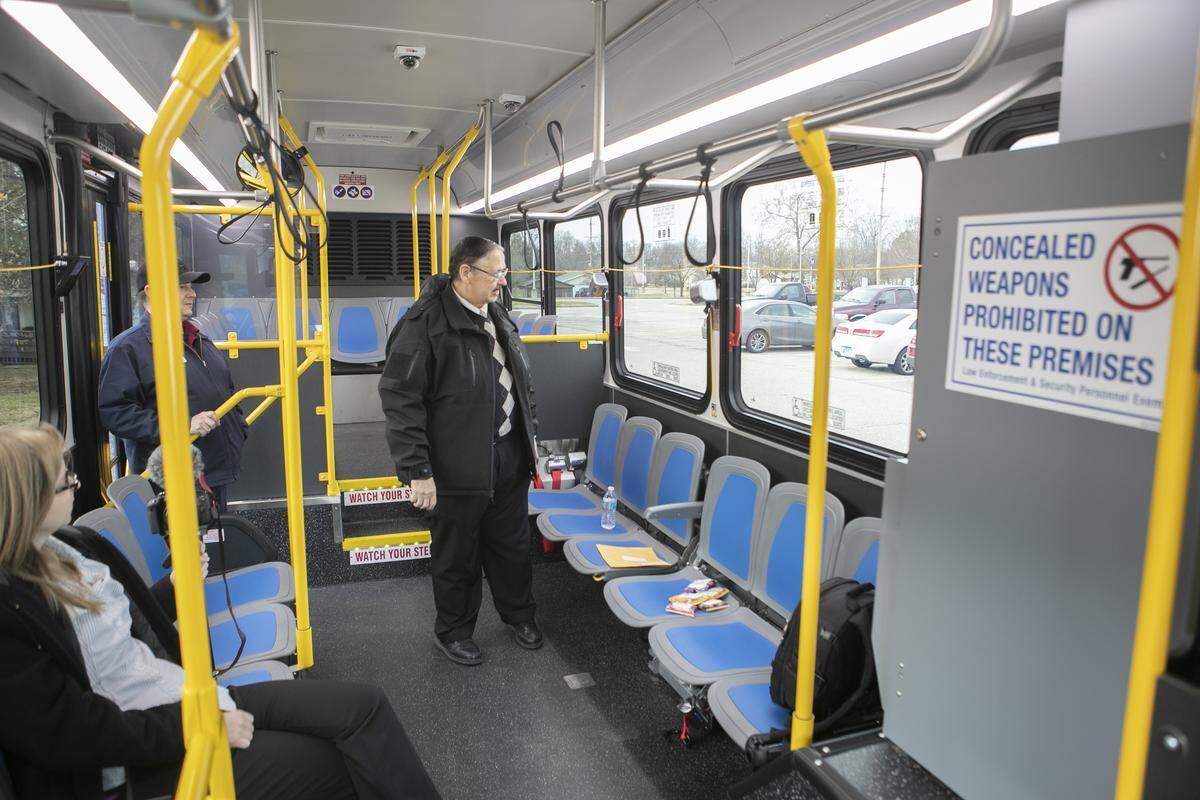
Almost all the changes are a result of shifting employment centers and housing in the county, District Board Chairman Herb Simmons said.
“Since the last comprehensive plan was completed more than two decades ago, employment centers have developed in new areas and new housing stock has been added in outlying communities,” Simmons said.
A shrinking ridership
Sharkey said the expected growth from new routes and changes to old routes would be a turnaround from years of shrinking ridership.
“We’re positive about the recommendation from the consultants,” Sharkey said. “We’re trying to turn around a declining ridership. and we needed to come up with a plan to address that.”
According to preliminary study data, annual Metrobus and MetroLink boardings have declined by 16.6 percent and 24.3 percent, respectively, since 2014. On average, MetroBus ridership is 9,500 during the week, 6,500 on Saturdays and 3,900 on Sundays.
Before the plan was introduced, ridership was expected to continue dropping in 2020.
More man-hours, more cost
The new plan comes at a cost.
Due to an increase in running time for some routes, the district will need to add almost 18% in total man-hours, Sharkey said. That will amount to a $4.7 million increase to the district’s operating budget, which also was set and approved recently at $29.6 million.
Sharkey said state funding helps, but the district itself will pay for roughly 35 percent of the total increase.
As time goes on, Sharkey said route changes can be adjusted.
“We hope to start tracking and charting any increase in ridership to see if it was a good decision or not,” he said. “We’ll be monitoring it as it goes. When you start any kind of new service, it takes at least six months to 12 months to see results.”
Sharkey said the changes may just be the start of adjustments to the MetroBus system. The plan is to chart the success and use of the routes over a 12-month period, making changes as needed.
Fares on the routes have remained the same. Currently, the fare for MetroBus is $2 with passes for several hours up to a day ranging from $3 to $7.50. A weekly pass is $27 and a monthly pass is $78. Those rates are lower for children, seniors and the disabled.
The new routes
By June, these route changes and new routes will be implemented:
Route 1 – Main Street-State Street: Improved frequency. Route 1 will operate with 15-minute service all day on weekdays and every 20 minutes on weekends.
Route 2 – Cahokia: New alignment with improved frequency. This route will be streamlined to more directly and frequently serve Falling Springs Road and Camp Jackson Road on all trips and connect with Route 6/8 on Clarita Street. Route 2 will operate every 20 minutes, seven days a week.
Route 3 – Sauget-Dupo: New Route. This peak-only route will serve portions of the former Routes 2, 2X, and 22X and create connections between East St. Louis and employment centers in Sauget, Cahokia, and North Dupo. Route 3 will operate every 30 minutes in the AM and PM peaks on weekdays only.
Route 4 – 19th & Central: New alignment with improved frequency. This route will be streamlined along its eastern loop to allow for improved frequency. Route 4 will operate every 20 minutes on Monday through Saturday and every 40 minutes on Sundays.
Route 5 – Missouri Ave: New alignment with Improved frequency. This route will be streamlined to allow for improved bi-directional frequency. Route 5 will operate every 20 minutes on Monday through Saturday and every 40 minutes on Sundays.
Route 6/8 – Rosemont-Alta Sita: Combined route with new alignment and frequency. Routes 6 and 8 will be combined in order to better match regional travel patterns and provide more frequent service. Route 6/8 will also connect with Route 2 at Clarita Street to allow for improved connections to more destinations. Route 6/8 will operate every 20 minutes, seven days a week.
Route 9 – Washington Park: New alignment with improved frequency. This route will serve portions of Washington Park formerly served by Route 6 and offer improved frequency. Route 9 will operate every 30 minutes, seven days a week.
Route 11 – Memorial-O’Fallon: New route. This route will create a new connection between Memorial Hospital Station and St. Elizabeth’s Hospital and O’Fallon via Frank Scott Parkway while retaining some of the route segments formerly served by Route 12. Route 11 will operate every 30 minutes, seven days a week.
Route 12 – O’Fallon-Fairview Heights: New alignment with improved frequency. This route will be streamlined in order to offer more frequent and direct service between Fairview Heights and O’Fallon. Route 12 will operate with 15-minute service all day on weekdays and every 30 minutes on weekends.
Route 13 – Caseyville-Marybelle: New alignment with improved frequency. This route will be streamlined to provide more frequent and direct service. Portions of the route south of Washington Park Station will have access to Route 6/8 or new MOD service. Tucker Drive will only be served during commute times. Route 13 will operate every 30 minutes, seven days a week.
Route 14 – Memorial Hospital: New alignment with improved frequency. This route will be streamlined to provide more frequent and direct service to the most popular portion of the route and remain on North Belt W/Old St. Louis Rd. Route 14 will operate every 30 minutes, seven days a week.
Route 15 – Belleville-Shiloh-O’Fallon: New alignment with improved frequency. Streamlining this route to remain on Cross Street south of O’Fallon will allow for an optimized schedule with more predictable arrivals. Route 15 will operate every 30 minutes on weekdays and every 60 minutes on weekends.
Route 16 – St. Claire Square: New alignment with improved frequency. This route will be streamlined to allow for more frequent service in Belleville (new Route 23) and improved weekend service. The new southern terminal will be Belleville Station, with the remainder of the route served by Route 23. Route 16 will operate every 30 minutes, seven days a week.
Route 17 – Carlyle Plaza-17th Street: New alignment with improved frequency. This route will be streamlined to allow for more frequent service while still only using one vehicle. Route 17 will operate every 90 minutes in each direction on Monday through Saturday.
Route 22X – Sauget Industrial Parkway: Replaced. Sauget Industrial Parkway will be served by the new Route 3, maintaining the connection to MetroLink.
Route 23 – Belleville-SWIC: New route. This route connects SWIC and the MetroLink station with residential areas south of Carlyle Ave and Belleville Station. Separating this route from Route 16 allows for improved frequency between these important areas. Route 23 will operate every 20 minutes, seven days a week.
Editor’s Note: A previous version of this article stated the No. 17 route from Carlyle Plaza to 17th Street in Belleville would be cut in the new plan. That is incorrect. The No. 17 from Carlyle Plaza to 17th Street in Belleville is not being cut but rather streamlined to allow for more frequent service.
This story was originally published January 30, 2020 at 5:00 AM.