Coronavirus shouldn’t keep people from worship, a southwestern Illinois sheriff says
As some states face lawsuits accusing them of restricting religious freedom in their efforts to prevent the spread of the coronavirus, a southwestern Illinois sheriff wants people to know he is not going to stop them from attending drive-in church services during the stay-at-home order.
Perry County Sheriff Steve Bareis said he is trying to balance residents’ First Amendment rights with public health restrictions and risks during the coronavirus pandemic.
Illinois Gov. J.B. Pritzker’s mandatory stay-at-home order limiting gatherings is in effect until April 30.
“I’m not willing to enforce a governor’s order to the point that it violates a Constitutional right if there’s not a public safety issue,” Bareis said in an interview.
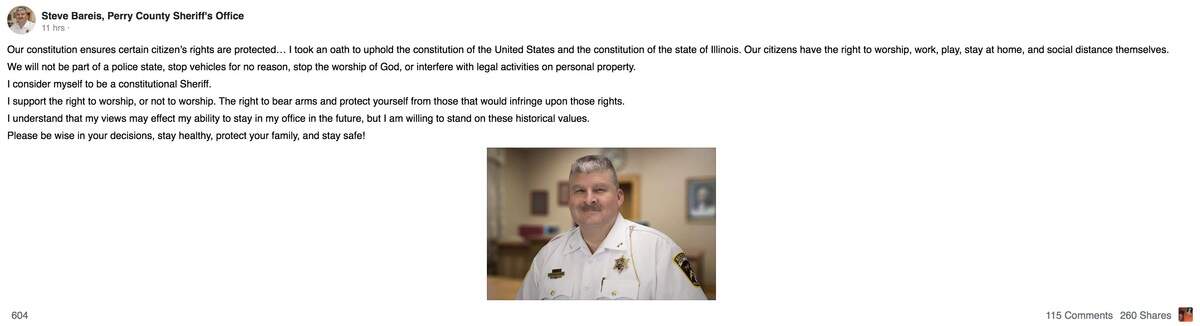
He had explained his stance on enforcing the order in a statement he posted on Facebook late Tuesday night. It received more than 300 comments and was shared over 450 times by Thursday morning.
“Our constitution ensures certain citizens’ rights are protected…” Bareis wrote. “We will not be part of a police state, stop vehicles for no reason, stop the worship of God, or interfere with legal activities on personal property.”
In Kentucky, officials are facing a lawsuit after state troopers collected license plate information of the people who went to Easter Sunday services inside a church so they could later send out quarantine notices.
Drive-in church services were exempt from that effort in Kentucky. But city leaders in Mississippi have been sued for trying to stop congregations from gathering in parking lots to listen to their preacher’s message broadcast over their car radios.
Bareis thinks people leaving home to listen to services from inside their car are still adhering to “the spirit” of the governor’s order because they are following its social distancing guidelines. The coronavirus that causes COVID-19, a respiratory disease, spreads from person to person through coughs and sneezes. Experts recommend people stay at least 6 feet away from others.
“The order has restricted personal liberty, and I agree with some of the restrictions for public safety’s sake,” Bareis said. “We don’t want to become a hot spot, and we don’t want people to die.”
To date, one person in Perry County has been diagnosed with COVID-19.
“I’m not going to go break up a worship service unless they gather inside a building,” Bareis added. “I may have to take action. I’m not saying I’m not willing to do that in that situation.”
Churches tell people to stay home during coronavirus pandemic
The Belleville Diocese, which includes Perry County parishes, has asked pastors to make changes to keep their congregations safe. Bishop Edward K. Braxton suggested sharing homilies online or live-streaming services.
Dr. Ngozi Ezike, director of the Illinois Department of Public Health, has also called on places of worship to move services online or over the phone rather than in person.
Bareis said he hasn’t received complaints about the drive-in services but calls have come in about other stay-at-home order violations: a few people continuing to use a golf course and an all-terrain vehicle track.
He said he does not have the personnel to be able to police those activities, which he feels are not posing a public safety risk because of the distance between people. The sheriff’s office staff was cut in half by layoffs last year. Now, there are five deputies who patrol the county of about 21,000 people.
When Pritzker announced the stay-at-order on March 20, he acknowledged that Illinois did not have “the resources, the capacity or the desire to police every individual’s behavior.”
“Enforcement comes in many forms, and our first and best option is to rely on Illinoisans to be good members of their communities and good citizens, working together to keep each other safe,” Pritzker said at the time. “I’ve instructed law enforcement to monitor for violations and take action when necessary, but that is not an option that anyone prefers.”
Bareis said he contacted the owners of both the golf course and the ATV track to ask that they comply with the governor’s order, which shuttered businesses like those because they are deemed “nonessential” during the pandemic.
The ATV track had been open for business until Wednesday, when the owner closed voluntarily after contact with both Bareis and Illinois State Police. Bareis estimated that three to five people were at the 100-acre track Wednesday riding ATVs.
State police are assisting law enforcement officers statewide during the pandemic, including by conducting investigations related to enforcement of the order, the agency said in a statement to the Belleville News-Democrat.
“The ISP’s goals are to prevent the spread of the coronavirus, thus saving lives through education and voluntary compliance with the state and national guidelines,” Illinois State Police said. “The maximum effectiveness of these preventative measures will only be realized when everyone does their part.”
Perry County Sheriff Steve Bareis’ full statement:
“Our constitution ensures certain citizen’s rights are protected… I took an oath to uphold the constitution of the United States and the constitution of the state of Illinois. Our citizens have the right to worship, work, play, stay at home, and social distance themselves.
We will not be part of a police state, stop vehicles for no reason, stop the worship of God, or interfere with legal activities on personal property.
I consider myself to be a constitutional Sheriff.
I support the right to worship, or not to worship. The right to bear arms and protect yourself from those that would infringe upon those rights.
I understand that my views may effect my ability to stay in my office in the future, but I am willing to stand on these historical values.
Please be wise in your decisions, stay healthy, protect your family, and stay safe!”
Bareis later added this sentence to his original Facebook post: “Nothing in this release diminishes the need to exercise precautions and abide by the spirit of a Governor’s order. Be wise and prudent.”
The Associated Press contributed information to this report.