Amid protests, Black-owned businesses in East St. Louis demand change
The wide building next to the railroad tracks on State Street stands alone.
Vacant lots nearby make it seem deserted, but for East St. Louis residents, Personal Touch Boutique has been a community staple for nearly 30 years.
Store owner Derrick Maxwell said the store prides itself on providing affordable and stylish clothing for men in the area. He said its strong bond with the community - a Black-owned business in a Black majority city - is especially important in times of nationwide civil unrest.
“During this protest, by us being here, it inspires our community because it tells them that after the protest is over, this is our chance to take back our community and build our Black-owned businesses,” said Maxwell, an East St. Louis resident. “Not only do we have to take back the streets, but we have to take back our businesses.”
Black-owned businesses are critical to the life of communities such as East St. Louis, said Joseph Gray, manager of the Grow East St. Louis Fund. That’s especially true now as demands to end systemic racism become more pervasive, he said. An issue in East St. Louis is there just aren’t many businesses. Gray wants that to change.
While Black residents make up about 96 percent of the city’s 26,000 population, less than a third work in East St. Louis.
“If you’ve worked in East St. Louis, you know there aren’t a lot of businesses in general,” Gray said. “A lot of them aren’t necessarily Black-owned, which is a part of the challenge. “
The Grow East St. Louis Fund was created in 2018 to encourage small business expansion, including offering long-term, fixed rate loans. Gray said it’s been difficult trying to get eligible businesses to apply for the program.
The lack of generational wealth within the Black community is a primary reason that Gray thinks there are so few black businesses. According to The Brookings Institution, the net worth of a typical white family is 10 times greater than that of Black households.
“There haven’t been those types of legacy opportunities,” said Gray, an East St. Louis native. “In the white community, businesses are passed down through families. In the Black community, there has never been that much opportunity for that to happen.”
Gray is determined to change the economic trajectory of his hometown by finding ways to make the Grow East St. Louis Fund more accessible for businesses that wouldn’t typically be eligible.
‘They’ve always had their knees on our necks’
Maxwell sees connections between today’s unrest across America and what happened more than a century ago during what is called the East St. Louis Riots, especially as it relates to his presence as a Black business owner.
Leroy Bundy, a Black businessman, was falsely accused of starting the unrest in 1917, said Tiffany Lee, an East St. Louis native who’s the co-author of Legendary East St. Louisans: An African-American Series. Lee was an educational liaison for the East St. Louis 1917 Centennial Commission & Cultural Initiative.
Bundy owned a dental practice and several other businesses.
“He was the quintessential ‘new negro’, which basically means that he was what we should be aspiring to be, and I think that made him the target for being the person to blame for starting the riot,” Lee said. “[Black people] always have to worry about being too successful in a community that doesn’t necessarily believe in the success of Black people.”
White people participated in lynchings, beatings and burnings of Black people and property during the riots. The official death toll was 39, but historians estimate that over 100 Black Americans were actually killed.
Maxwell said: “We had people die in the streets of East St. Louis all because a lie was told, and now the same thing is basically happening now, so it just shows how we have never been given a fair chance. They’ve always had their knees on our necks.”
“I was just watching something about Black Wall Street in Tulsa, Oklahoma, and how that led to race riots, but [Black businesses] are still here, and I think that shows how Black people have always had the initiative to keep going, in spite of everything that we’ve faced, and that empowers me.”
Maxwell started his business in 1994 after noticing the lack of Black-owned stores that catered to men’s fashion. Although he’s had his struggles throughout the years, he’s thankful for the community’s consistent support.
“That [support] allowed me to grow in my community because they know Mr. Maxwell is going to stay here and represent us, and that’s why I’ve been able to remain here for almost 30 years,” he said.
Terrance Taylor, of East St. Louis, said one reason he has been a frequent customer of Personal Touch Boutique is because Maxwell is a Black business owner who supports his community.
“When he was selling clothes out of the trailer, I was one of his first customers,” Taylor, 50, said. “I think he’s grown with me. My style has grown with his style, and he stayed in touch with the type of clothes that I like to wear. He’s probably one of the only ones in our community that cater to men who like to wear high-end clothing instead of the regular cheap stuff.”
Camaraderie with the East St. Louis community isn’t exclusive to Maxwell’s business.
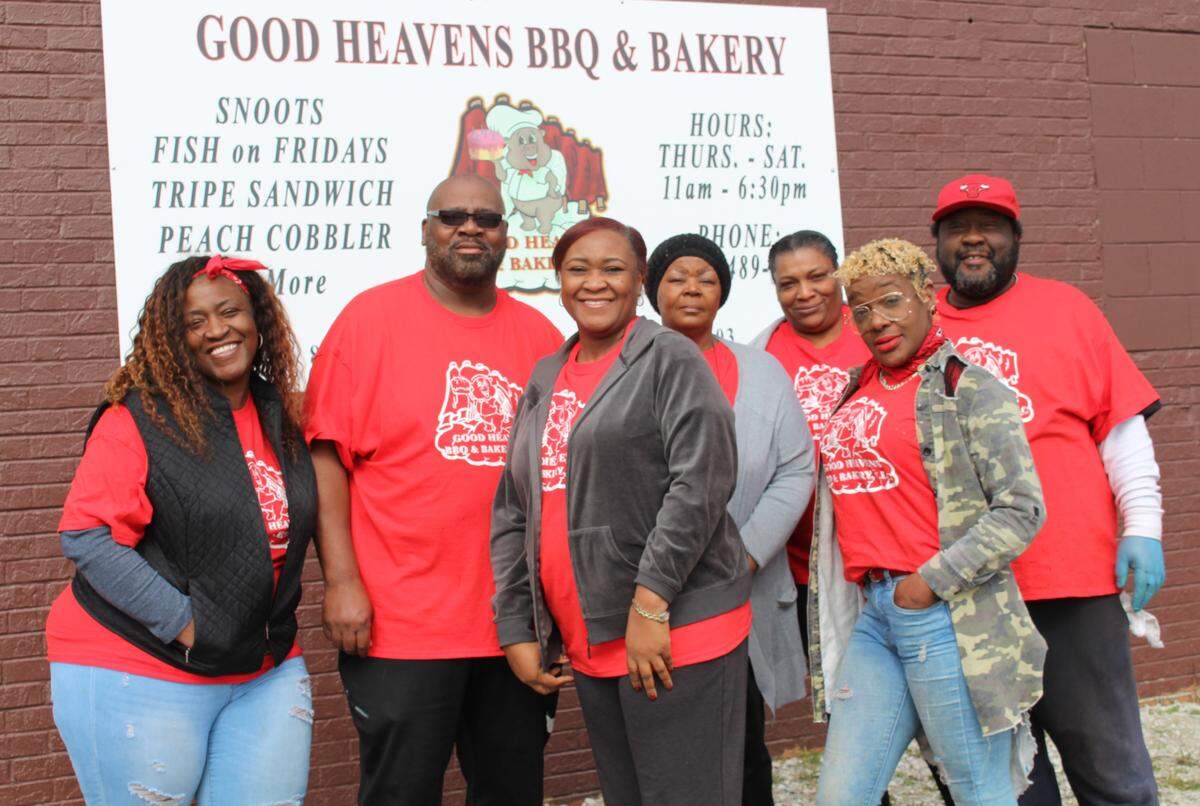
Kattie Williams-Goodwin, the owner of Good Heavens BBQ & Bakery in East St. Louis, said the community’s devotion to her business is a main reason why she decided to reduce the restaurant’s hours and continue to have customers use their carry-out service when stay-at-home orders were initially enforced.
“We’re Black in a Black-owned environment, so we cook in a way that people enjoy our food because we grew up on the same things,” said Williams-Goodwin, of Belleville. “We were scared and we wanted to close our business (because of COVID-19), but people were coming in to tell us that we were essential.”
In 2016, Good Heaven’s started as a food truck and catering service on 59th Street in East St. Louis. Now, after switching locations throughout the years, it mainly operates as a carry-out service on 8015 State St.
Williams-Goodwin said seeing the current protests keep her motivated to serve her community, although she was devastated to hear the news of George Floyd’s death.
“I couldn’t sleep for days,” Williams-Goodwin, said. “I felt like I saw a live lynching. Every night I just began to pray for him and for us as a community”
Floyd, a Black man, died in police custody on Memorial Day after a white police officer in Minneapolis jammed his knee onto his neck for nearly nine minutes. Floyd’s death has triggered weeks of Black Lives Matter protests in communities large and small across the nation, including southwestern Illinois. Most have been peaceful, though some cities have seen violence.
Williams-Goodwin’s daughter, Randi Goodwin, often volunteers in the restaurant. She channeled her anger regarding police brutality by attending a recent protest in Belleville.
“It was a very powerful day,” said Goodwin, who attends Illinois State University. “We had a lot of allies with the LGBTQ community and the white community and us coming together to raise awareness for the cause. And it was very emotional as I and others shared our personal experiences with police brutality and how it has affected our families.”
Williams-Goodwin understands the built-in frustration of her community.
“This is a time in society for decision makers and lawmakers to take their knee off of Black people’s neck and let us have an opportunity,” Williams-Goodwin said.“Give us those business loans. Give us those grants to start our own businesses.”
Giving back to the community
Illinois Gov. J.B. Pritzker, in partnership with the Illinois Department of Commerce and Economic Opportunity, recently announced a plan to give $11 million in grants to minority-owned businesses in Illinois. The grants are intended to create more jobs in underserved cities in Illinois.
Courtney Hoffman, the owner of Hoffman Feingold Agency, a financial services firm in East St. Louis, is one of 32 grant recipients.
Hoffman plans to use the $240,000 grant to create a center in East St. Louis that will provide employment opportunities for people in the community.
“I decided I would create an opportunity for individuals, like felons or young adults that have a hard time finding employment,” said Hoffman, an East St. Louis native. “I looked at that and I also looked at the abundance of abandoned and vacant buildings in the city of East St. Louis, and I figured how could I bring the two together and build a community and provide opportunities for individuals who wouldn’t typically get those opportunities and would tend to lead towards crime.”
Terrance Taylor, the longtime customer of Personal Touch Boutique, is also the vice president of Community Development Sustainable Solutions. The East St. Louis nonprofit focuses on providing programs, like work readiness and mentorship, that’ll help address community issues.
Like Hoffman, Taylor is a proponent of supporting his hometown, instead of leaving it to build a community elsewhere.
“My family has been here for over 100 years in this community, and I’m not going anywhere,” Taylor said. “Even though there’s work that’s needed to be done, I love this place.
“We love, laugh and make friends in this community, and if we can continue to do that, we can continue to support our businesses. We have an opportunity to build here.”
This story was originally published June 19, 2020 at 9:38 AM.