Granite City hospital could have lost millions over decision to stop delivering babies
The decision by Gateway Regional Medical Center in Granite City to close its obstetric unit could have caused it to lose its status as an Illinois “safety-net hospital” for the poor.
That would have eliminated millions of dollars in supplemental Medicaid funding each year.
But Gateway kept its status under Illinois Senate Bill 1530, which was signed into law April 2 by Gov. J.B. Pritzker. It amended the Illinois Public Aid Code with a clause that didn’t mention Gateway by name, but effectively added it to a list of hospitals allowed to continue in the state’s safety-net program, despite not meeting some requirements.
Gateway CEO Bob Moore described the legislation as something of a lifesaver.
“If we got out of the safety-net program, this hospital would not be viable,” he said Tuesday. “We get about $8 million a year in funding from it.”
The percentage of Gateway patients covered by Medicaid has increased from about 50% in 2018 to 57% today, Moore said. Supplemental funding for safety nets is designed to make up for unpaid bills, longer waits for payments and administrative costs associated with Medicaid managed-care organization contracts.
Moore said Gateway closed its obstetric unit last spring because of COVID-19 and “low volume” and wants to keep it closed permanently, sending women to Anderson Hospital in Maryville 12 miles away to give birth. Before the pandemic, fewer than 250 women were having babies delivered at Gateway each year.
The hospital’s long-term plan must be approved by the Illinois Health Facilities Planning Board.
“If we had to stay in the OB business, it would be detrimental to the overall operation for us,” Moore said. “We would not be able to expand what is really one of the most needed services, and that’s behavioral health (mainly adult psychiatric treatment and opioid detox).”
Safety-net hospitals and other facilities that provide health care to people regardless of ability to pay are vitally important, according to Bonyen Lee-Gilmore, vice president for strategy and communications for Planned Parenthood of the St. Louis Region, which operates Fairview Heights Health Center.
But closing Gateway’s obstetric unit will create hardship for some local residents, she said.
“When you increase travel time and you push care further away from a person’s home, particularly a person with low income ... Those are just more barriers that you’re putting in their way,” Lee-Gilmore said.
Mary Kitley, interim executive director of Good Samaritan House homeless shelter for mothers and children in Granite City, said Wednesday she wasn’t aware that Gateway had stopped delivering babies.
Kitley called the news “disappointing.”
“I think it limits access for people in one of the poorest areas of our county and our region, especially people who don’t have their own transportation,” she said.
Kitley said she will need to speak with a pregnant woman who has lived at the shelter for about a month to make sure she has plans for the birth. The woman doesn’t have a car.
Safety nets serve Medicaid patients
Most states have public and private safety-net hospitals eligible for supplemental Medicaid funding for serving a large percentage of low-income and uninsured patients. Many are struggling to survive after a year of catastrophic losses due to COVID-19.
Illinois has 26 safety nets, including Gateway and Touchette Regional Hospital in Centreville in the metro-east. That’s down from 40 five years ago.
“(Safety nets are) very important because they serve vulnerable and underserved populations across the state,” said Danny Chun, vice president for corporate communications and marketing for the Illinois Health and Hospital Association.
An IHHA brochure also points to the economic impact of safety nets, which employ tens of thousands of people statewide, and their role as major providers of mental-illness and substance-abuse treatment.
Gateway employs nearly 500 people, according to Moore.
The Illinois Department of Healthcare and Family Services determines safety-net eligibility. A hospital must be licensed for general acute or pediatric care with more than 50% of inpatient services covered by Medicaid or more than 40% covered by Medicaid plus 4% provided free through charitable programs.
“It’s defined in state law which hospitals qualify,” according to Dan Jenkins, IDHFS deputy administrator for rates and finance.
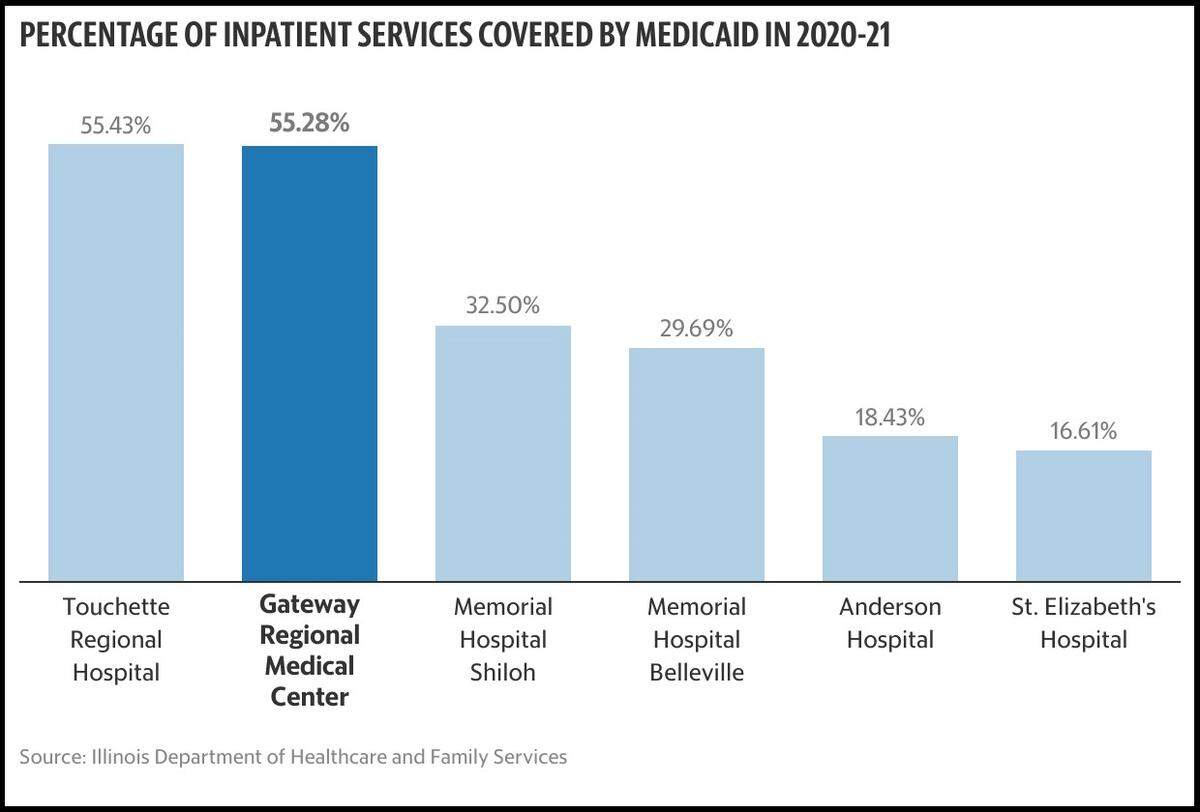
Some 55.28% of Gateway’s inpatient services were covered by Medicaid and 1.74% by charitable programs during the last reporting year (2019-2020), according to the IDHFS.
That compares to:
- 55.43% and 5.22% for Touchette
- 32.5% and .67% for Memorial Hospital Shiloh
- 29.69% and .65% for Memorial Hospital Belleville
- 21.71% and .71% for Alton Memorial Hospital
- 18.43% and .52% for Anderson Hospital in Maryville
- 16.61% and 0% for St. Elizabeth’s Hospital, formerly in Belleville and now in O’Fallon
- 13.71% and 0% for St. Joseph’s Hospital in Breese
- 12.87% and .61% for Red Bud Regional Hospital
- 12.68% and 0% for Community Hospital of Staunton
- 12.6% and 0% for Washington County Hospital in Nashville
- 10.89% and 2.03% for St. Joseph’s Hospital in Highland
Illinois law also requires safety nets to meet the standards of a Medicaid “disproportionate share hospital,” as defined in the federal Social Security Act. It specifically mentions the need for obstetric services in poor communities.
“No hospital may be defined or deemed as a disproportionate share hospital ... unless the hospital has at least two obstetricians who have staff privileges at the hospital and who have agreed to provide obstetric services to individuals who are entitled to medical assistance for such services,” the act states.
Change in law preserves hospital status
Over the years, Illinois legislators have amended the Illinois Public Aid Code to create and maintain an exception that allows hospitals to continue as safety nets, despite not meeting some requirements, if they qualified when the program began in 2011. Today, four of 20 in the “grandfathered” group fall into that category, most due to drops in Medicaid percentages.
“It basically says these hospitals will continue to qualify as safety-net hospitals no matter what because they were eligible in 2011,” Jenkins said.
Gateway wasn’t part of the grandfathered group because it didn’t become a safety net until 2012. Senate Bill 1530 amended the code to extend the exception to hospitals that qualified in 2012.
Without the change in state law, Gateway could have stopped receiving supplemental Medicaid funding. That includes an “add-on” payment of $57.50 for each day a Medicaid patient stays in the hospital, according to the IDHFS.
Senate Bill 1530 was sponsored in last year’s Illinois General Assembly session by State Sen. Christopher Belt (D-Centreville). He emphasized the importance of safety-net hospitals in a news release.
“Nobody should be afraid to seek medical attention when they need it,” he stated. “By signing this initiative into law, we’re ensuring that thousands of residents in the Granite City area will still have an affordable option.”
Belt declined to be interviewed for this story.
Gateway is a 305-bed hospital with a long history serving Granite City and the adjacent communities of Pontoon Beach and Madison. It originated as a private facility in 1900. The Sisters of Divine Providence, a Catholic religious order, took over in the early 1920s and operated it on a non-profit basis as St. Elizabeth Hospital for more than 80 years.
Community Health Systems bought the hospital in 2002, renamed it Gateway and transferred ownership in 2015 to a “spin-off” known as Quorum Health Corp. Both CHS and Quorum are for-profit companies based in Tennessee.
Quorum, which also owns Red Bud Regional Hospital, filed for Chapter 11 bankruptcy in April 2020 and completed financial restructuring in July.
“Completing this process allows our hospitals and subsidiaries to continue providing quality care and developing new ways to deliver much-needed health services to the communities we serve, now and in the future,” CEO Joey Jacobs stated in a news release.
Touchette, the region’s other safety-net hospital, also closed its obstetric unit last spring and plans to keep it closed because of “low volume,” according to Steve Tomaszewski, corporate director of communications and development planning.
In 2019, only 37 women had babies delivered at the non-profit hospital, which is operated by the Southern Illinois Healthcare Foundation.
“If you have an OB department, you have to have 24/7 coverage so to speak,” Tomaszewski said. “So you have two nurses around the clock.”
Most SIHF doctors were delivering babies at Memorial Hospital Belleville until April 2020, when that hospital announced it was transferring obstetric services to Memorial Hospital Shiloh under a temporary consolidation plan prompted by COVID-19.
Unlike Gateway, Touchette wasn’t at risk of losing its safety-net status when it closed its obstetric unit. It’s grandfathered in because it qualified for the program in 2011.

Lack of obstetric care is national issue
At one time, babies were delivered at virtually all community hospitals. It was considered a basic service.
But lack of obstetric care has become a problem in some parts of the United States, according to a 2017 study published in the journal Health Affairs. It reported that the percentage of rural counties with no hospitals that deliver babies went from 45% in 2004 to 54% in 2014.
“Counties with lower median incomes, those with greater percentages of non-Hispanic black women and states with lower Medicaid-income-eligibility thresholds for pregnant women were the most likely to lack or lose obstetric services,” the study stated.
“This should raise concerns that counties that may already be socioeconomically disadvantaged face compounding challenges in ensuring access to necessary care.”
CEO Moore said Gateway’s doctors continue to perform gynecological surgeries and provide prenatal care, but they’re delivering babies at Anderson Hospital and will soon expand to Alton Memorial.
Moore said several other hospitals in St. Louis and the metro-east offer obstetric services, and many women in the Granite City area were traveling to them by choice before Gateway closed its obstetric unit.
“It’s been over a year since we did this, and we have had literally no backlash, no negative comments,” he said. “There’s been good, coordinated care with the doctors and the patients at Anderson for people to get the care that they needed.”
Lee-Gilmore, the Planned Parenthood spokeswoman, said all health-care providers are being forced to make difficult decisions due to an inadequate national health-care system that doesn’t serve people of different races, genders and socioeconomic levels equally.
As for the closing of Gateway’s obstetric unit, Lee-Gilmore said lack of vocal opposition isn’t necessarily a sign of agreement.
“When you’re talking about patients with low incomes in marginalized communities, they often times face the hardest challenges in voicing opposition when things like this happen to them,” she said. “They’re low on resources, they’re low on connections, and it’s hard to advocate for yourself when you face so many barriers to surviving in this world.”
Both Chun, of the Illinois Health and Hospital Association, and Moore expressed concern about the stability of Illinois hospitals, not just safety nets, coming out of the COVID-19 pandemic.
Chun said the Coronavirus Aid, Relief and Economic Security (CARES) Act of 2020 provided financial help for hospitals, but it didn’t make up for all their pandemic-related losses. Funding in the Coronavirus Response and Relief Supplemental Appropriations Act of 2021 goes mostly to small, rural hospitals.
Could a hospital such as Gateway go out of business?
“If you would have asked me that question in 2019, I would have told you, ‘No,’” Moore said. “You ask me that question in 2021, after what we have faced in 2020 ... Not just Gateway, but a lot of hospitals are in jeopardy. Most hospitals saw a 40% to 50% drop in admissions (and) surgeries. The COVID pandemic really changed the landscape of health care.”
This story was originally published April 24, 2021 at 7:00 AM.