What are other examples of gas price chaos over the course of recent U.S. history?
Do you have a question about U.S. history, popular culture, celebrities, trivia, other topics you are curious about in this wondrous world of ours? Please send your questions to newsroom@bnd.com and we’ll try to find the answers. Here’s today’s topic:
The average price of gas hitting an all-time high this week in the U.S. and President Joe Biden banning Russian oil while Ukrainians try to fend off the invasion of their country prompted memories of previous disruptions in the gasoline market.
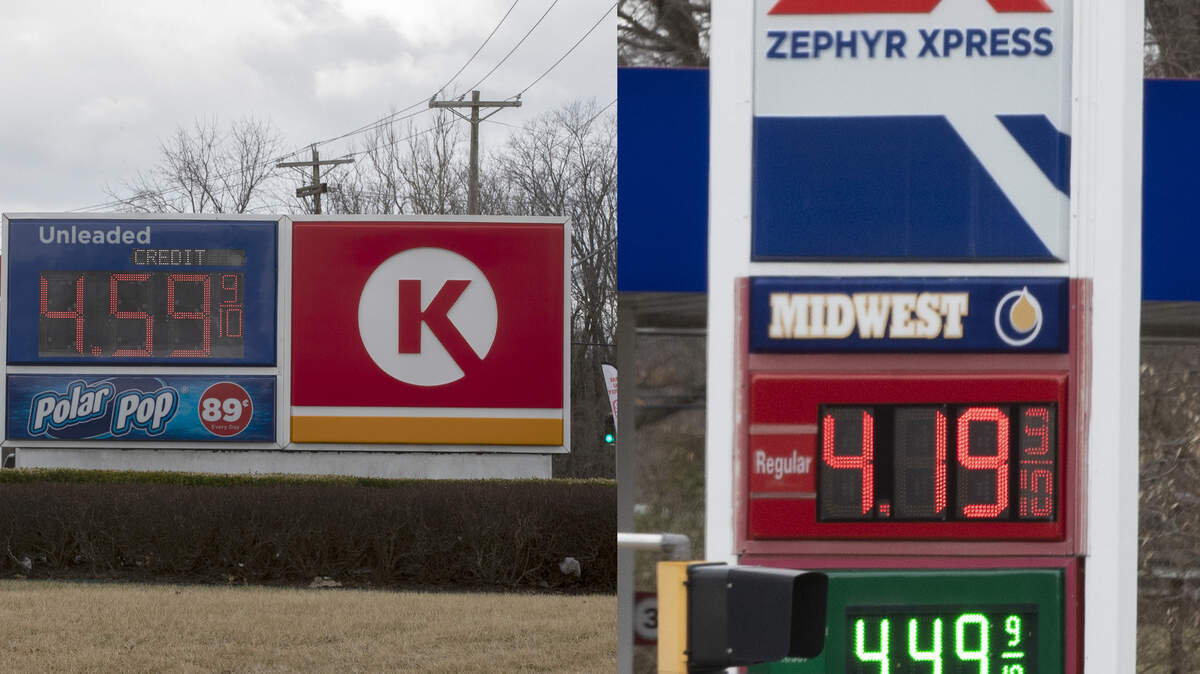
Biden’s move came as the AAA motor club reported the average price of gas nationwide set a record of $4.17 a gallon on Tuesday, beating the record of $4.11 in 2008, according to USA Today. In the metro-east, AAA reported the average price was $4.36 in St. Clair County and $4.23 in Madison County. And now Illinois motorists are wondering if gas will hit $5 a gallon.
Here’s a rundown of three previous oil crises that have hit American drivers:
OPEC embargo of 1973-74
In October 1973, the Organization of Petroleum Exporting Countries, or OPEC, refused to send oil to the United States and other countries for their support of Israel in the Yom Kippur War in the Middle East.
Before the OPEC embargo, oil cost $2.90 a barrel but by January 1974, the price had nearly quadrupled to $11.65 a barrel due to production cuts, according to a report by the Federal Reserve Bank of Boston.
The U.S. Department of Energy reports the average price for a gallon of gasoline in 1973 was 39 cents, but in 1974, it rose to 53 cents.
There were long lines and panic buying at gas stations as Americans were shocked to see gasoline shortages during the embargo.
Before the price spike prompted by the 1973-74 OPEC embargo, Americans had enjoyed decades of stable gas prices.
For instance, between 1953 and 1966, the average price of a gallon of gas never strayed from a low of 29 cents and a high of 32 cents, according to Department of Energy records.
The average price in the 1940s was about 22 cents while in the 1950s, it was 29 cents. In the 1960s it was about 32 cents.
While OPEC ended the oil embargo in 1974, the higher prices for gas and oil remained in place, according to the Federal Reserve Bank.
Shock of 1978-79
A Page 1A photo in the News-Democrat on June 26, 1979, showed a line of more than 20 cars snaking out of a gas station at 6001 W. Main St.
It had the headline of “Long lines hit home.”
The BND caption noted that lines at gas stations had first been seen on the West Coast but that the “panic buying” there had subsided.
The disruption all stemmed from the rise of oil prices linked to the Iranian Revolution that began in 1978 and Iran subsequently dropping oil production in early 1979, according to a report by the Federal Reserve Bank of Atlanta.
Oil prices doubled between April 1979 and April 1980, the Fed report stated.
At the pump, the average price of gasoline in the United States was 63 cents a gallon in 1978, but it had nearly doubled to $1.19 a gallon in 1980, according to Department of Energy records.
2008 record price
The record set this week for the highest national price of gasoline broke the previous record that had stood for nearly 14 years since 2008.
And 2008 was the first time the annual average price for gasoline nationwide cracked the $3 barrier.
The annual average price for a gallon of gas that year was $3.27, according to the Department of Energy.
A professor from the University of California at San Diego has reported that the sticker shock for oil prices in 2007-08 was caused by “strong demand” coupled with “stagnating” production.