West Main Street redesign among projects in Belleville’s master bike plan
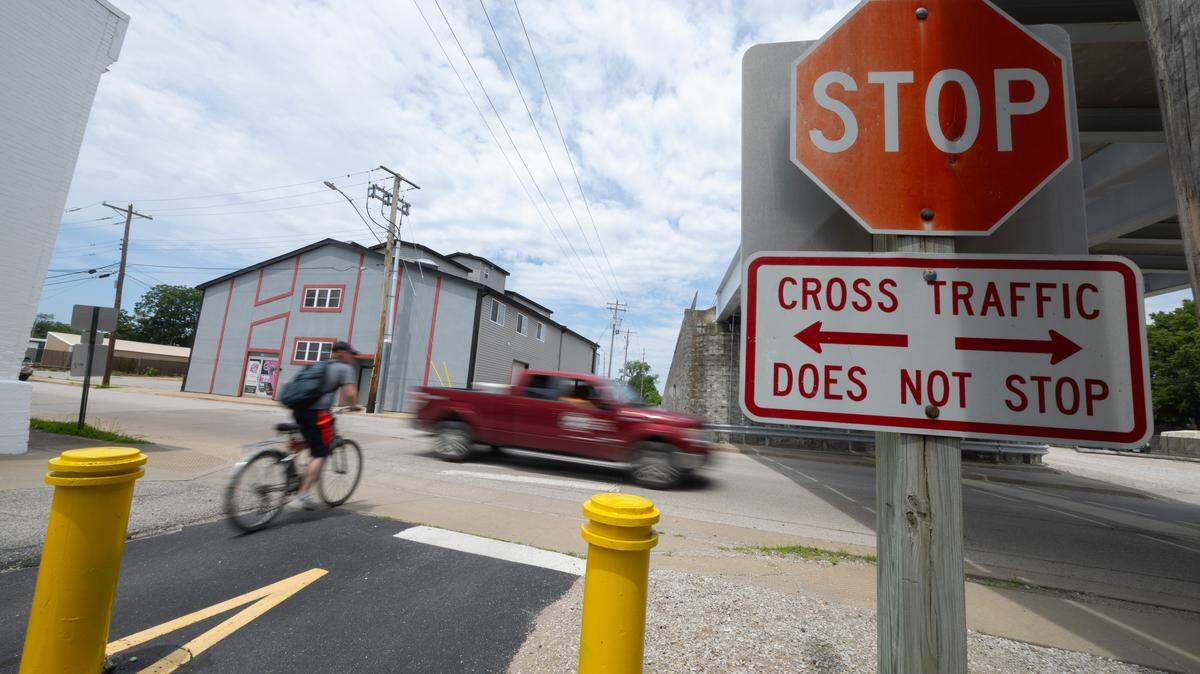
Rik Taylor looks forward to a day when Belleville residents can hop on their bikes and ride to restaurants or downtown festivals or even commute to work easily and safely.
The 59-year-old biking enthusiast, who works as service manager at The Cyclery in Shiloh, was happy to see Belleville City Council approve a Bicycle and Pedestrian Master Plan this summer.
“The upkeep of a car is becoming more and more expensive,” Taylor said. “People are looking to be a little more conscious of energy savings and pollution, and they’re seeing bikes as a way to get exercise but also to accomplish tasks, such as going to the store.”
The 42-page plan is essentially a blueprint for connecting proposed and existing trails to neighborhoods, schools, parks, government centers, business districts and each other.
The plan’s main purpose is to guide decision-making in the next 20 years, according to Jason Poole, director of public works. He also expects it to help the city get grant funding for projects.
“It’s a planning tool,” he said. “... When it comes to making decisions, you’re not out there saying, ‘I think that’s a good idea. Let’s do it.’ You have some type of plan that you’re working toward.”
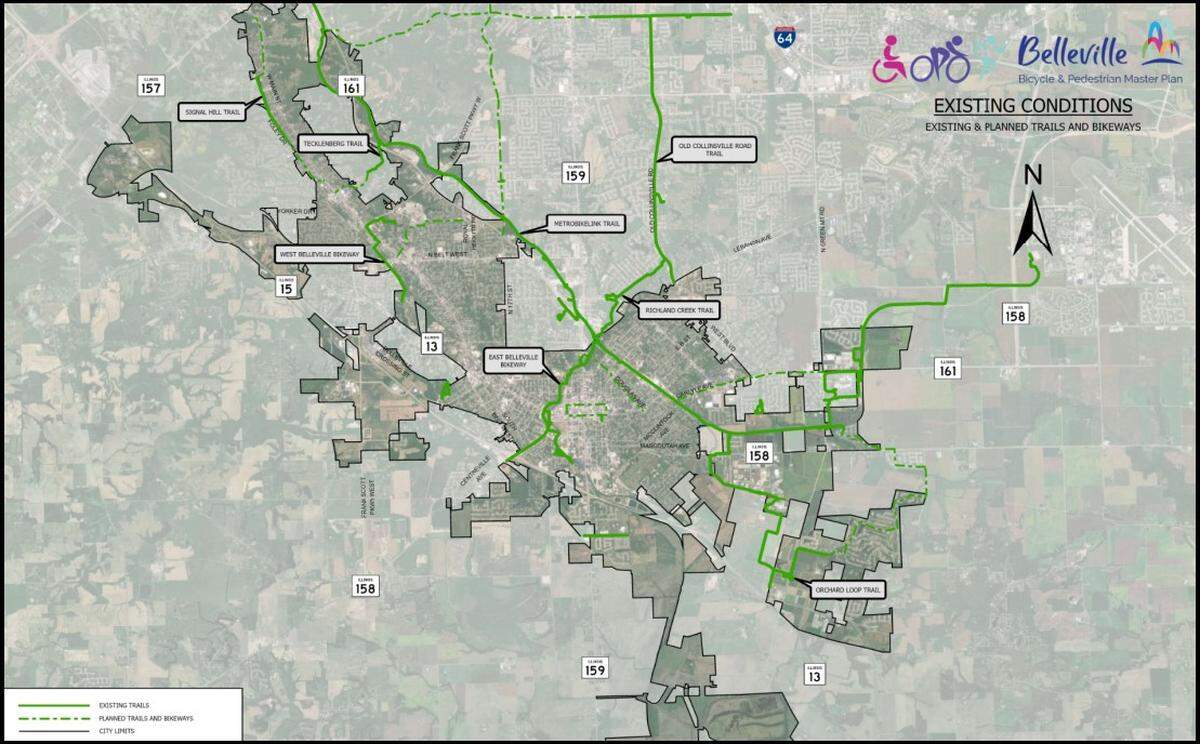
The current biking map in St. Clair County is dominated by MetroBikeLink Trail, a 14.5-mile paved trail that begins at the MetroLink station in Fairview Heights and runs east through Swansea and Belleville before ending at the Shiloh-Scott station.
Taylor refers to the trail, which is operated by St. Clair County Transit District, as the “main artery” for area biking.
Other trails in or near Belleville include Old Collinsville Road Trail (3.5 miles), Richland Creek Trail (1.5 miles), East Belleville Bikeway (2 miles), Orchard Loop Trail (4 miles), Tecklenburg Trail (1.1 miles), West Belleville Bikeway (1.5 miles) and Signal Hill Trail (.7 mile).
Projects already planned
Belleville’s new master plan was developed by the engineering firm Oates Associates in partnership with Heartlands Conservancy and funded in part by Metro East Park and Recreation District.
“(The city is) in pursuit of a more walkable and bikeable community,” the introduction states.
The plan starts by listing projects already recommended in past studies. That includes a Signal Hill Trail extension from Foley Drive to West Main at South 70th Street. It’s partially funded and in the design stage.
Also recommended in the past were improvements around Memorial Drive and Park Avenue near Memorial Hospital, bike lanes downtown and a shared-use path along Douglas Avenue.
Officials plan to move forward with a bike trail from Memorial Drive to Abraham Lincoln School if they can get a grant through the Illinois Safe Routes to School Program. They’re preparing an application now.
“It’s highly competitive,” said Jody Shaw, an Oates project manager, noting about one-third of applicants are successful.
Perhaps the most consequential project for all Belleville residents, not just bicyclists and pedestrians, is called the “West Main Street Road Diet.” It’s funded and in the design stage.
The project will reduce the number of vehicle lanes from four to three on West Main from 28th Street to 49th Street, resulting in one eastbound, one westbound and one center turn lane. It also will add “protected” bike lanes (separated by curbing), crosswalks near bus stops and islands for pedestrians to land between lane crossings.
Studies have shown West Main Street to be a highly injury-prone roadway in the region, according to Shaw.
“You can slow vehicle traffic by reducing the number of lanes,” she said. “People will no longer see it as a racetrack. It will feel tighter, slower and more accessible to bicyclists and pedestrians, and we’re hoping it will also help with development.”
St. Clair County Transit District also is expanding its trail system in ways that will affect Belleville, the master plan states.
The district has grant funding to build a bike trail between Green Mount Road and West Boulevard along the south side of Carlyle Avenue. It’s planning a future connection to Fairview Heights along Sullivan Drive and continuing to work on Tecklenburg Trail.
Other priorities in the plan
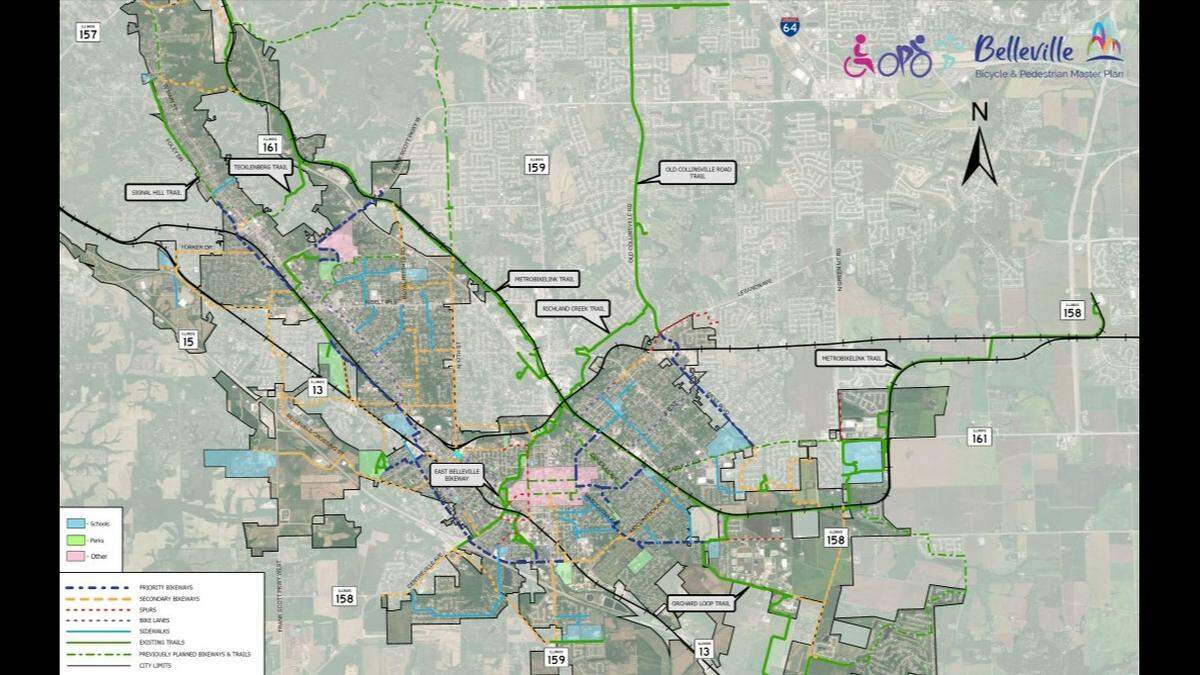
Here are other priority projects recommended in Belleville’s Bicycle & Pedestrian Master Plan:
Signal Hill Trail to Citizens Park: Extend Signal Hill Trail to West Belleville Bikeway, which goes southeast to Citizens Park. This would serve Althoff Catholic High School.
Belleville West Bikeway to Bicentennial Park: Extend West Belleville Bikeway from Citizens Park to Bicentennial Park. This would serve Union School and Southwestern Illinois Justice & Workforce Center and create a continuous trail from Signal Hill to Bicentennial Park.
Belleville MetroLink station to downtown: Widen the Scheel Street sidewalk and remove a parking lane on North Charles to make room for bicyclists heading to bike lanes on A Street.
West Boulevard area: In addition to the bike trail being built along Carlyle Avenue, remove parking lanes or create a center turn lane and build a pedestrian island on West Boulevard (Illinois Department of Transportation roadway). Widen a sidewalk and improve a pedestrian crossing along Old Collinsville Road (county roadway).
Illinois 13/South Belt West: Make improvements to an area that provides little or no pedestrian accommodations or opportunities for safe bicycling and create possible connections to Bicentennial Park, East Belleville Bikeway and Belle-Clair Fairgrounds.
Tecklenburg Trail to Signal Hill Trail: Utilize 66th Street to connect Tecklenburg Trail to the Signal Hill Trail extension that’s now being designed (from Foley Drive to West Main Street at 70th Street).
West Belleville Bikeway to Memorial Hospital: Upgrade Frank Scott Parkway and Illinois 161 intersection and utilize Frank Scott to connect West Belleville Bikeway to the MetroLink station at Memorial.
Illinois 158/Mascoutah Avenue: Connect Orchard Loop Trail to downtown Belleville with a shared-use path that could pull Laderman Park and East End Park into the system.
East Main Street: Implement a road diet to reduce vehicle lanes on East Main, provide space for bicycles and pedestrian accommodations and connect MetroBikeLink Trail to downtown.
Tool for community growth
The new master plan had a grassroots beginning several years ago. Residents who asked city officials to make Belleville more walkable and bikeable included Kathy Mordini, a local real-estate agent and developer.
Mordini said she got fired up after taking an online course through Strong Towns, a nonprofit organization that works to make communities “safe, livable and inviting” and opposes the prevailing pattern of development referred to as the “suburban experiment.”
Bicycle and pedestrian trails are community assets that can help with growth, according to Mordini.
“Some people look for these types of activities whenever they’re looking for a community to move to,” she said. “And I think you’ll find that the majority of those people have disposable income.”
Safety also is a factor, Mordini said. She pointed to a recent accident involving a 14-year-old boy riding on the MetroBikeLink Trail who was hit by a car and injured while crossing East B Street. Improvements to that intersection are now being considered by officials.
For years, St. Clair County has been playing catch-up in the biking arena with Madison County, where the transit district operates 12 trails covering 138 miles, its website states. St. Clair County trails cover 39 miles.
The city of Belleville signed a $72,500 contract with Oates Associates in 2023 to prepare the master plan. The city’s share was $43,500 after it got a Metro East Park and Recreation District grant.
The plan’s priority projects were largely based on input from city employees and hundreds of local residents who participated in two surveys. They shared goals ranging from recreation to tourism.
“(One survey) gauged the community’s interest in destinations and concerns regarding specific streets and intersections,” the plan states. “Corridors of concern included Carlyle Avenue, West and East Main Streets, IL-161, and IL-13 or South Belt West.”
The plan also lists several other large projects deemed worthwhile but not prioritized to create loops and expand the network, as well as smaller projects such as bike lanes, spurs and sidewalk and crosswalk improvements throughout Belleville.
“(Sidewalk replacements) should work in conjunction with the addition of new sidewalks as recommended,” the plan states. “... Specifically recommended are sidewalks along Garden Boulevard east of McClintock Avenue, Lucinda Avenue, East McKinley Street, and North 37th Street.
“The City could develop or improve on a sidewalk program intended to ensure that sidewalk improvements happen yearly, or give a way for community members to participate financially in the addition of sidewalks that impact their property.”
This story was originally published September 25, 2025 at 5:30 AM.