Here’s how COVID-19 affected attendance, enrollment in Illinois public schools last year
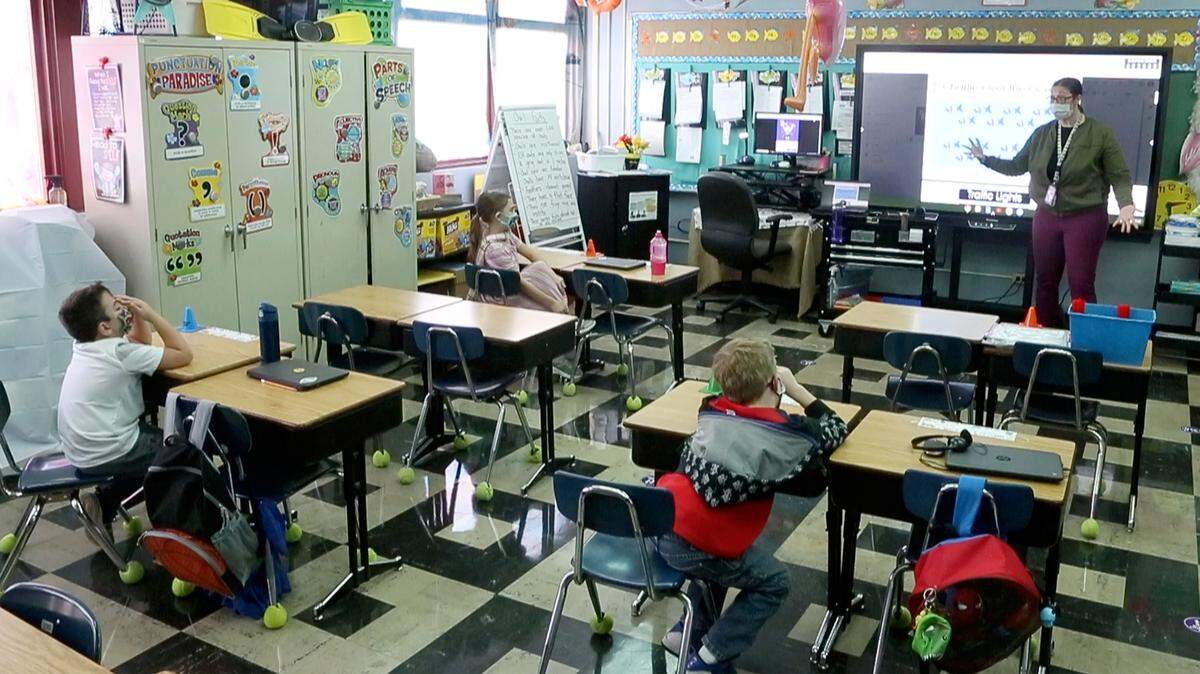
One in five Illinois students were chronically absent last school year during the COVID-19 pandemic, according to new data from the Illinois Report Card shared Friday.
The data, which is collected and reported by the Illinois State Board of Education, covers everything from student achievement to administrator diversity and teacher experience. The newly-released data from 2020 is one of the first in-depth looks at how the pandemic affected education statewide.
A student is considered chronically absent if they miss 10% or more of the school year. The student groups that saw the biggest increases in chronic absenteeism included English learner students, students receiving special education services, low-income students, and Black and Hispanic students.
Nationally, school districts that primarily serve Black and Hispanic students were the least likely to have in-person learning last year.
“We suspect that less access to in-person learning led to less engagement,” said Brenda Dixon, the state state education board’s chief research and evaluation officer.
Lower student engagement can fuel chronic absenteeism, Dixon said. Having “wraparound” services for students and working to increase family engagement is the best way for school districts to address chronic absenteeism.
English learners, in particular, were at risk for disengagement from school, State Superintendent Carmen Ayala said.
“They may or may not be utilizing English as much as they would have if they were in a school setting,” she said. “I think the pandemic really had an impact on the English learner because the environment for school in which they can learn English as a second language was interrupted.”
Based on preliminary and incomplete assessment data, the student groups that were most likely to be chronically absent also suffered from some of the steepest rates of learning loss. While Dixon said it was a “good hypothesis” to assume that lower attendance rates led to lower test scores, there haven’t been any studies on the data to directly tie the two together.
Fewer than 10% of Illinois students had access to fully in-person learning at the beginning of the 2020-2021 school year. In the 2018-2019 school year, the last school year unaffected by COVID, 16.5% of students were chronically absent and the overall student attendance rate was 94%.
The student attendance rate looks at the overall attendance rate of students, whereas chronic absenteeism looks at what percentage of students were chronically absent.
The attendance rate has hovered around 94% since 2007, when the state education board began publishing the data with the Illinois Report Card.
Attendance rates from the 2019-2020 school year were artificially inflated to 95.4% by remote learning.
When schools first went remote in March 2020, there was not yet a clear standard for what was counted as attendance as schools were faced with choosing different formats for class, including having live lessons on Zoom, having pre-recorded videos and allowing students to complete work on their own time, or having printed out work for students to complete in areas with low access to internet.
Last school year, with two days added on average to the school year and districts moving between remote, hybrid and in-person learning, the attendance rate dropped to 92.5%.
“We’re much more confident about our attendance data for this school year than for spring 2020,” said Jackie Matthews, the state education board’s executive director of communications.
Overall student enrollment also dropped in 2020. Based on enrollment trends from prior years, the state education board anticipated a 1.1% decrease in enrollment. With COVID, there was a 2.5% decrease in enrollment, which is similar to what other states reported.
During a press call, the state board said it couldn’t determine where those students went, including whether students left public schools to enroll in private schools or to be home schooled.
“We do not have adequate data to answer that question with certainty at this point in time,” Dixon said.
The greatest enrollment decreases by grade level were in prekindergarten and kindergarten, as some families chose to wait to enroll their children because of COVID.
This story was originally published November 1, 2021 at 5:00 AM.