
Illinois grew its teaching force last year. So why is there still a shortage?
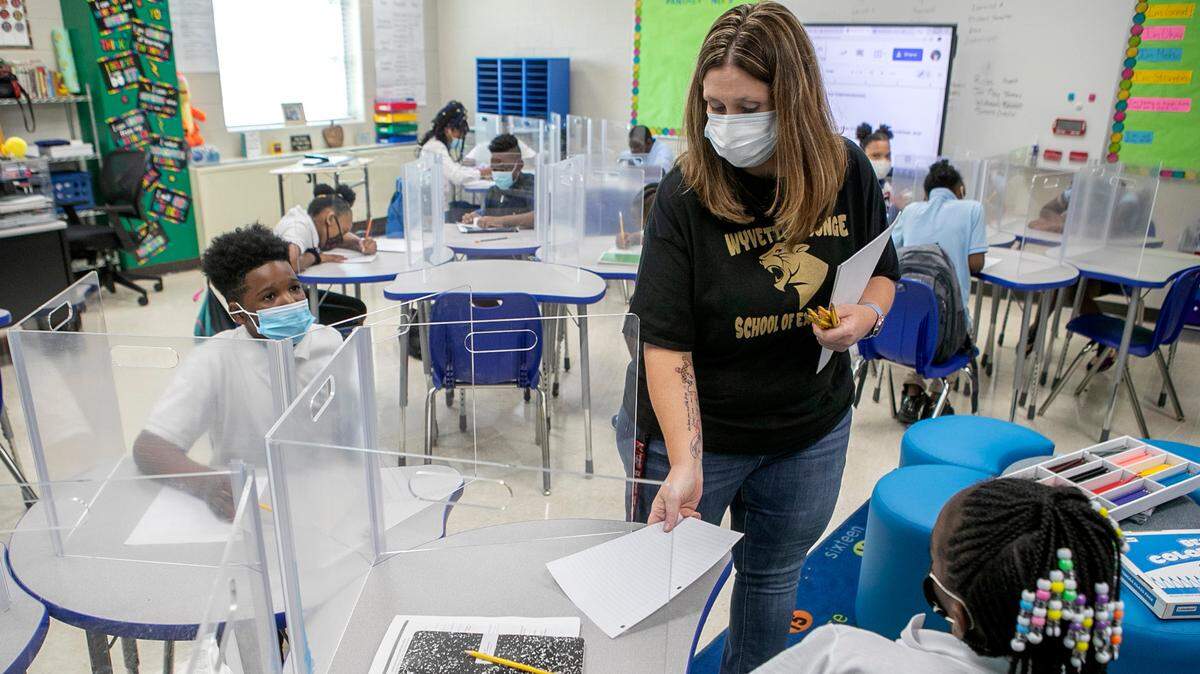
Despite hardships from COVID-19, Illinois grew its teaching force and increased retention rates last school year, according to new state data.
The Illinois State Board of Education released statewide data from the 2020-2021 school year on Friday with the Illinois Report Card. The Report Card covers student and school staff data and provides one of the first high-level looks at how the COVID-19 pandemic affected Illinois public schools.
Illinois added more than 2,000 teachers to its teaching force last school year. At the same time, the retention rate increased to 87.1%, which is the highest its been since the state board started publishing that data in 2014.
“What this tells us is that the teacher shortage is driven in part by school districts having the resources to create more and more teaching positions,” said Brenda Dixon, Chief Research and Evaluation Officer for the state board.
Even while the teacher pool is growing, the number of unfilled teaching positions in Illinois is growing at a faster rate.
The labor shortage isn’t relegated to just teachers.
There were 4,121 unfilled positions this year, including teachers, guidance counselors, paraprofessionals, administrators and other positions in public education. While that’s down slightly from the year prior, there were only 2,007 unfilled positions in 2017.
“We must continue expanding the teacher pipeline in order to meet this demand, but overall, it’s good news that our teacher workforce continues to grow and that our school districts have the financial capacity to hire the staff that students need for a well-rounded and rigorous education,” Dixon said.
In particular, local schools have struggled with substitute teacher and bus driver shortages at various points in the pandemic.
Research shows that students of color perform better when they have teachers of color, and many school districts have said they’re making an effort to diversify their teaching staffs. That has not always been reflected in statewide data, though.
Last school year, Hispanic teachers saw an increase of almost 1 percentage point from the year before, up to comprising 7.9% of the teaching force in Illinois. Black, Asian, Native American and Pacific Islander teachers stayed even from the 2019-2020 school year.
The pupil-to-staff ratio went down across the board from the year before COVID. Elementary pupil to teacher, secondary pupil to teacher, pupil to certified staff and pupil to administrator ratios all decreased last school year.