Mysterious heist of famous portrait solved 70 years later — and the motive was curtains
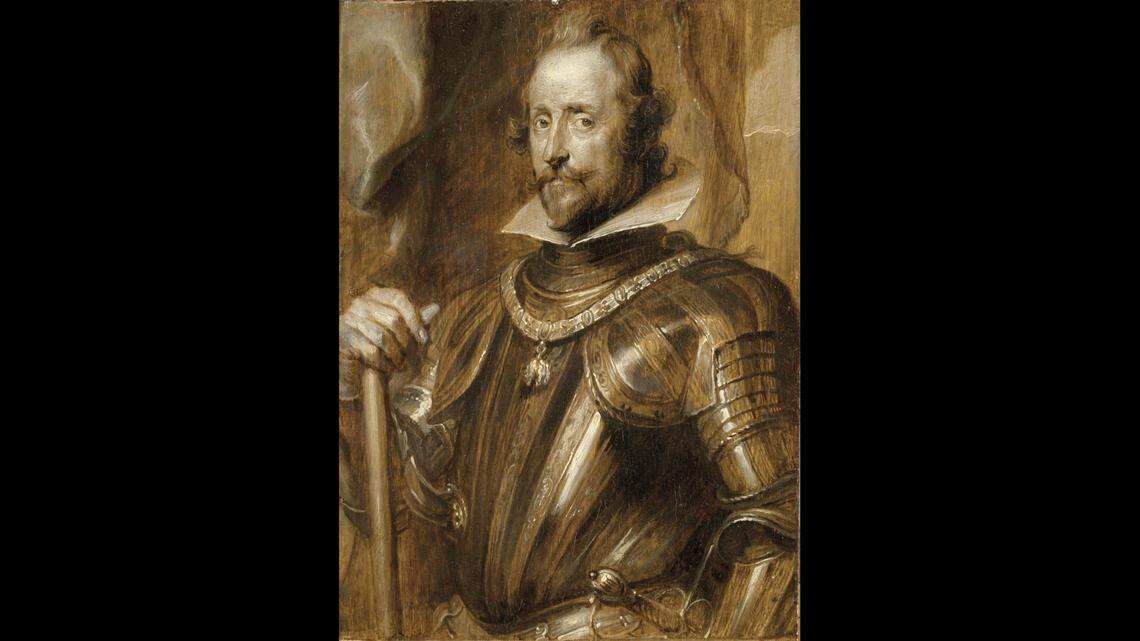
Seventy years ago, an art scholar and trusted member of the art community stole a priceless painting, sold it and used the money to buy curtains, according to new research.
For decades, its authenticity was debated as other experts in the field were accused of participating in the cover-up. Thanks to a review of more than 70 years of communication between the parties involved, it has now been returned to its rightful owners, according to research published by Meredith M. Hale in the British Art Journal.
The oil sketch “Portrait of Wolfgang Wilhelm of Pfalz-Neuburg” by Flemish artist Anthony van Dyck was stolen in 1951 from the Boughton House – the Duke of Buccleuch’s ancestral home filled with an extensive collection of historical artifacts and fine art.
The work was part of van Dyck’s “Iconography series,” a collection of 37 similar portraits that had been intact for nearly 270 years, Hale said. Wilhelm was a high-ranking official who lived from 1578 to 1653.
A familiar painting on display at Harvard
The painting’s disappearance wasn’t noticed until six years later, when Mary Montagu Douglas Scott, Duchess of Buccleuch and Queensberry, made an “extraordinary chance visit” to a Harvard University art gallery and saw the sketch on display, according to Hale.
The Duchess mentioned the striking similarity of the painting she saw at Harvard to the one in her family’s collection, prompting a Boughton House staff member to investigate, Hale said.
“It so happens that ours is missing,” the staff member told the duchess in a memo. “It was here in 1940. I cannot find any reference or evidence that it was lent or sent away for any purpose,” according to an excerpt of a letter shared in Hale’s research.
Sold for curtain money
“I was able to reconstruct the painting’s movements over three generations,” Hale, a senior lecturer in art history and visual culture at the University of Exeter, said in a March 18 news release announcing her research solving the decades-long mystery.
At the heart of the heist was “the audacity of a thief cloaked in the respectability of expertise,” Hale said in the release.
Hale’s year poring over archival records and correspondences revealed van Dyck’s work was swiped from the Boughton House by Leonard Gerald Gwynne Ramsey, the editor of the journal The Connoisseur, and a Fellow of the Society of Antiquaries, according to the release.
His were the first of many hands through which the painting passed over the next 73 years, research shows.
In 1951, Ramsey asked art historian Ludwig Goldscheider to authenticate the painting, telling him he needed to sell it so he could afford to “pay for new curtains” in the house he’d just purchased, according to an excerpt included in Hale’s research.
“The present sketch in oil is the only one known which corresponds with the engraving in van Dyck’s ‘Iconography,’” Goldscheider told Ramsey, research shows.
“The picture is a fine original and in perfect state,” Goldscheider confirmed.
In 1954, Portrait of Duke Wolfgang Wilhelm of Pfalz-Neuburg was sold anonymously at Christie’s in London for 189 pounds.
A year later it was bought by a New York art dealer and sold to a private collector, Dr. Lillian Malcove, for $2,700. Malcove donated the painting to Harvard’s Fogg Art Museum in 1957 where it was noticed by Mary Montagu Douglas Scott.
Expert corroborates false doubt
Professor John Coolidge, art director at the Fogg Museum, tried to establish the origins of the painting after the Duchess raised concerns, going back and forth with Ramsey about where and how he acquired it, Hale said.
Ramsey said he bought the painting from a market, then “attempted to cast doubt on the authenticity of the picture,” according to Hale.
Goldscheider, who had previously provided Ramsey with a certificate of authenticity for the painting and noted only one like it ever existed, corroborated Ramsey’s false doubt, according to Hale’s research.
“I feel sure that it never belonged to the famous set in the collection of the Duke of Buccleuch,” he said in a letter to Sir Alec Martin, the managing director of Christie’s, records show.
“With doubts growing,” the Fogg Museum returned the picture to Malcove in 1960, and when she died in 1981, it was donated to the Art Museum of the University of Toronto where it sat until 2024, Hale said.
Hale’s research confirmed the painting was the same one that disappeared from the Boughton House in 1951 and it was returned to the Duke of Buccleuch in January 2024.
“This is an important case because this was a particularly egregious breach of trust by Ramsey – a trust fundamental to scholars working in this field, and the museums and libraries who hold these priceless objects and artefacts,” Hale said in the release.
This story was originally published March 20, 2025 at 3:31 PM with the headline "Mysterious heist of famous portrait solved 70 years later — and the motive was curtains."