
Pritzker to present 8th budget as Illinois faces federal funding uncertainty
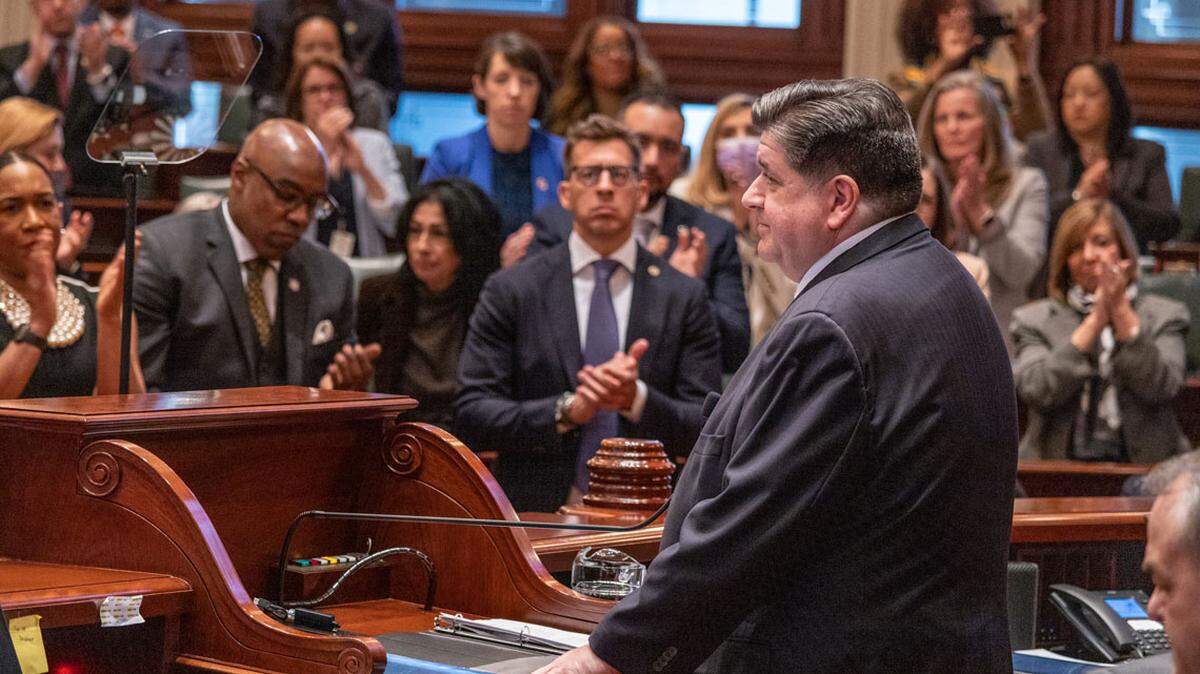
Gov. JB Pritzker will stand in front of the General Assembly on Wednesday in a familiar position: confronting tremendous uncertainty over the state’s financial future.
Pritzker will present his eighth budget as he seeks reelection to a rare third term and becomes a growing national presence as a possible 2028 presidential candidate and one of President Donald Trump’s loudest critics.
The Trump administration has put Illinois and other states whose leaders disagree with his vision in the crosshairs, targeting them for massive cuts to federal funding. In the last two months alone, that has included a $1 billion child care funding cut that’s temporarily been blocked by the courts and $100 million in threatened health care funding cuts.
At the same time, the economy has been shaken by Trump’s tariff policies and Congress passed a sweeping domestic policy bill, known as the One Big Beautiful Bill Act, that will alter the fiscal landscape for states across the country. That measure cuts eligibility for Medicaid and the Supplemental Nutrition Assistance Program, increases administrative costs and reduces what the state can collect in provider taxes.
The ever-changing federal funding landscape presents lawmakers and Pritzker with a murky picture of the future — one that can change as fast as the president can send a social media post or a judge can issue a restraining order.
But the state constitution requires lawmakers to pass a balanced budget, and Pritzker will outline his plan for one on Wednesday. His annual budget address sets up months of negotiations — mostly between supermajority Democrats. They’ll try to balance their desires to fund programs while revenues — both from the feds and the state’s base sources — are projected to flatten at best.
Rep. Kam Buckner, a top House Democrat budget negotiator from Chicago, said one of the goals of this year’s budget will be to play “defense.”
“It’s hard when the biggest variable in the budget is not something that you can control,” he said, referring to federal funding. “And with this president, the volatility isn’t a possibility; it’s a given.”
Pritzker and his team have already started setting expectations for a conservative budget, telling agency leaders in memos and signaling to legislators that it will be difficult for the state to fulfill funding requests this year.
Federal impacts
The Governor’s Office of Management and Budget estimated in October that lawmakers will have to close a $2.2 billion deficit for fiscal year 2027, which begins July 1. Much of that deficit is driven by the state’s own spending exceeding projected revenue. But GOMB projected changes at the federal level are making the problem more challenging and will further exacerbate deficits in the coming years.
In the short-term, Pritzker’s budget office estimates income tax revenue for the state will be lower because of federal tax code changes and some administrative costs for food assistance programs will be required this year.
Most of the impacts of Trump’s big bill won’t be felt until FY28. But that doesn’t mean it won’t factor into this year’s process.
“You can’t ignore what is coming down the road, and so we should expect and work towards a proactive plan for next year’s gap starting now, not after May, because the gap is being driven by forces that won’t wait for the spring,” Buckner said.
Dwindling federal funding is already starting to appear in the state’s balance sheets. The Commission on Government Forecasting and Accountability’s January report shows revenue was 3% lower in January compared to the same month in 2025, largely because of decreased federal funding.
Federal funding to Illinois has declined for three consecutive months, though the commission cautioned there could be a variety of reasons for that, such as the timing of payments. In any case, federal funding was 35% lower this January than last and is now down 8% for the year. Overall revenue for the year is still up 3.5%.
Economic conditions
It’s not just federal funding that presents a challenge for lawmakers — the overall health of the economy does as well. A forecast by Moody’s Analytics released last week set an ominous tone: “Illinois’ economy is in a precarious spot,” and a weak economy ultimately makes it difficult for revenue to naturally grow.
“Potential budget shortfalls in Illinois and the city of Chicago mean lawmakers may need to consider a mix of revenue enhancements and spending adjustments, measures that could ultimately stifle consumer spending,” the report said.
The forecast predicts employment will not grow or decline, and the economy will grow at a slower rate than other states because of outmigration, a shrinking tax base, and a massive long-term pension liability. Additionally, tariffs are hurting the state’s manufacturers, and rural areas are suffering from both tariffs and higher farming costs.
“Illinois has a lot at stake, given its reliance on manufacturing and logistics and its above-average exposure to foreign trade,” the report said.
Moody’s said the results of Trump’s big bill will be mixed by region, but the overall impact of the policy will be negative because it weakened social services.
More broadly, Moody’s notes an artificial intelligence bubble in the stock market could burst and trigger a recession.
Health care costs to balloon
Lawmakers could also consider taking proactive steps to absorb new health care costs and cuts set to take effect in the coming years.
Under a provision in Trump’s big bill — one that applies only to states like Illinois that expanded Medicaid eligibility under the Affordable Care Act — a 6% cap on the tax Illinois can charge health care providers will gradually be cut starting in FY28 until it reaches 3.5% in FY32.