
From flu and rainouts, Marmol has an eventful first week as St. Louis Cardinals manager
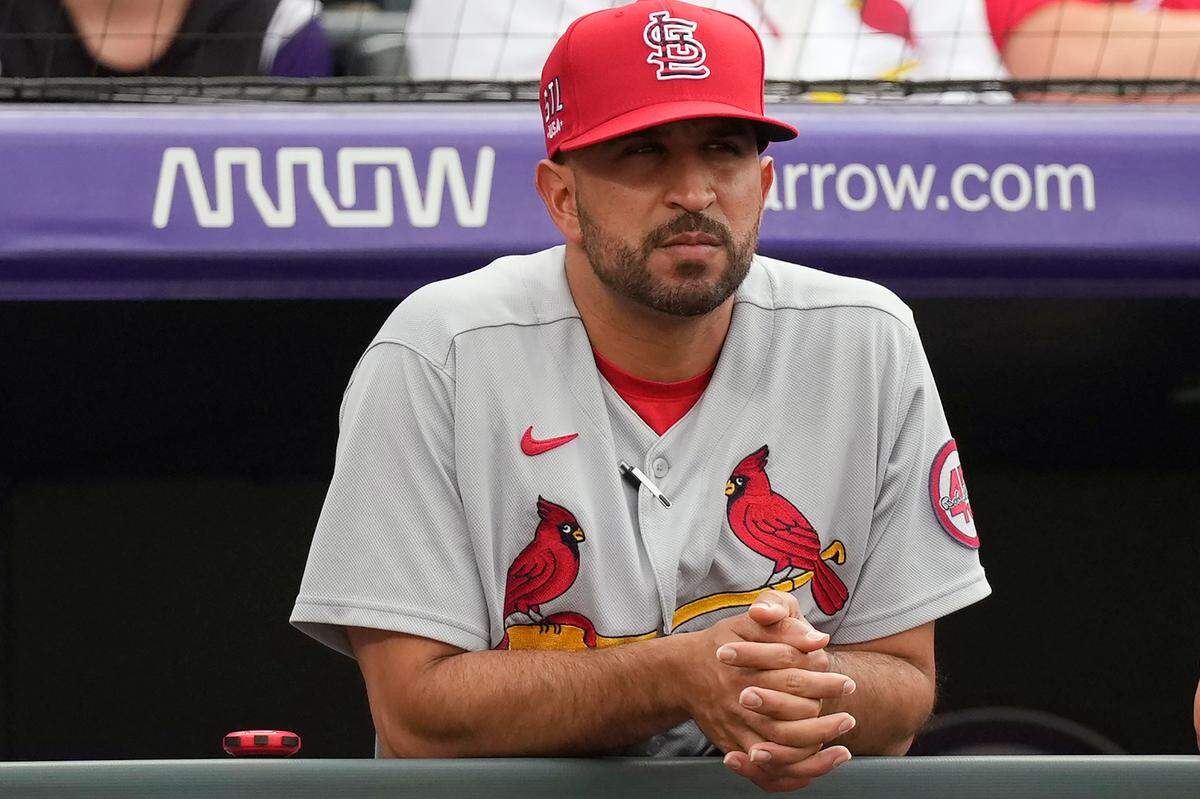
The first week of his first season as manager of the St. Louis Cardinals didn’t go exactly as Oli Marmol had imagined.
In that time, his team played two games with him in the dugout, played two more games with him sick at home with the flu, and had two games rained out on top of a scheduled off day. As a result, the starting rotation has moved and shifted, at least one reliever and two bench players have been stuck in dry dock, and the regular rhythm of the season hasn’t quite been established.
Still, there’s been enough time to learn a great deal about the decisions Marmol is likely to make as manager.
With Paul DeJong thus far validating the decision the organization made in spring to name him the established starter at shortstop, eight of the positions in the Cardinals’ everyday lineup will be largely static. The spot open for discussion each day is at designated hitter, where Corey Dickerson and Albert Pujols form the rough outlines of a platoon.
Rough, but not complete.
Pujols, after all, started on opening day against Pittsburgh righty JT Brubaker. But he was also in the lineup Thursday against Milwaukee fireballer Brandon Woodruff, a decision that Marmol summed up by saying, “we want to see what he looks like against Woodruff.”
The decision, though, is hardly that simple. The concept of seeing what a player looks like in a given situation is as old school baseball as decisions get, but doing so early in the season with a rejuvenated Pujols who is as healthy as he’s been in many years has its merits. And given that Dickerson still appears to be rounding into form, the gamble that Pujols could build on a three-hit game that included a homer was one that was understandable in its undertaking.
“When you look at the algorithmic suggestions of matchups or moves, it’ll give you a pretty good idea of what the outcome should be over time,” Marmol said Thursday from his office at American Family Field. “But then you also start to look at ... kind of how it matches up against his style of fastball and changeup. Is it within the path where he usually has success? And then, is there a better matchup there?”
‘You look at the videos’
Marmol’s example of those kinds of matchups was Cardinals reliever Nick Wittgren and Kansas City right fielder Whit Merrifield. Merrifield faced Wittgren in the seventh inning of Tuesday’s game and walked, the first time he’d reached base against the righty after previously having been 0-for-12.
“Well, you look at the videos,” Marmol explained, “three of them are caught on the track. Two of them are live drives to short, right? So you’re sitting there going, we like the Wittgren matchup.
“Do you? Like, it’s 12 at bats. How meaningful are they? Because a little better placement, he’s 5-for-12 with three doubles. How do you feel about that matchup?”
The blending of old and new school tools — here’s what the algorithm says, and here’s how it looks — touches on all aspects of the game. Marmol described an atypical defensive shift against Pittsburgh’s Yoshi Tsutsugo by explaining that his numbers, over time, generated an algorithmic prediction for how he is likely to hit with two strikes.
Pairing with that, coaches including first base coach Stubby Clapp examined video to determine what would cause those effects, including how a hitter held a bat and how he might swing more cautiously to cover more of the strike zone.
More on Marmol’s managing
It’s those same precise measurements paired with gut feelings that have also determined, in part, the club’s bullpen usage in the early going. The same seventh inning which saw Merrifield matched up with Wittgren included the Royals putting the tying runs on base, creating the highest leverage spot of the game.
In spring, Marmol preached he wouldn’t be beholden to typical management practice which could see a team’s best reliever held for save situations at the end of a game. His best relievers, he said, would be in the spots where they were needed most, and by his estimation, the success of the team would make asking for additional buy in unnecessary.
When Kodi Whitley started to warm up behind Wittgren rather than Gallegos, it was telling that Marmol had a precise and specific rationale at the ready.
“I liked Whitley’s ability to run the fastball up top,” he explained. “With his vertical movement he could run it up there 20 inches, 22 inches. I liked that combo with the changeup for where we were in the lineup.”
Accepting the slings and arrows
Wittgren escaped the jam and a move to the bullpen wasn’t necessary. A day later, without notes in his hands and without ever bringing Whitley into that ballgame, the manager still knew precisely why he felt the move he would have made but didn’t would’ve been, in his eyes, the correct one.
Part of managing a Major League team is accepting the slings and arrows of first, second and third guesses, even with an incomplete set of information possessed by those flinging. And Marmol, like everyone else who commands a dugout, will make mistakes and have a gut feeling go south.
His willingness to blend his decision process and spell it out frankly, though, portends more good outcomes than bad. And the ease with which his explanations are offered has made it clear why the Cardinals felt he was more than prepared to lead his team — weather permitting, of course.