Four pitchers fighting to establish their futures with the St. Louis Cardinals
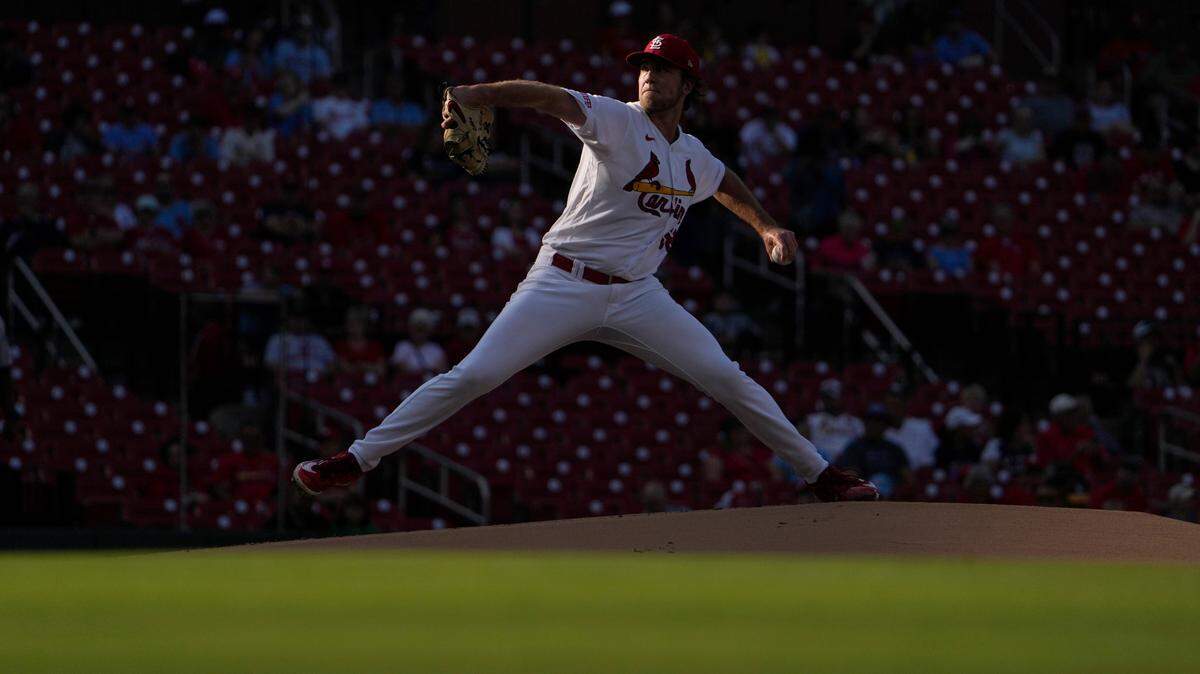
Three starters is the minimum bar, and anything less is a failure by definition. Those are the terms established by the Cardinals for themselves, and that is the standard to which they have to be held.
The 2023 season, St. Louis’s first without a winning record since 2007, was orchestrated and scripted by a front office led by John Mozeliak and its calamity lands squarely upstairs. Arriving at an obvious conclusion clearly too late, Mozeliak and his lieutenants have pledged an increase in arms over the winter as a necessary component in avoiding two consecutive wasted years.
In the meantime, as the string is played out, four pitchers have gotten their shot to assert themselves as part of that mix. None has, or will, firmly lock down a spot. Each has taken steps to clarify their place and provide the Cardinals with the necessary data to determine the extent to which they can be trusted to get outs.
Dakota Hudson
As the season approached its midpoint, Hudson seemingly had no place at all. Pitching poorly for Triple-A Memphis, the sinkerballing righty didn’t make his first appearance in the big leagues until a doubleheader pressed him into duty on July 1 and didn’t make his first start until July 19.
Assuming a spot in the rotation after Jack Flaherty and Jordan Montgomery were traded at the deadline, Hudson got off to a solid start but has since regressed. His six wins look like an outlier next to an earned run average over five and a walks plus hits per innings pitched rate of 1.439, worse than his career mark of 1.377.
Hudson simply walks too many hitters and doesn’t generate nearly enough strikeouts to get himself out of sticky spots. Though he’ll enter 2024 with minor league options remaining and will come in just short of the necessary service time to block a demotion, it’s difficult to see how he fits in the team’s plans moving forward.
Heading into his third year of arbitration, Hudson would likely be in line for a salary of at least $3 million. Unless he comes to an agreement with the team well below that number and comfortable with the likelihood of again spending large chunks of 2024 in the minors, he’s a strong candidate not to be tendered a contract this winter and allowed to pursue free agency.
Matt Liberatore
The runway was clear for Liberatore to demonstrate his best skills consistently and carve out an unquestioned future as a Major League starter, but a weight room mishap tossed him on the injured list for several weeks and tossed him from the rotation upon his return.
His August 10 start in Tampa Bay, against the team which drafted and played a major role in developing him, is perhaps the high water performance mark for any Cardinals starter this season. He simply hasn’t been able to repeat that performance over stretches longer than a few innings at a time, and without that reliability, he can’t establish himself in the way that’s necessary.
Since returning from the injured list, the Cardinals have opted to deploy Liberatore as a short burst, high leverage reliever. Part of that is born from need, but part is an attempt to see if the shorter outings allow him to access his best stuff in focused bursts. If so, perhaps that simplification will make him into a bullpen weapon.
Liberatore is likely to enter 2024 in much the same way Hudson entered 2023 – he will have chances, but the clock will be ticking loudly, and the Cardinals won’t be counting on much from him as a starter. Should he become a valuable reliever, the calculus changes.
Drew Rom
Acquired from Baltimore at the deadline in the Flaherty deal, Rom made his major league debut with the Cardinals as a fill-in following Liberatore’s injury. In two impressive starts for Memphis, he struck out 18 in 11 innings; with the Cardinals, he nearly reversed those numbers, striking out 11 in 17 ⅓ innings. Only once in the majors has he completed the fifth, tossing 5.1 innings against the Phillies in a hard luck 3-0 loss on August 27.
Rom is much newer to the organization than the other three and much less experienced, and as such, he’ll be evaluated with a lot more leeway. In a perfect world for the Cardinals, he would be quietly toiling in the minors, being evaluated and shaped in a way the team thinks will suit him.
Expect him to be a major part of next year’s Memphis rotation. There seems to be little he’s done or could do in what’s left of the season to make any firm pronouncements.
Zack Thompson
It’s rare that a pitcher would be much better in the big leagues than he’s been in the minors, especially so when he opens the season as a team’s top leverage lefty reliever and closes it as perhaps their most reliable starter. And yet Thompson has neatly pulled off such a feat, perhaps reclaiming from Liberatore his status as the starter closest to the big leagues and in possession of a high ceiling.
In seven appearances (six starts) since the deadline, Thompson has 38 strikeouts and just 10 walks in 34 innings, posting a 3.71 ERA that slightly underperforms his fielding independent pitching mark of 3.53.
The 2023 Cardinals were felled by a lack of depth, and Thompson provides it. There’s no need to use him to supplant any of the three desired outside additions, but his emergence could allow the Cardinals to be more comfortable with a higher risk depth addition, or perhaps someone with whom he would compete directly for a spot – or, perhaps, could leave Steven Matz vulnerable to such a competition.
In a year where finding bright spots in St. Louis requires a great deal of squinting, Thompson has shined. Expect him to have the chance to do so again next season.