Cardinals’ Contreras hears snickers about playing first base and ‘I don’t give a (flip).’
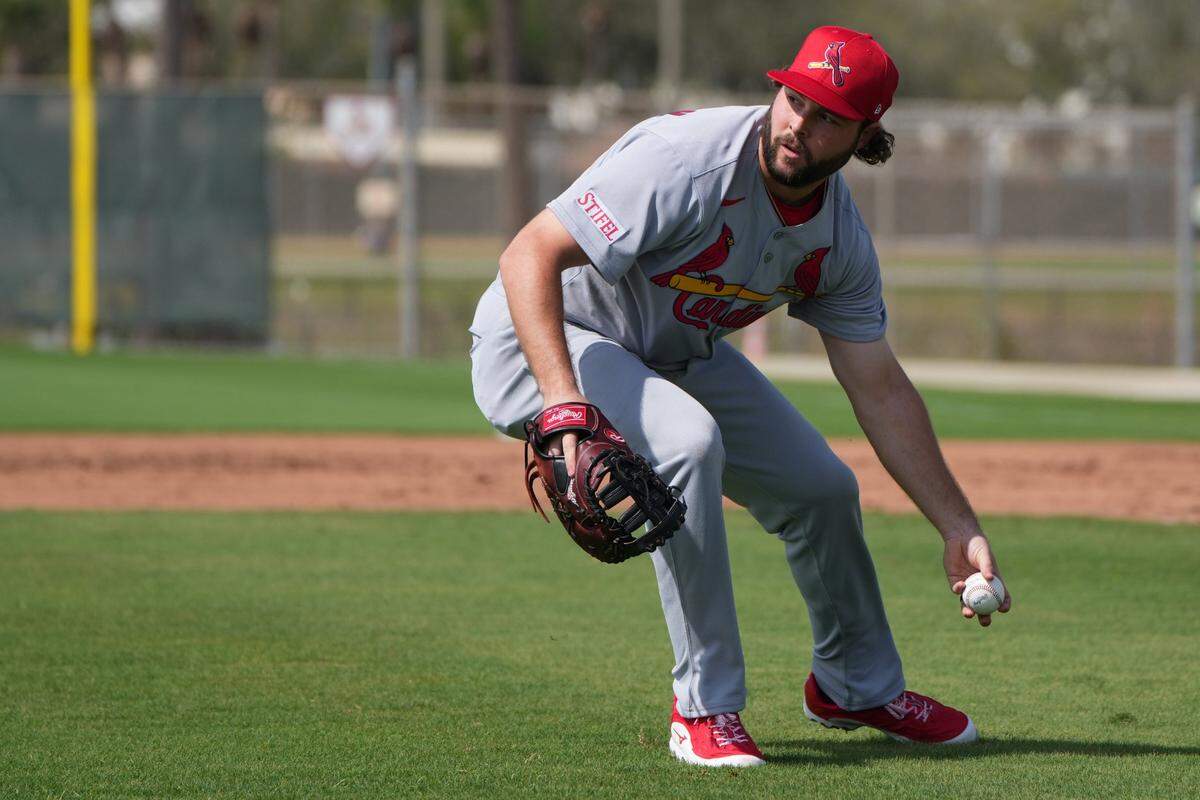
As St. Louis Cardinals coaches Stubby Clapp and Daniel Descalso drove ground balls around the horn for infield practice on Tuesday, Alec Burleson and Willson Contreras agreed to a friendly stipulation to raise their stakes.
Every misplayed grounder would result in five pushups, face down in the infield dirt.
Burleson owed and delivered one set. Contreras kept his uniform front clean. It’s a good start at a new spot.
“I feel relaxed, I feel confident,” Contreras said after the team’s workout. “I’m just trying to enjoy the process more than anything.”
The team approached him near the end of last season, as they did with their other established veterans on long-term contracts, to inquire whether he would prefer to be traded than to stick around for a change in organizational direction. Contreras wanted to stay, and to take it a step further, was willing to shift from behind the plate to first base, taking over as the starter at that spot from the departed Paul Goldschmidt.
The change was immediate, and its ripples significant.
Contreras reported to camp weighing 245 pounds, having added, in his estimation, 12 pounds of muscle to his upper body over the winter. As a catcher, he placed a premium on flexibility and agility, preferring to keep himself in the range of 230 pounds while knowing he would lose weight as the season unfolded.
Now? Grip it and rip it, both the barbells and the bats.
“He’s been working hard at it,” manager Oli Marmol said of Contreras’s transition. “You see him first thing in the morning, he eats something, and he’s already on the turf field with Stubby [Clapp] and Cheo [Oquendo] and the guys.”
Clapp, the team’s primary infield coach as well as first base coach, echoed the sentiments of many others around camp in discussing the most challenging part of the switch – it’s all in the feet.
“There’s a lot more that goes on at first base than you realize,” Clapp said. “When you anchor first base down, it anchors everybody else down, and you have the confidence to be able to throw the ball across the infield.
“I think you’ll see that his feet play over at first base. He moves well. We’ve just to make sure that we get him calmed down and make sure that we’re not trying to go too fast. And help him realize, like, how close he really is to first base, and identifying the speed of the ball hit and stuff like that, and not to panic and be able to do stuff like that.”
Luken Baker, who has played more than 4,000 innings at first base as a professional, said that “everything starts from the ground up” for a first baseman.
“Before I started playing first base, I thought it was, you just stick the guy over there that can hurt you the least,” Baker explained. “But the more that I played over there, there’s a lot of little things in the footwork and how you’re setting up reactions. You’re at a hot corner too. It’s not just third base, right?”
Burleson, who figures to be Contreras’s primary backup, echoed Baker’s sentiments nearly word for word.
“It’s the hot corner, just on the other side of the diamond,” Burleson said. “It’s not as easy as it sounds. Yeah, your main job is to catch the ball. But [the infielders] making tough plays and stuff, they don’t have good grips on the ball. You’ve got to be able to read that. You’ve got to make some picks and stuff. Without a first baseman, I mean, you don’t really have baseball.”
Contreras is well aware of the necessary work, and was vehement in his desire to tune out exterior skepticism.
“Having confidence, being confident, is a huge key for me right now,” he said. “I feel the same way I did last year. I feel good about it. Feel confident that I’m gonna have a good season.
“I’ve seen [people] say [things] about my defense at first base, or this and that, but people are gonna say whatever they’re gonna say. I don’t give a [flip]. I’m the one here doing my work, putting in my stuff, and I know what I’m able to do.”
Another thing Contreras is able to do, freed from behind the plate, is dream about what could happen for him over a full season. His 138 games played in 2018 were a career high, and that was also the only year in which he put up more than 500 plate appearances. Catching takes a toll on the body that modern managers seek to avoid through prescribed rest, and between those plans and the wear and tear of injuries, it remains to be seen what his bat might deliver if he’s able to climb north of 150 games or 600 plate appearances.
Asked if he had a home run total in mind for his inaugural season out of shin pads, Contreras smirked and relayed a conversation he recently had with his brother, William, the catcher for the Milwaukee Brewers.
“I said, ‘I’m gonna hit 62 [homers] this year,’” Contreras relayed. “He was like, ‘whoaaa.’ It was just a joke. I don’t have any numbers in mind. Whatever comes to me, I’ll take it. But the one thing I have for sure in my mind is to just play hard, be a good guy in the clubhouse, and pick each other up.”
And so he did on Tuesday, with he and Burleson egging each other on to make increasingly difficult stops with the threat of calisthenics looming in the background. He didn’t have to get down in the dirt himself, though, which already looks a great deal different from years past.