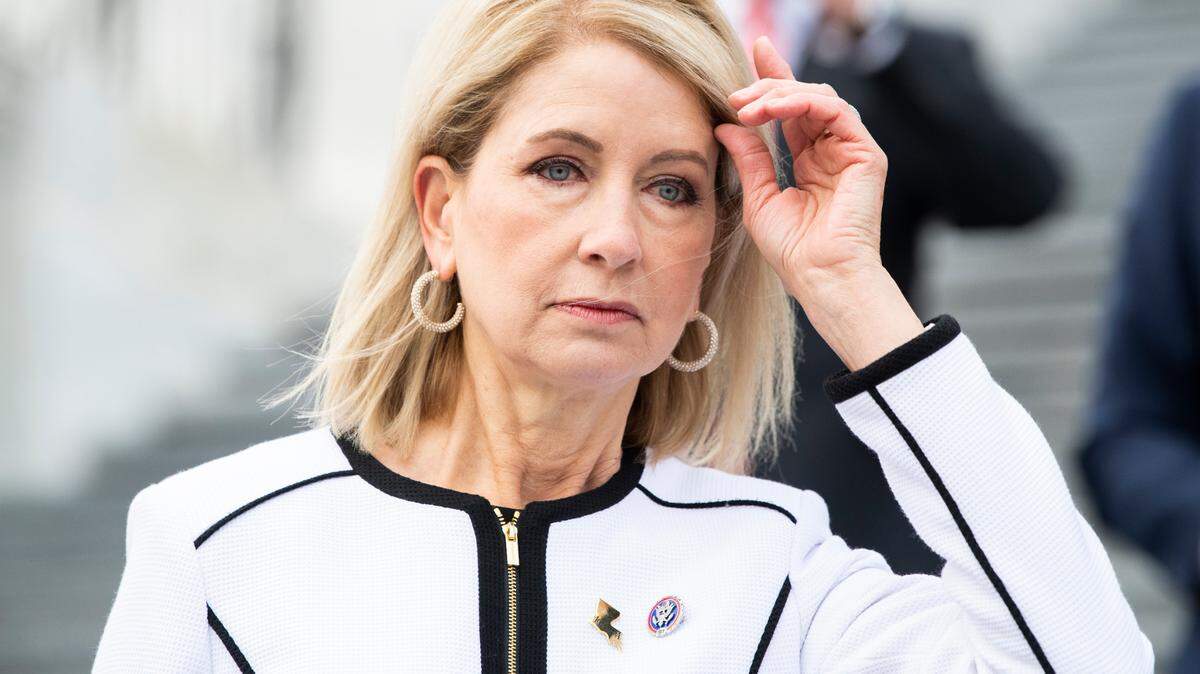
Mary Miller is known as the IL congresswoman who cited Hitler. Can she overcome it?
READ MORE
More coverage of US Rep. Mary Miller
Read more stories about Illinois 15th Congressional District Rep. Mary Miller
Expand All
Before she cited Adolf Hitler in a speech at the U.S. Capitol on Jan. 5, few people outside of Illinois, or the 15th Congressional District for that matter, paid much attention to Mary Miller.
She later apologized for saying Hitler was right when he talked about the importance of youth, and said her comments were taken out of context. But it was too late. Suddenly, the 61-year-old House Republican freshman, a farmer, mother of seven and grandmother of 17, had everyone’s attention, and for the wrong reasons.
Like the QAnon conspiracy theorist Republican Marjorie Taylor Greene from Georgia or Lauren Boebert of Colorado, who claimed she would bring a handgun to Capitol Hill, Miller, from rural Oakland, Illinois, became a spectacle and a target — the Congresswoman who quoted Hitler.
The blaze of heat from both parties consumed Miller’s first days representing the 15th, nothing like her smooth glide to election last November.
Her devotion to former President Donald Trump won her campaign money, powerful political allies and the votes she needed to beat her Democratic opponent with more than 73% of the vote in the conservative rural district.
But Trump is in Mar-a-Lago, and Miller faces at least two years in the House minority under a Democratic president. She will have to regain the respect of 15th District constituents who lost faith in her after the Hitler comment, said Jim Zeeb, a farmer from rural Bond County who worked with Miller’s campaign.
“I think at heart she is a very good human being and I think she made some rookie mistakes of profound proportions,” Zeeb said. “I think she’s humble enough that she’ll land on her feet and become a wiser person, but I think Mary is going to have to moderate her ideology a little bit.”
Yet it was Miller’s ardent Trumpism that helped send her to Congress. With the former president’s future in flux, at least for the moment, her identity as a Trump loyalist may not carry the same weight should she choose to run again.
Miller declined an interview for this story.
For those who already prefer to look at Trump through their rear-view-mirrors, there’s no salvaging Miller.
“The idea a member of our United States Congress would even think — let alone express — this mass-murdering xenophobic racist’s ideas is beyond demoralizing,” said Erika Weaver, the Democratic nominee who lost to Miller. “It is appalling and even this word is not strong enough to truly express how repulsive her words and actions were.”
Who is Mary Miller?
Miller was born Mary Meyer in the Chicago suburb of Oak Park in 1959 to Harvey and Annette Meyer, from whom Miller says she learned the “value of hard work and putting other people first.” Her father worked in management for Kmart for more than 40 years and was married to Annette for more than 60 before he died in September. They had four children together, according to Harvey Meyer’s obituary.
Miller graduated from Naperville Central High School in 1977 and by 1981 had completed her bachelor’s degree in business management from Eastern Illinois University. She married her husband, Illinois state Rep. Chris Miller, in 1980.
After graduating from Eastern, Miller went to work in administration at Sarah Bush Lincoln Health Center, a regional hospital in Mattoon, but later decided to go back to her family’s cattle and grain farm to work with her husband and homeschool her children, said Zeeb, who got to know the Millers over meals and campaign events.
By the late 80s, she was back at Eastern studying education and obtained a teaching certificate.
Miller’s dedication to farming and family made an impression on Zeeb, who was interested in finding a candidate he could support to replace retired U.S. Rep. John Shimkus.
“They were just a wonderful people, very personable, well-spoken, handled themselves well, polished, successful,” said Zeeb, who identifies as a moderate Republican worried about Democratic farming and business policies.
Formerly a Democrat, Zeeb is an example of the vanishing breed of Illinois centrists who admire former U.S. Rep. Paul Simon, a Democrat known for his bipartisan work as lieutenant governor under Republican Gov. Richard Ogilvie. Former U.S. Rep. Jerry Costello, a moderate from East St. Louis, was also Zeeb’s type of Democrat.
But as he watched far-left members of Congress such as Bernie Sanders and Alexandria Ocasio-Cortez gain influence, he felt more comfortable with Republican candidates. He saw an ad for Miller while perusing a local news site, and decided to look into her.
“All the candidates seemed like capable people, but Mary struck me because she was a farm wife, a mother of seven, she and her husband Chris ran a grain farm and a cattle herd,” Zeeb said.
The more time he spent with her campaign, however, the more it seemed that her message aligned too closely with Trump’s partisan rhetoric. Zeeb finally cut ties with the campaign after finding Miller’s politics didn’t address how Trump’s retaliatory tariffs on China hurt American farmers by cutting billions of dollars in exports.
“One thing that began to distance me from Mary’s camp was the fact that they seemed to be entirely wrapped up in Trump ideology,” Zeeb said.
Trump was the ultimate North Star for both Millers.
As the elder Miller sons became more involved in operating the farm, Chris Miller decided to run for the state 110th House District in 2017. He told The (Champaign) News-Gazette he had been “complaining for a long time.” At a pro-Trump “Save America” rally where the former president spoke prior to the Capitol riot, Miller said the United States is in “a culture war.”
“We’re engaged in a great culture war to see which world view will survive, whether we will remain a free people under free market capitalism or whether they will put us into the tyranny of socialism, communism and dangerous Democrat terrorists that are trying to destroy our country,” Chris Miller said.
Language from the “radical left” and “talk of socialism and remaking America to look like Venezuela” prompted his wife to get into politics as well, Miller told the East Central Reporter, a partisan website that’s part of a network funded by conservative political groups.

“She wants to come along and work side by side with President Trump to keep the tax cuts permanent, build the wall and be part of the overall solution,” he told a representative of the website.
By 2019, the 66-year-old farmer had alienated state Republican leaders for vocally criticizing members of his own party. House GOP Leader Jim Durkin took away Chris Miller’s state-funded communications staffer after he attacked fellow Republicans on social media, calling them “rinos,” or “Republicans in name only,” the daily political newsletter Capitol Fax reported at the time.
Mary Miller said she also prioritizes conservatism over party.
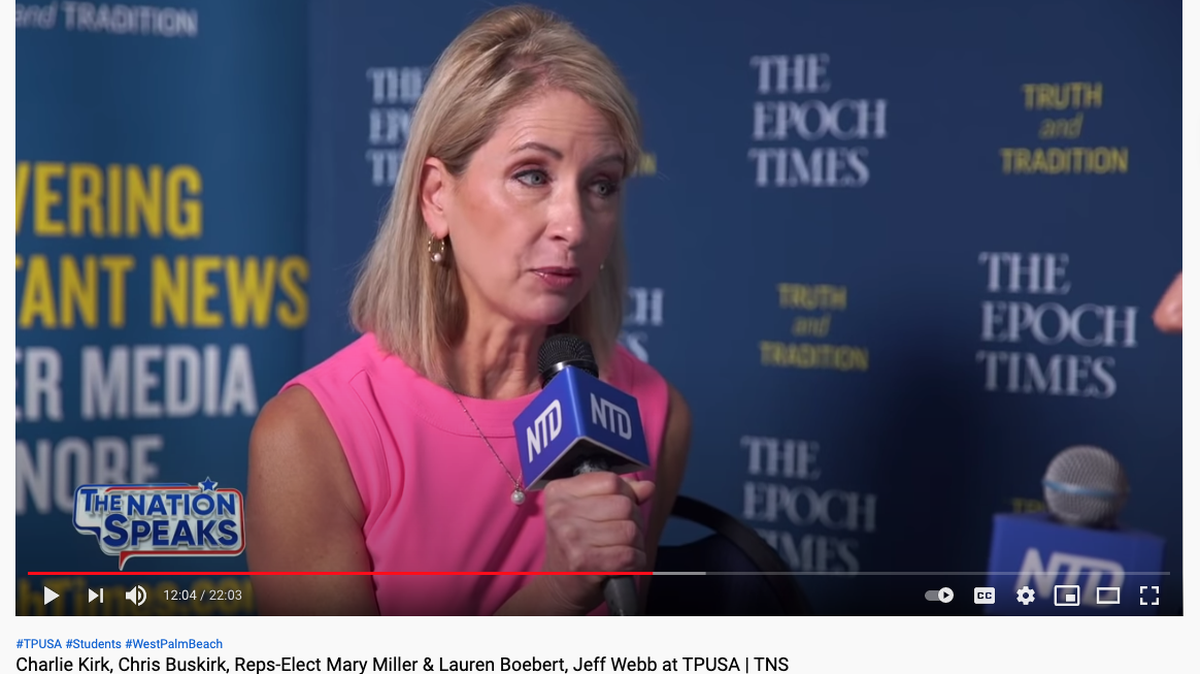
“I am committed to the conservative platform even more than to the Republican Party,” Miller recently told The Epoch Times, a far-right media organization founded by supporters of a Chinese spiritual movement that some consider a cult called Falun Gong.
Similar to her husband, Miller’s entry into politics started with encouragement from a fellow Republican. The difference was that her advocate had powerful political friends with ties to Trump’s inner circle.
Miller’s path to Congress
William Montgomery, an entrepreneur from Peoria who later lived in Lemont, was active in Illinois politics and liked to scout out new talent for the conservative movement.
Montgomery “discovered” Charlie Kirk, a conservative youth activist, and in 2012 they co-founded the pro-Trump campus activism group Turning Point USA. Kirk went on to form close ties to the Trump family and Trump’s eldest son, Donald Trump Jr. after meeting him at the Republican National Convention in 2016.
It was Montgomery, a COVID-19 denier who died of the virus last summer, who convinced Miller to run, as she tells it.
“Bill Montgomery, who was instrumental in getting Turning Point USA started, said, ‘Mary, we need you to represent the family,’” the congresswoman said at the speech in Washington, D.C where she paraphrased Hitler.
“(Montgomery) had a knack for spotting people he felt had unique qualities,” Chicago crime blogger Vic Maggio said in a video memorializing Montgomery’s life. “ … Bill had a couple of heartfelt projects. One was to get Charlie elected president of the United States one day, and the other was to turn Illinois red.”
How Miller initially met Montgomery wasn’t clear, but following his death she tweeted he was a mentor to one of Miller’s daughters.
If turning Illinois red was Montgomery’s goal, Miller certainly fit the bill to replace Shimkus, an opponent of some Trump policies. Shimkus’ successor said she was “part of a group looking for a conservative to fill his seat” when Montgomery urged her to run, Miller told The Epoch Times.
Money from conservative PACs flowed into Miller’s campaign once she decided to run for the 15th following Shimkus’ retirement announcement in August 2019. Before Illinois’ March 2020 primary, where she faced three other Republican candidates, she received 14 times what the runner-up received from PACs.
Trump and other powerful figures such as U.S. Sen. Ted Cruz endorsed her, and she collected more than $435,000 from 340 individuals donors, only half of them from Illinois.
“It’s the money that has driven all this,” said Dr. Chuck Ellington, a family physician from Camargo who lost to Miller in the primary. “I always knew money was important, but I didn’t know it was the only thing.”
Miller’s top donor was the House Freedom Fund, a PAC that supports far-right House candidates to compete with establishment Republicans. It donated $132,645 to Miller’s campaign. PACs associated with Cruz and GOP U.S. Reps. Darin LaHood and Rodney Davis of Illinois, Steve Scalise of Louisiana and Kevin McCarthy of California also contributed generously.
“With her husband being a state rep., being connected to that has been a huge benefit,” Ellington said. “I think that’s what it was. From the beginning, they knew who they wanted. It was going to be her. That’s just where they gave the money.”
Prior to Trump’s efforts to cast doubt on the outcome of the 2020 — and before a pro-Trump mob broke into the U.S. Capitol building — the former president enjoyed virtually rock-solid support from congressional Republicans. But after the violence on Capitol Hill in January, some more moderate GOP members began tip-toeing away.
It’s unclear how Trump creations such as Miller will establish their own identities.
“That’s going to be a challenge for her,” Ellington said. “She was so closely connected and identified with President Trump, I certainly hope that she’s able to sort of forge her own identity and her own vision for the district.”
Future of Trump-inspired candidates
Beyond occasional tweets sharing prepared statements and interviews with friendly niche right-wing news outlets, Miller has remained relatively quiet since her Hitler comment.
Miller was assigned to the House Education and Labor Committee and the House Agriculture Committee, where she hopes to work on farming issues critical to the 15th District and on investment in internet infrastructure, Miller said in a prepared statement.
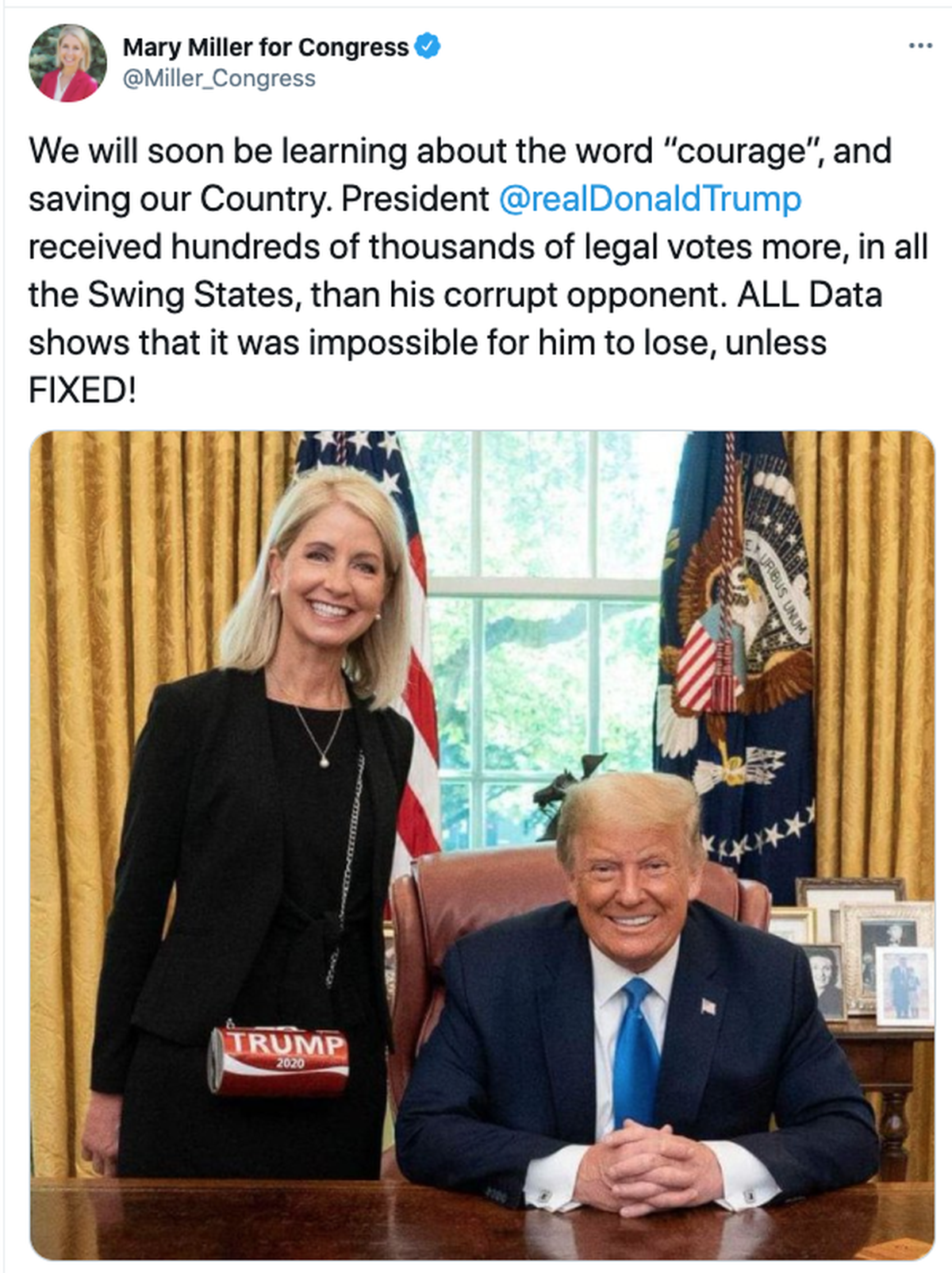
Her office staff consists of mostly political newcomers. Her chief of staff, Cari Kelly Fike, is the most experienced, having worked for six years under U.S. Rep. Gary Palmer from Alabama. Miller faced trouble with staff back home when her Danville office director resigned following Miller’s decision to paraphrase Hitler.
“Congresswoman Miller’s comments are unfortunate and serious,” Will Nesbitt said. “They do not belong in our political discourse and they do not represent my beliefs and values. And, for that reason, I resigned.”
Nesbitt declined further comment.
Despite the Hitler incident, Ellington, Miller’s primary challenger, believes she can earn a reputation as someone who cares about farming, rural health care and restarting the economy amid COVID-19. Ellington met Miller during the campaign, and says his wife, who is from Oakland, knows her personally.
“I think she’s a very lovely person. I think she’s a very good mom and a good grandmother with strong rural roots and midwestern values,” Ellington said. “I think she’s a good fit for the 15th. She probably represents how the 15th District thinks.”
Illinois’ disappearing congressional district
The Hitler problem isn’t the only one that threatens to make Miller a one-term congresswoman.
Eastern Illinois’ congressional district tends to shapeshift with each U.S. Census. New boundaries could force her to jump into another district if she decides to run again.
Eastern and Southern Illinois have seen some of the biggest population losses over the past 20 years. It lost the 20th District after the 2000 Census and the 19th a decade later. Shimkus hopscotched from the 20th to the 19th and then to the 15th in 2013, but announced his retirement before his district faced redrawing once again.
The 15th District’s population dropped to about 690,000 from 2013 to 2018, according to Census data. A congressional district should have roughly 710,000 residents.
With Democrats possibly controlling redistricting, eastern Illinois’ congressional district could shift to cut the number of southernmost GOP-controlled House seats from three to two or even one.
Republican U.S. Reps. Rodney Davis represents the 13th District and Mike Bost represents the 12th. If the 15th is redrawn, it could set Miller up to face Davis or Bost, depending on how and if the district is redrawn.
Though their margins weren’t as wide as Miller’s in November, both congressmen enjoy solid name recognition and popularity with their conservative constituencies. Bost in 2020 won a fourth term with 60.4% of the vote and Davis a fifth term with 54.5%.
There are a number of possible arrangements that could eliminate two seats. Democrats could decide to redraw the 13th District to include East St. Louis, possibly overcoming the margins needed to elect a Democrat. That would leave the 12th in Republican control, but eliminate two Republican seats.
The Census Bureau is verifying the results of the 2020 count, but they could be delayed because of the pandemic. The bureau would normally send redistricting counts to states by the beginning of April, but a bureau spokeswoman said states shouldn’t expect numbers before July 30. States will use the information to redraw legislative districts based on population changes.
“The 15th District is going to look, if it even exists, is going to look very different,” Ellington said. “If Mary gets put in with Mike Bost or someone else, it’s not going to be as easy (as in 2020).”
This story was originally published January 28, 2021 at 5:00 AM with the headline "Mary Miller is known as the IL congresswoman who cited Hitler. Can she overcome it?."