
Every Catholic Church in the metro-east holds part of a saint. Why?
American author Raymond Carver once said, “There are cathedrals everywhere, for those with eyes to see,” and in the metro-east, that is certainly true.
But did you know that in most of these cathedrals, body parts of dead saints are kept and preserved?
"Relics," as they’re called in the Catholic Church, are body parts or personal items belonging to canonized Christians, or materials they interacted with. These are classified as first, second, and third class, respectively, and each is kept inside holy places such as churches and cathedrals.
Some relics are displayed in reliquaries, while others are placed elsewhere. In some cases, relics are displayed for the entire congregation; in others, they are buried or encased in concrete.
The Rev. John Myler, a retired priest who was ordained in the Diocese of Belleville in 1982, said the veneration of relics began before the widespread establishment of the church.
“Relics start with the early church,” Myler said. “Remember that early Christians were persecuted, and to worship they would gather wherever they could. That often meant they would worship on the tombs of the early martyrs.”
Many of those early martyrs are still on display, such as Saint Peter’s entire skeleton, which is enclosed in a case of concrete within the Vatican. As the church has grown over the centuries, many reliquaries now hold later martyrs or tiny fragments of early saints.
“We’re talking a finger bone or a lock of hair in many cases,” Myler said.
Myler said the holding of saints in altars isn’t "worship," but veneration. The significant difference is that, while God is worshiped in the Catholic Church, saints are honored more in the manner of deceased loved ones.
Just as communion pays homage to the physical body of Christ, keeping the bones of saints serves as a remembrance of the power of God made manifest, he added.
“It’s more that we’re committed to the tradition to offering communion to the savior with the bodies of the saints,” Myler said.
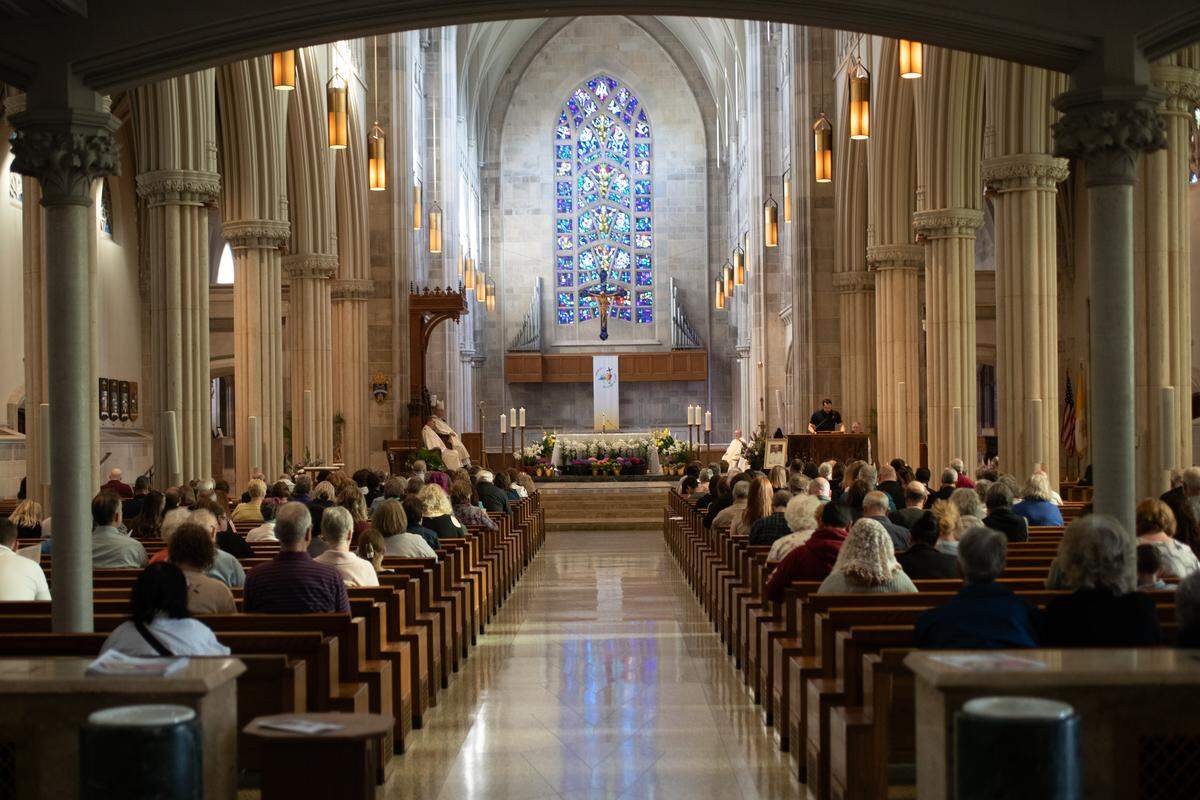
“So much of our relationship with God is about the body. Bodies are sacred. They’re holy, which is why we offer burials to our loved ones. We aren’t worshiping them by putting them in the ground, but venerating them for what they have done.”
The practice of keeping relics hasn’t been without controversy, Myler said. Around the Middle Ages, before the dawn of Protestantism, the sale of bogus relics proliferated throughout much of Europe.
One example involved John the Baptist, who was beheaded in the first century and whose “head” was being sold in two separate places simultaneously.
Now, such relics must come with certifications and paperwork directly from the Vatican to certify their authenticity.
“You might find someone selling some kind of ‘relic’ online, but it’s bogus,” said Myler.
Most certification paperwork lies at the Vatican, and many metro-east churches are unaware of what saints’ body parts may lie beneath them. In a Belleville News-Democrat inquiry to nine churches, only two said they were aware of any relics within their sanctuary.
The new St. Clare of Assisi Catholic Church in O’Fallon was built in 2007. Father Jim Deiters, who was there when it was built, remembers receiving the relic currently installed in the altar.
“Our relic is of St. Clare of Assisi, who died August 11, 1253,” Deiters said. “It was given to us by the Franciscan Hospital Sisters in Springfield. And we installed it in the base of our new stone altar when it was dedicated on September 28, 2007.”
St. Clare was of an ascetic order of nuns who chose to live in abject poverty. Many religious orders in the metro-east give heed to the saint, and nuns who follow in her footsteps call themselves “Poor Clares.”
Some churches, especially the larger cathedrals, have more than one relic, such as the Cathedral of Saint Peter in Belleville, where Myler served as rector. There lies a relic of St. Maria Goretti, the youngest saint to ever be canonized, who was given a posthumous tour around the world.
The entire body of the saint, who was martyred at age 11, was displayed at the Cathedral in 2015. The skeletal remains are encased in a wax effigy.
Other relics include those of “several early saints,” according to Myler.
Many relics are buried or hidden due to concerns about looting, a problem during early Christian persecution and later in times of war. Other reasons are to protect them from environmental disasters, such as the fire that ran through the Cathedral of Saint Peter in 1912.
According to Myler, other relics found in metro-east churches include bone fragments of Saint Ignatius of Antioch, who died in the second century A.D., and Saint Polycarp, an early martyr who died in 155 A.D.