Metro-east city considering stricter rules for data centers during moratorium
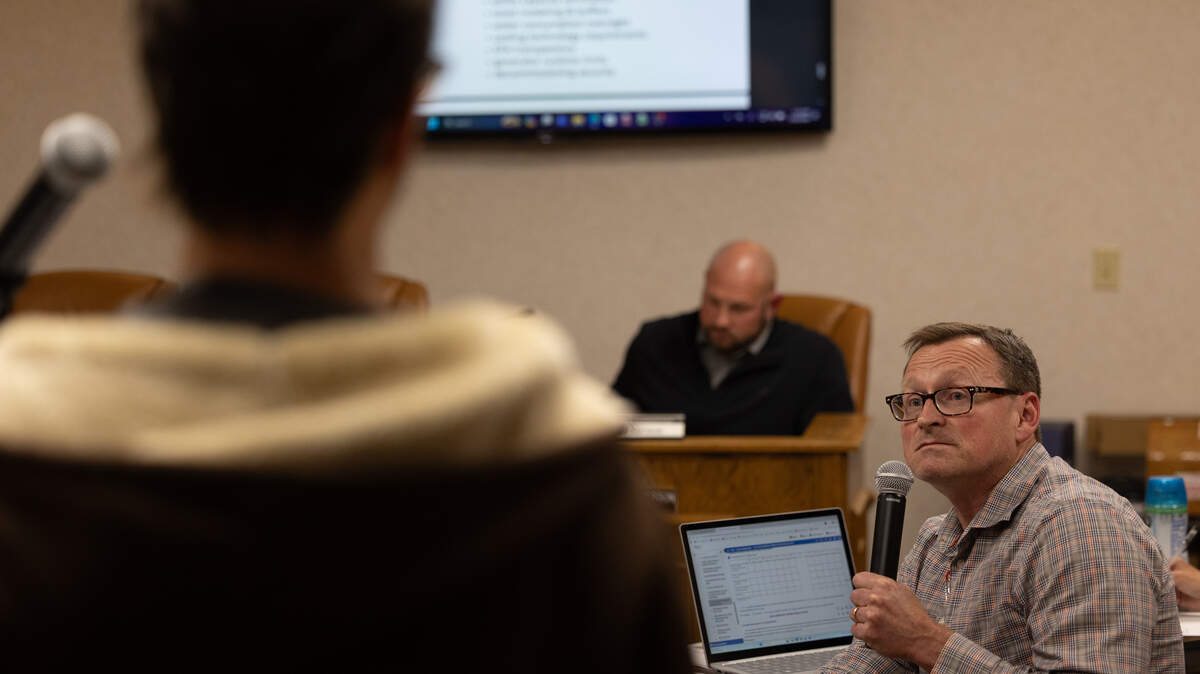
Troy officials on Thursday night offered a preview of stricter rules they are considering for data centers.
The city originally passed an ordinance on data centers in November. Now, its planning commission has voted to recommend the City Council pass a six-month moratorium on data center proposals while leaders rewrite regulations for those developments based on research of other towns’ rules and concerns residents have raised.
For months, Houston-based development company Cloverleaf Infrastructure has been exploring potential locations for a data center in Troy and assessing public opinion at community meetings.
Cloverleaf prepares sites for tech companies to build data centers, which power artificial intelligence and other kinds of data storage and processing. The company’s role is to work out land, power and zoning agreements ahead of time.
The company has not presented a formal proposal to Troy.
Days after Troy Mayor Dave Nonn announced the city was preparing a moratorium, Cloverleaf development principal Jeff Lake said in an interview the company has seen greater opposition in Troy than other markets.
“We’re not going to push an agenda in a community where there’s zero support from anyone,” Lake said. “If there isn’t support from the community, community leaders, the mayor, there’s no approval path forward.”
Cloverleaf has also identified potential sites in Granite City for a data center. Emails show the company has been talking privately with Edwardsville officials, according to reporting by the Illinois Answers Project.
Another, unnamed site in St. Clair County is also on Cloverleaf’s radar, the St. Louis Business Journal reported. Lake declined to identify the St. Clair County community to the BND.
Lake added other communities in southern Illinois have reached out with interest about a data center.
In Troy, the company was looking at farmland off Formosa Road. But residents and elected officials opposed the sites because of their proximity to Bethel Church, Christian school Bethel Academy and the Fawn Meadows subdivision.
Data center location restrictions
City Engineer Tom Cissell said one rule Troy might consider changing is the minimum distance between data centers and property lines in response to criticism of the original city ordinance, which said developers could build data centers about 200 feet from homes.
Matt Wiwczaroski, who lives in Fawn Meadows, said he knew the nearby farmland would be developed one day, but he did not imagine a massive data center complex.
Cloverleaf’s goal was to secure 500 megawatts — enough electricity to power 350,000 homes — for the data center it wanted to build in Troy. Wiwczaroski said it would have been 100 yards from his property.
“When we moved here, I told my wife, ‘Enjoy the view right now because eventually something will be coming,’” he told the planning commission during its meeting Thursday. “However, we never considered a compound of this size and magnitude to be there.”
He asked officials to give the same consideration to his subdivision’s enjoyment of their properties as they gave to residences near a proposed economy hotel on Edwardsville Road, which the board also discussed Thursday night.
Planning commission member Eric Patton said he was concerned about a three-story hotel blocking residents’ view and creating new traffic. Chair Jami Stone also raised safety concerns about children from nearby residences walking in that area to get to Tri-Township Park.
“Think about how it’s going to affect the citizens who live here and pay taxes,” Wiwczaroski said.
Cissell shared a map Thursday night showing distances of a quarter-mile and half-mile from the city’s subdivisions that he said would be used in future city discussions about data centers.
Resident Carol Black said during the meeting she thought half a mile was still too close to homes.
“Can we not extend it to a minimum of a mile or two miles?” she said.
Cissell referred to the maps as a “hypothetical scenario” but noted the city only has a say on land up to 1.5 miles from city limits.
More possible rules for data centers
Cissell said officials could put restrictions on the size of a data center Troy would consider based on the amount of power it will need.
Troy might add a requirement for a bond to cover the cost of repurposing or demolishing a data center if it becomes obsolete, according to Cissell.
The city may also require data centers to guarantee or certify the amount of water they use and conduct studies to prove the noise they produce is within Troy’s decibel limits.
“Another thing that I heard is the penalty’s gotta be really stiff,” Cissell said of resident feedback. “... I heard that, and I agreed with that. When you’re talking about somebody with a billion dollars, whatever our penalties are in our current code is not going to even make it dent, so we need to strengthen the penalties if they exceed.”
Cissell and Stone said they would take other residents’ suggestions into consideration, like Justin Mattea, who asked Thursday night if Troy would also consider protections from nuisances such as traffic and noise during a data center’s construction, which can last up to 10 years.
“That outlasts many businesses,” Mattea said of the construction timeframe.
Three members of the planning commission were absent from Thursday’s meeting: Vice Chair Liz Compton, Danielle Bogue and Matt Reiter. Those present included Stone, Patton, Shane McBride, Rich Curtis, Rachel Lybarger and Mike Niermann.
Troy City Council’s next meeting is Monday, March 16.
This story was originally published March 13, 2026 at 10:00 AM.