These metro-east cities are most likely to get data center proposals, groups say
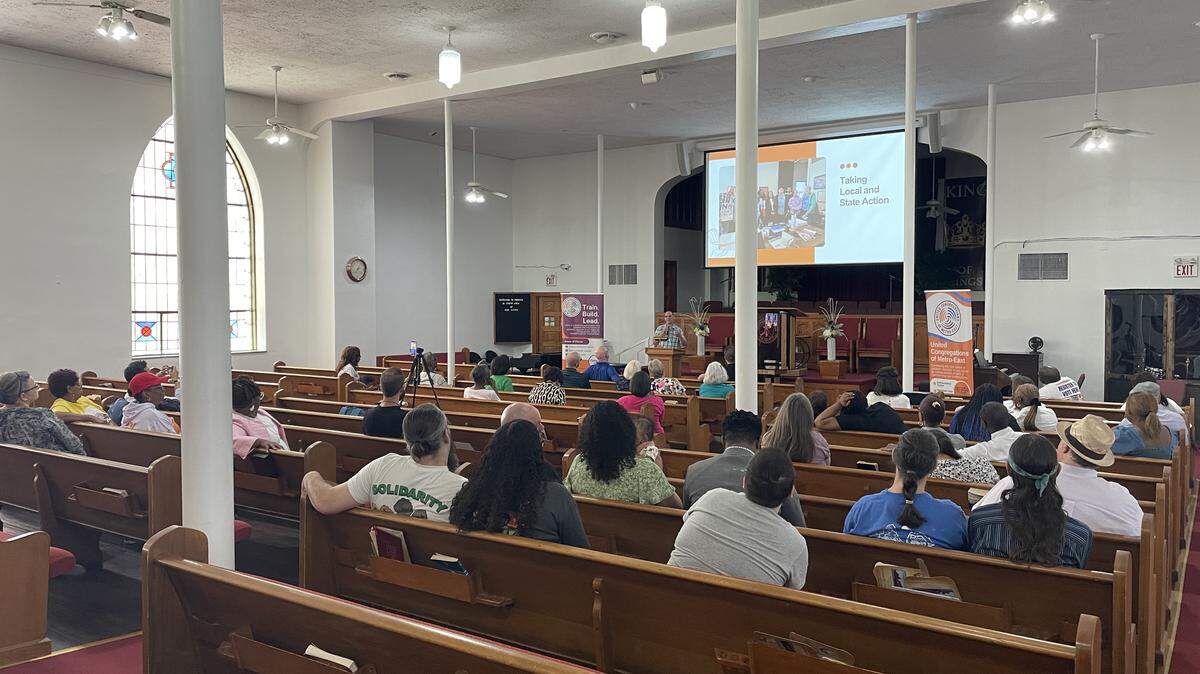
East St. Louis and Cahokia Heights are the most likely metro-east cities to get proposals for data center developments, according to legal and environmental community organizations.
The developments are controversial because of concerns about their massive energy and water needs, noise, pollution and long-term viability.
At a town hall Saturday, the local groups argued data centers, like other industrial development, often are built in low-income communities of color, sometimes referred to as “sacrifice zones.”
Among the town hall organizers were United Congregations of Metro-East, the Citizens Utility Board, Equity Legal Services, Centreville Citizens for Change, and Faith in Place.
The organizations are calling on residents to get involved before a data center developer comes knocking. During Saturday’s event, they suggested educating friends and neighbors about the issue, attending City Council meetings and advocating for community protections included in proposed state legislation.
A crowd of about 40 people gathered at Southern Mission Missionary Baptist Church in East St. Louis for the conversation.
Representatives from the groups raised concerns about negative consequences for those communities, which struggle with longstanding industrial pollution, failing infrastructure and the related health risks.
Heavy rain can force sewage to spill out of pipes into streets, a public lake and residents’ properties in Cahokia Heights and East St. Louis.
“We already don’t have working stormwater infrastructure. We already don’t have working sewage infrastructure. Putting another huge industry on top of that will only make it worse,” said Kennedy Moehrs Gardner, an attorney for the nonprofit Equity Legal Services.
Cahokia Heights resident Yvette Lyles echoed that sentiment.
“Any area where people are living where it’s already impoverished, where they’re already having infrastructure issues, sewage issues, you don’t add insult upon injury because you’re going to destroy the area,” she said.
Attorneys from Equity Legal Services represent Cahokia Heights residents in federal litigation seeking infrastructure fixes and compensation for their property damages.
Lyles is one of several plaintiffs in the litigation. She is a member of the resident group Centreville Citizens for Change. The group organized to find solutions to the issues before the former city of Centreville merged with Cahokia and Alorton to become Cahokia Heights in 2021.
Scott Allen, the energy policy specialist for the state watchdog and consumer advocate Citizens Utility Board, said the need for funding to address costly problems like deteriorating infrastructure puts communities like Cahokia Heights and East St. Louis at risk of “exploitation” from data centers.
“Where I think we fear exploitation the most is you take a community that has been neglected like East St. Louis, like many other parts of the state, and offer tens of millions of dollars a year or more in tax revenue; it’s hard to turn that down,” he said.
“... We shouldn’t take the claims the data centers are making about jobs and property taxes,” Allen added. “They have no obligation to tell the truth to the public, but they do have a lot of reason to convince the elected people who are really concerned about those two things.”
East St. Louis resident Flossie Hunt said during the town hall that she worries elected officials are not educated on the negative effects of data centers or what those effects would be for East St. Louis, specifically. She proposed organizing meetings with local officials and writing letters to state legislators.
“I want our elected officials to protect us,” Hunt said after the meeting.
Tim Dever, a member of the Sierra Club Kaskaskia Group, turned the conversation to personal responsibility, arguing an overreliance on artificial intelligence is spurring the data center construction boom.
Wade Halva, the southern Illinois outreach coordinator for Faith in Place, agreed.
“I think one of the things we have to do as community members is think judiciously about ‘Where is AI coming in? Where do we need to use it?’” he said. “… I got two college-aged kids right now, and the amount of students writing papers with AI is obscene, and that’s not setting people up for success.
“We’ve made this demand because we think it sounds cool and shiny and so like anything else, if the demand goes away, the supply will go away,” Halva added. “… We need to be talking about that with our neighbors. ‘Using this stuff is leading to this kind of development, is leading to this kind of impact in our communities.’ That is a chain. It is predictable.”