BND expert offers tips for ramekins, bouillon bowls, cream soup bowls & soup plates
Q. I remember reading in your column one time about some old, or vintage, or Victorian (I’m not sure what the rules are on what is vintage or what) but anyway all I remember is it was about really old (long, long before my time) pieces of silverware and what it was used for. I am supposed to be getting some china which belonged to my great-great-grandmother which my mother and grandmother have been telling me about and I do not have a clue to what they are talking about and if I will even know what these different pieces will look like and how they are supposed to be used.
I wrote down a few things they have talked about: ramekins, bouillon bowls, cream soup bowls and soup plates, and underplates. I looked up a few things on the internet and got more confused than ever. Can you help inform me a bit and tell me how I can use these in today’s world especially since I am not a person who does fancy entertaining.
A. First of all, how wonderful you are going to inherit these lovely pieces and how exciting that you are interested in learning about them and hopefully actually going to use them in some capacity. I can understand why you may have become more confused because in today’s world, just as some dishes are referred to by different names or evolve into different names because of how they are used, so has been the case throughout history.
For example, the caveman had very limited utensils; therefore, whatever bowl was eventually made from a piece of animal bone, it was used to get water from a stream, gathering berries, holding erbs being crushed with a stone of some kind. Whether they referred to it as a water bowl, berry bowl or erb bowl, or medicine bowl, one does not know. If we then jump to the Victorian era (1837 to 1901), of course there was a different lifestyle and for many it was more formal, even more formal than today.
There were many specific items created for very specific purposes. For example, there was a master berry bowl which was used specifically to hold berries, not mashed potatoes because there was a specific bowl for mashed potatoes and vegetables. There were dishes just for serving celery, for asparagus, for soft-boiled eggs; dishes called bone dishes on which only bones were placed from the dinner plate; fish plates for serving only fish. As time passed and lifestyles changed, some of those very specific purpose dishes were no longer used.
Of course, there were many types and sizes of bowls as well. In addition to the smaller bowls specifically created to hold berries served from the larger master berry bowl, some were created for bouillon soup which had two handles which made it easier to lift the bowl and drink the bouillon rather than use a bouillon soup spoon which was an option.
There was also a bouillon cup created which was a narrow cup whose shape also preserved the temperature well. Yet, a different size bowl was created for cream soup. It still had two handles to make it easier to tilt to get the last remaining soup but it had a slightly different size diameter and depth. There was a different shape of bowl for cream soups which were a heavier type of soup or thicker consistency of soup.
In these earlier years, the bowl’s shape was determined by the temperature and texture of the soup. If it was a thicker, chunky type soup like a hearty beef soup, which retains heat, then it was served in a more shallow, wider bowl which releases heat better. If the soup was a smoother texture like a pureed soup, it was served in a deeper bowl because it held the heat better.
Could any of these various bowl shapes been used interchangeably, definitely, and they were in some cases because not everyone could afford to have all of these shapes and sizes of bowls and serving plates, much less the space required to store them, nor the staff required to wash them.
In today’s world, we may and do use the same size bowl for cold cereal, hot oatmeal, soup, fresh fruit, cottage cheese, pop corn, pudding, applesauce, jello or ice cream.
Now, having given you all this information, I have included some photographs of the types of bowls you listed with dimensions, and further details, possibly from your great-great-grandmother’s era; therefore, they are delicate china, which cannot be put in a microwave or extremely hot dishwasher. The fact that most of these dishes were trimmed in gold, is another reason why we do not use them as much today because the gold would cause a spark in the microwave.
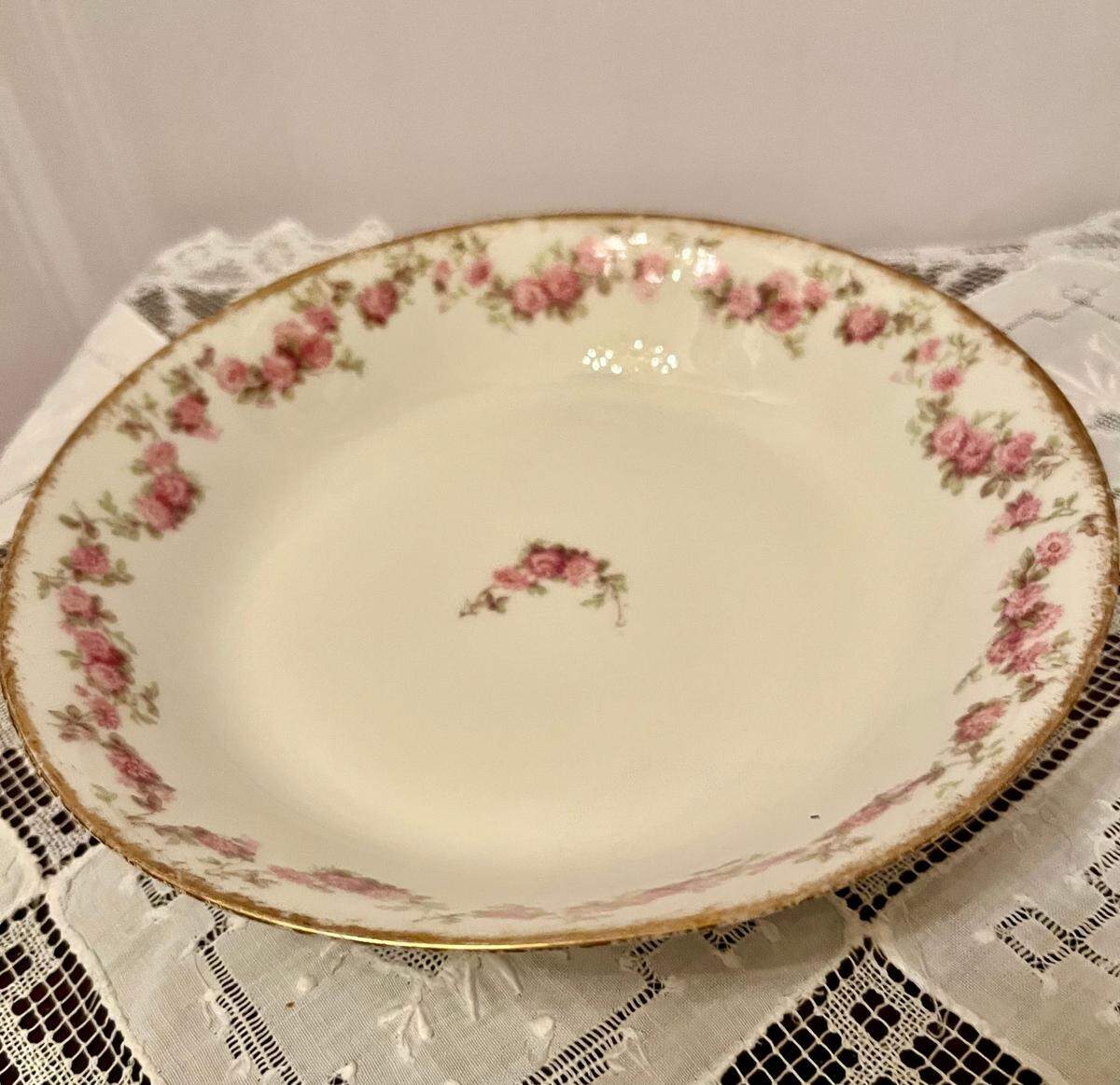
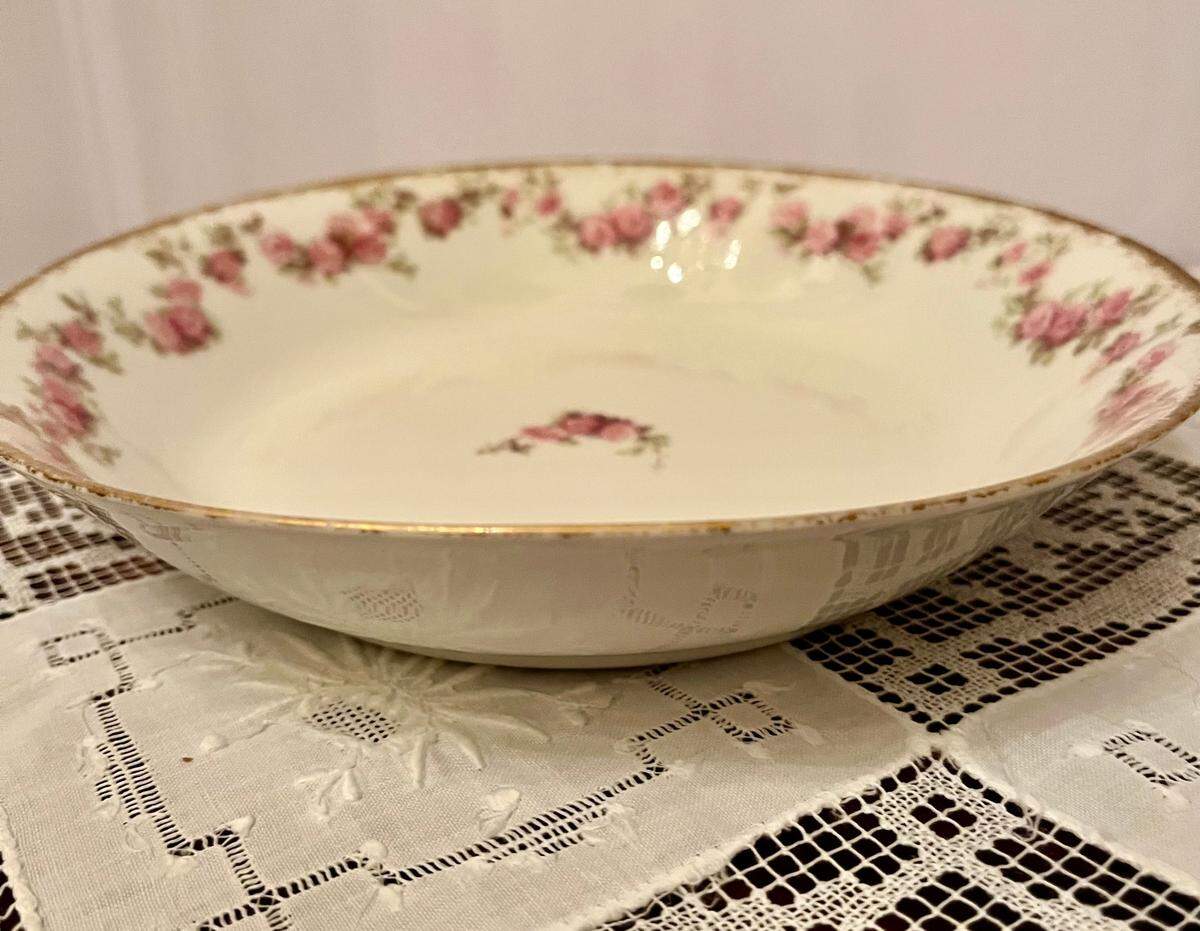
An unrimmed china soup or cereal bowl
It is 7-1/4” in diameter and 1-1/4” deep which is considered shallow. Without a rim, it would have been used only at informal meals. If it had a 1 to 2” flanged rim and were slightly larger in diameter — like 9 to 10” — it would be called a “soup plate” and it would have been the only soup bowl used in a formal dinner service.
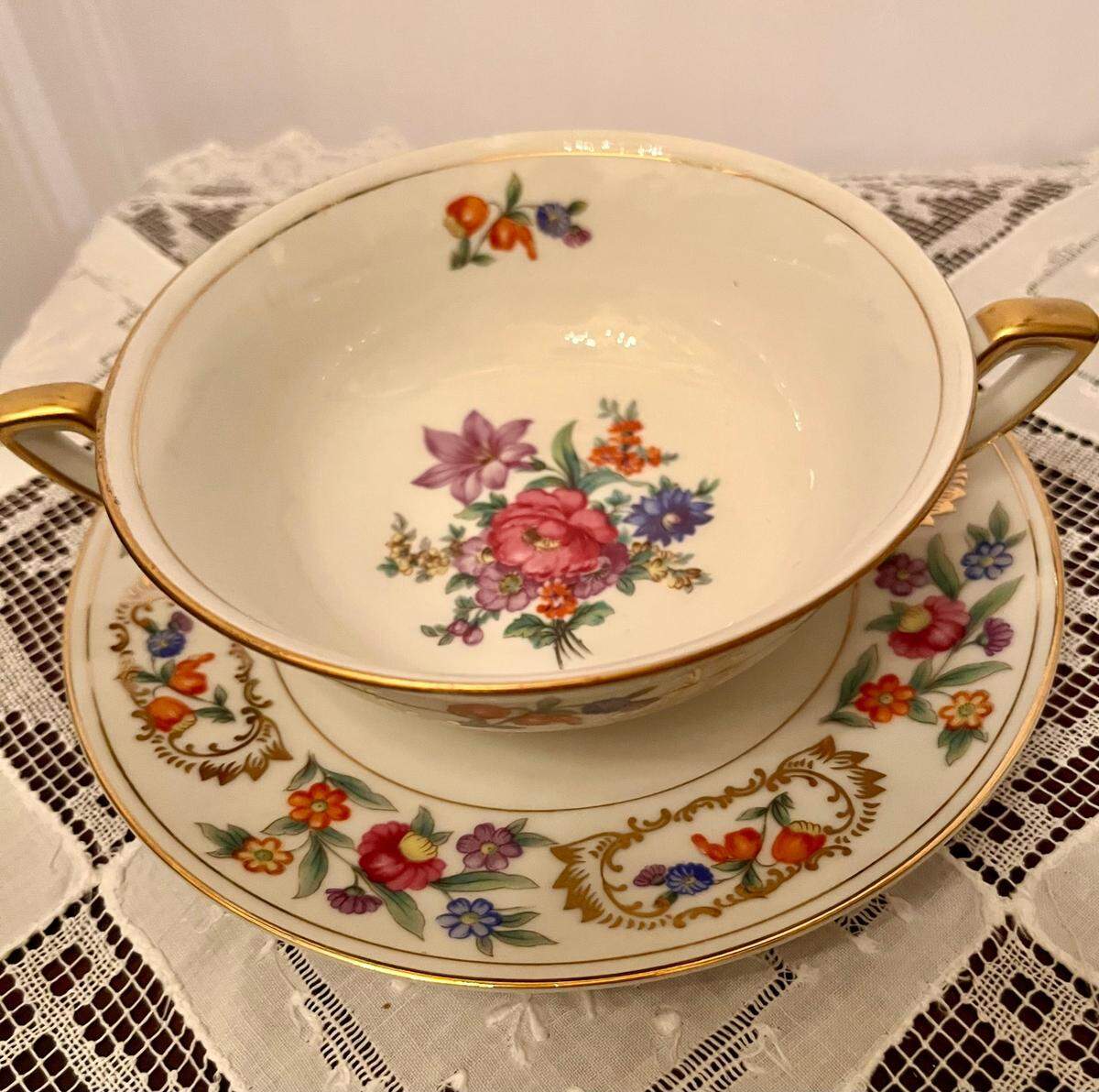
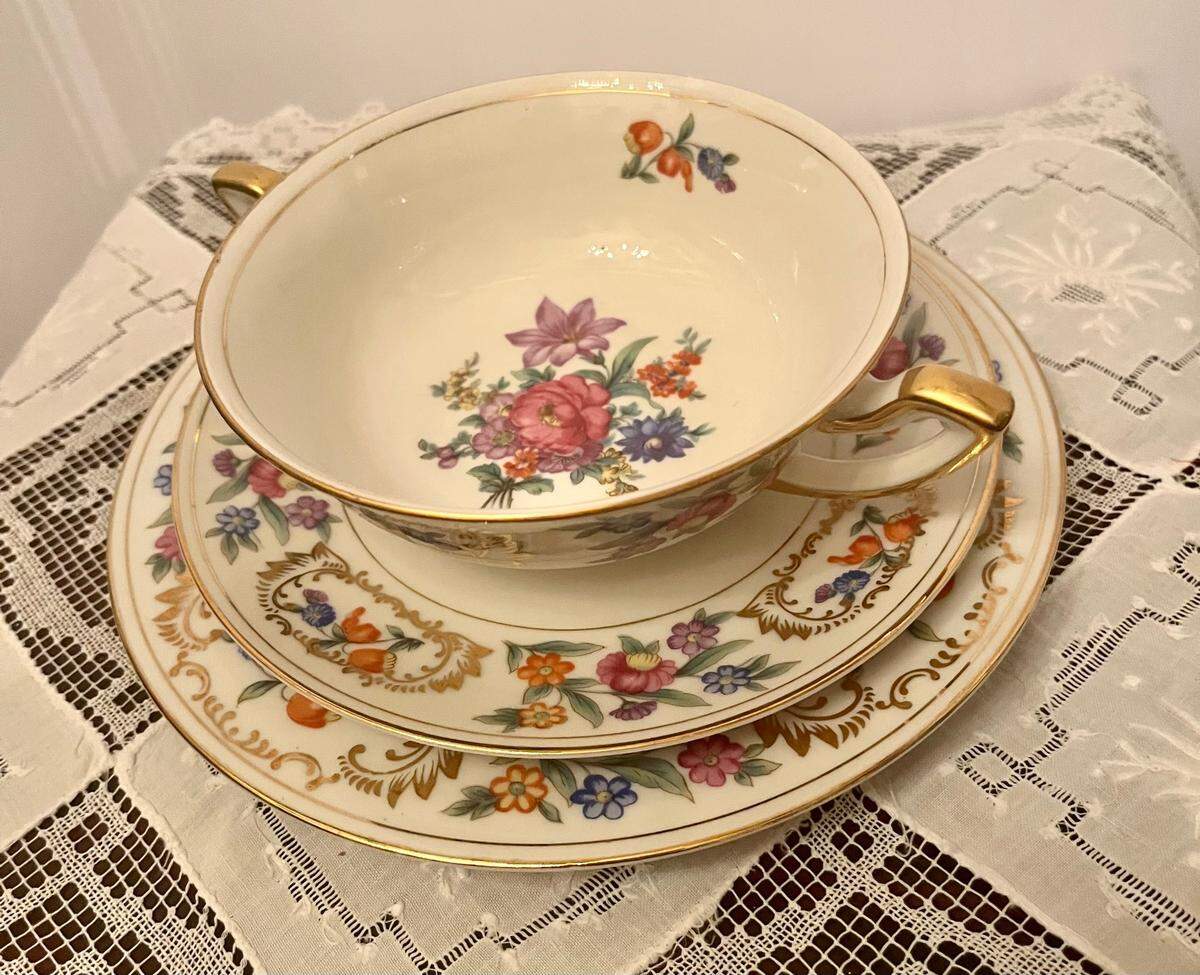
China cream soup bowl
Normal diameter was 4 to 5”. The one is 5” in diameter. The depth of the bowl is 1-3/4”. It was usually used to serve the first course which was a type of pureed soup particularly at a meal with a light menu. Note how small the handles are and the shape of the handles. This horizontal open loop handle is easier to tilt to gather the last bit of liquid. This is why it was proper to use both hands rather than just one if the bowl was to be tilted, or in some cases, if it was lifted to the mouth and the contents drunk. It has a flowered pattern which was apropos of the era and it is served on a matching saucer which is 6-1/2 “ in diameter.
Underplates
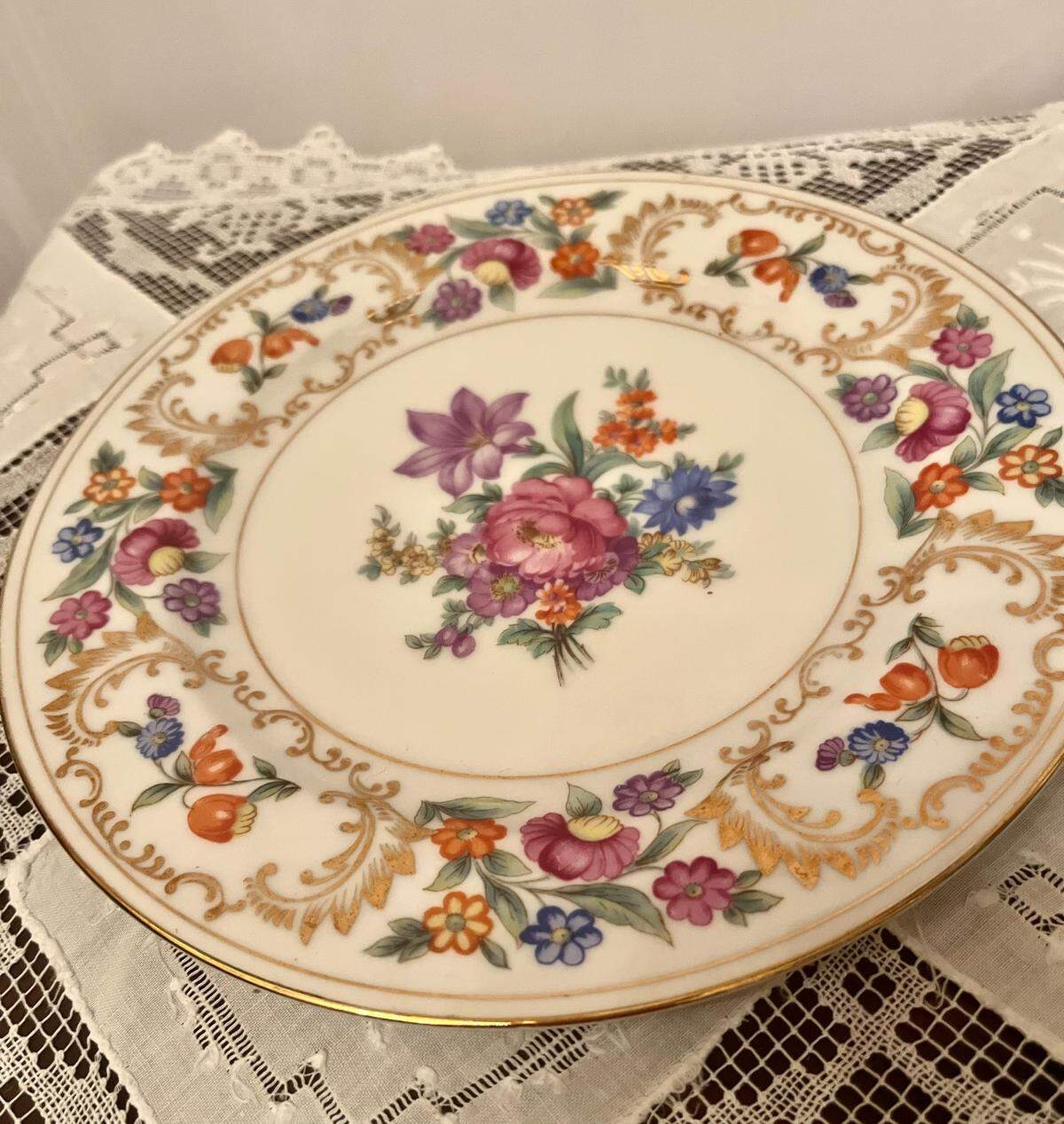
These were always necessary to help protect the table from the heat as well as to balance the place setting. Even if the bowl had a matching saucer, it would have been placed and served on an underplate like the matching plate here which is 7” in diameter. All three would have been removed to prepare for the serving of the next course.
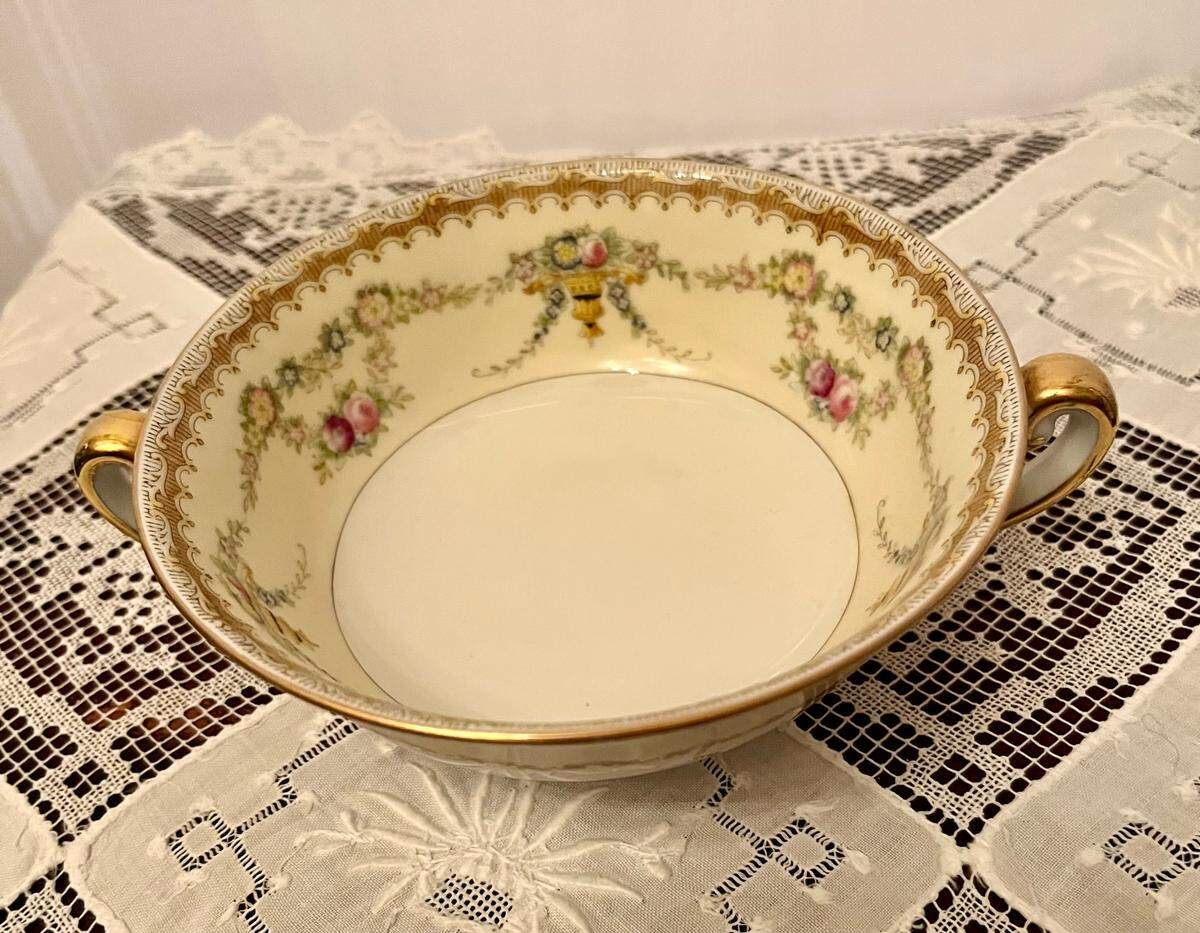
China Cream Soup Bowl
It is 5” in diameter and is 1-3/4” deep with again two small handles with a more elaborate pattern. Although it does not have a matching saucer or underplate, which was not irregular, it would have been served with a saucer and underplate which completed the pattern of the bowl.
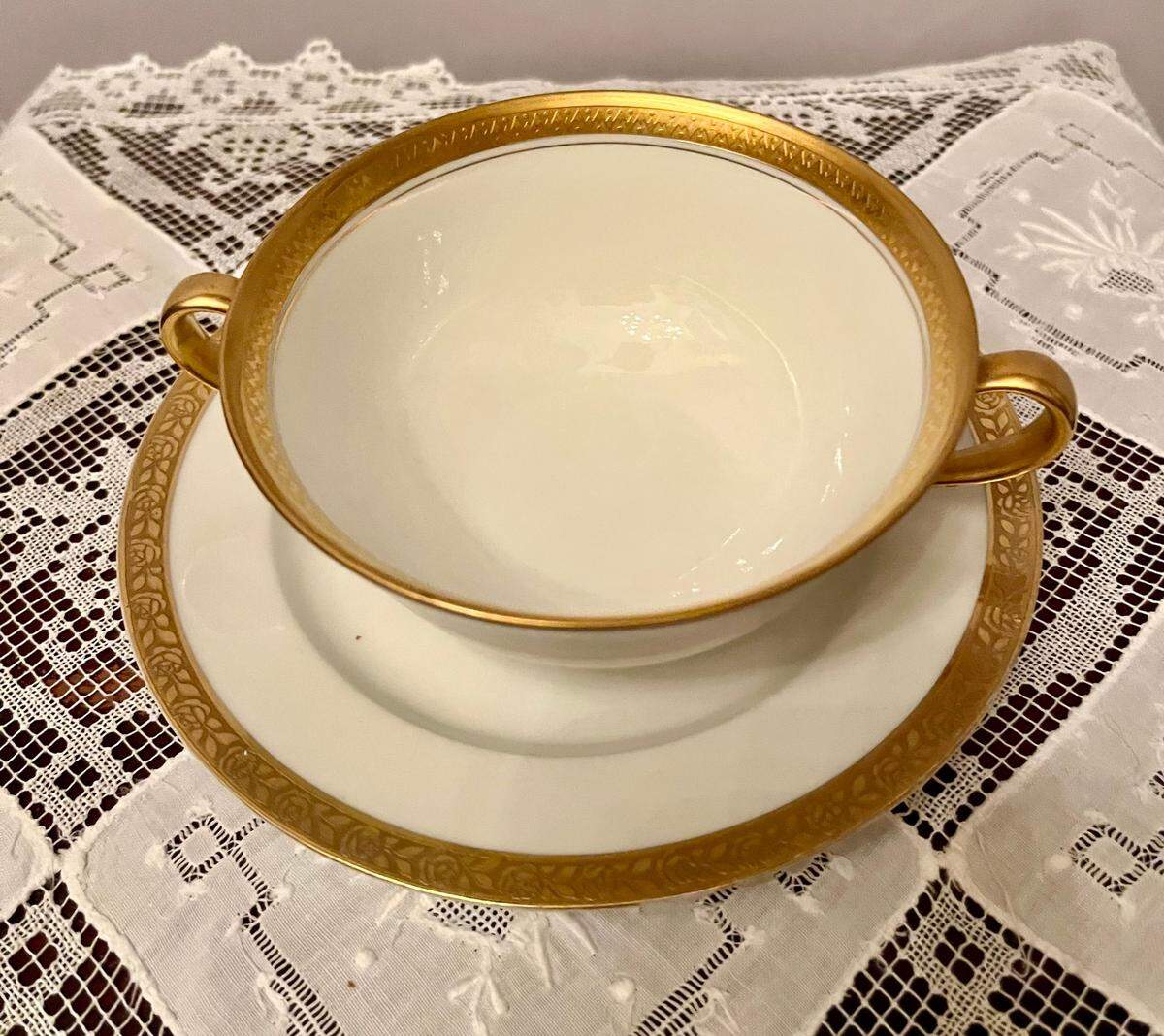
China Cream Soup Bowl and saucer
This does not have a pattern, just the gold trim, yet is very beautiful and elegant. It would have been served with a similar gold trimmed underplate or more solid gold patterned underplate.
Boullion Cup and Saucer
This is 4-1/2” in diameter and 2” in depth, with a matching saucer of typical size: 5-1/2 “. Bouillon is normally drunk entirely from this cup or it is sipped from a bouillon spoon. It was and is considered poor manners to do both. Having said this, it is, however, proper to test the temperature of the bouillon by using the bouillon spoon to take a single sip. The spoon is then placed to the right of the cup on the saucer with the bowl facing up.
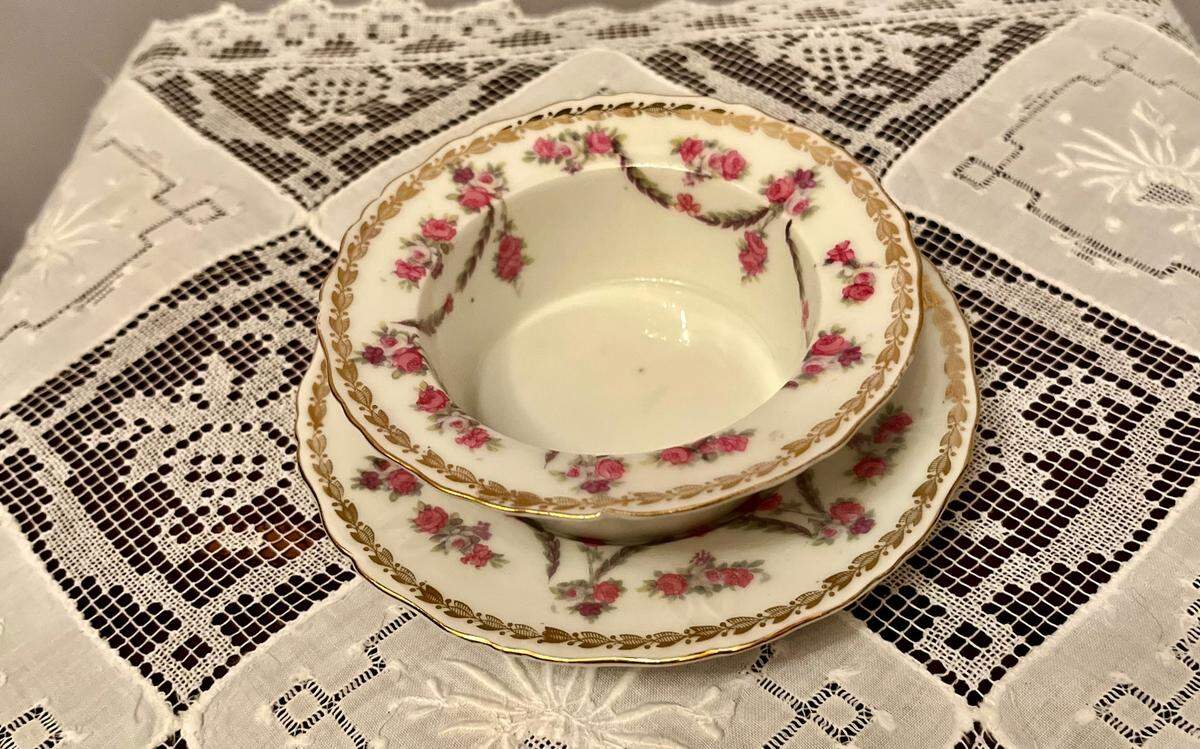
China Ramekin with matching saucer
This heat-worthy ramekin was created to serve baked dishes made largely of cheese milk, and cream. The contents were usually a custard, flan, creme Brulees, or cheese souffle.
As to how you will be able to use some of the beautiful pieces you are going to inherit: You can use them in any way you would like. Just because it has handles doesn’t mean you have to use it for cream soup or bouillon. You can serve ice cream or pudding or jello, m&m’s — or whatever you like in it. Keep an open mind and enjoy using them every day for yourself or for guests.
.jpg "IMG_3653 (1).jpg")