Here’s how Illinois plans to reopen the state from the coronavirus pandemic
Gov. J.B. Pritzker announced Tuesday a five-phase regional plan for reopening businesses as the coronavirus pandemic contagion curve begins to flatten.
“We’re one Illinois, but we are also one Illinois made up of of 60,000 square miles and reality on the ground looks different across our state,” Pritzker said.
The plan sets a series of statistical hurdles each region must clear to gradually reopen, including declines in positive tests and hospitalizations.
Schools could potentially open in the fall, but large gatherings such as festivals, concerts or sporting events — part of the fifth and final phase — would only be allowed if there was a vaccine, effective treatment or widespread immunity, the governor said.
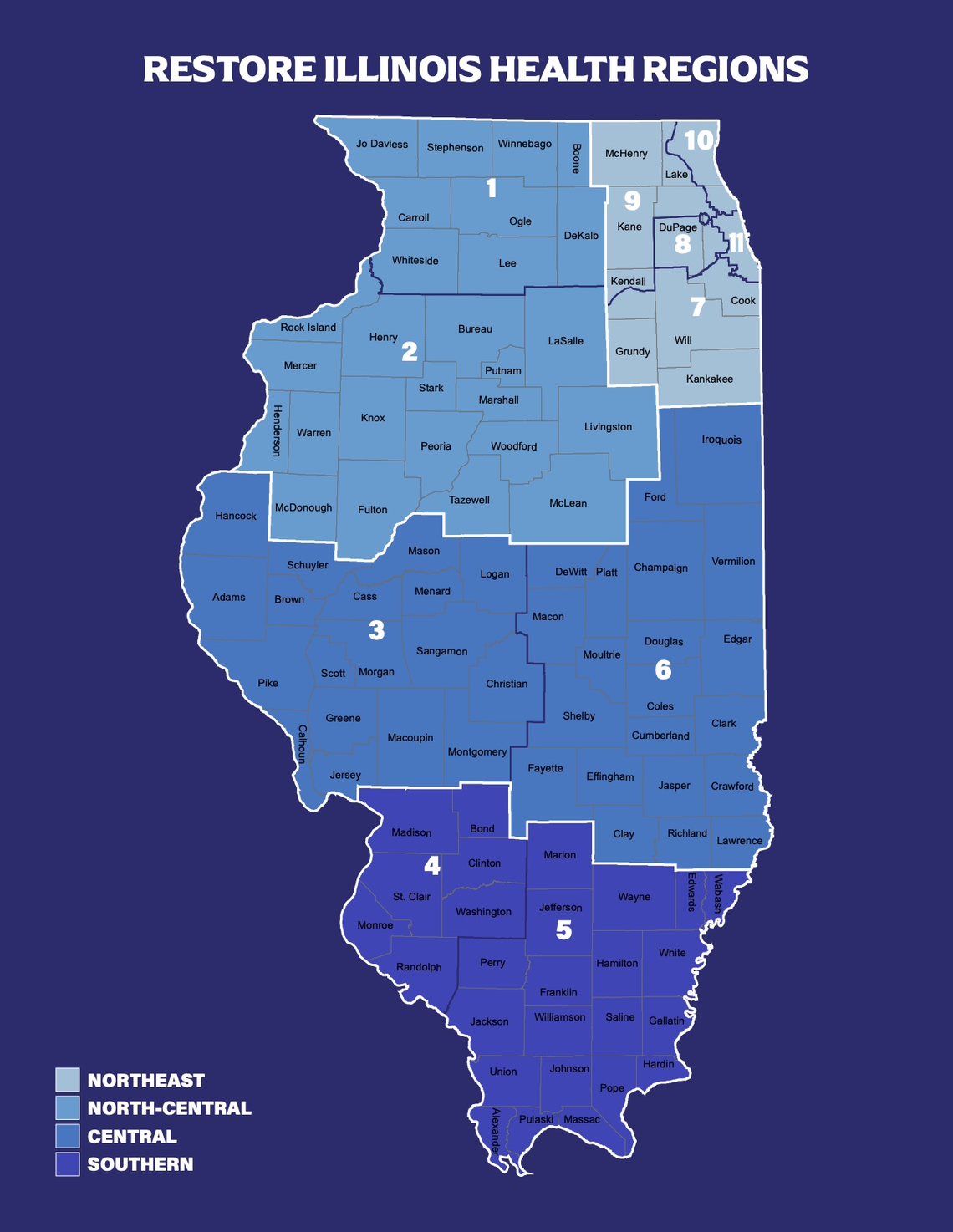
Officials have established four regions where the virus’ spread will be measured: northeast, north-central, central and southern. As of early May, every region in the state was experiencing “flattening,” which puts the Illinois in the second phase, according to the governor.
May 29 is the earliest the any region can advance to phase three, which authorizes reopening of barbershops and salons, retail and offices with safety precautions, Pritzker said.
Progress in the metro-east is likely to determine when southern Illinois moves to the next phase. With 24 new positive cases and three deaths in Madison and St. Clair counties alone Tuesday, the governor considers the metro-east a hotspot. And cases continue to increase daily.
Even though other counties in southernmost Illinois have yet to report a case, they will be counted in the same region as the metro-east.
To move from phase two to three, a region would need to meet the following thresholds: no more than 20% all COVID-19 tests come back positive, increasing no more than 10 percentage points over two weeks; no overall increase in hospital admissions for COVID-19-like illness for 28 days; and at least 14% of intensive care unit beds, medical and surgical beds, and ventilators available.
In recent weeks, southern Illinois Republicans and other GOP leaders have urged the governor to take a regional approach to slowing the virus’ spread, pointing to higher numbers in Chicago.
“I think it’s a good idea,” said Bob Elmore, Republican chairman of the Monroe County Board. “We need to get opened up, that’s for sure. People need to get back to work.”
Elmore criticized Pritzker last week after the governor singled out his county’s high death rate, caused mostly by deaths at a single nursing home.
The Republican chairman of Madison County, Kurt Prenzler, said he had hoped the governor would hand power over to local county health departments.
“We’re the largest population south of Joliet,” Prenzler said. “I was hoping he would recognize that we could manage this as a county.”
Roger Wigginton, who owns the Don Rodgers clothing store on West Main Street in Belleville and is a city alderman, said he would like to see Pritzker’s stay-at-home order modified to accommodate small shops. The governor has said he hopes to address this issue, but has not offered details.
“We need a time frame, we really do,” Wigginton said in regard to allowing small shops to open. “ ... This has got to happen a lot sooner than later because small businesses just cannot handle much more of this.”
Wendy J. Pfeil, executive director of the Greater Belleville Chamber of Commerce, said her group would like to see the stay-at-home order modified to allow small shops to open.
“With Belleville being made up of small retailers, the small mom and pop shops and small restaurants, it’s having a major effect on the city of Belleville,” she said.
The five phases of the governor’s “Restore Illinois” plan include:
Phase 1: Rapid spread
Phase one occurred from when the state first implemented stay-at-home orders in early March through the end of April. The governor said of this phase, “No one wants to go backward.”
The state’s definition: “The rate of infection among those tested and the number of patients admitted to the hospital is high or rapidly increasing. Strict stay-at-home and social-distancing guidelines are put in place and only essential businesses remain open. Every region has experienced this phase once already and could return to it if mitigation efforts are unsuccessful.”
Phase 2: Flattening
Every region was experiencing flattening as of early May. The state entered this phase on May 1 with revised stay-at-home orders.
The state’s definition: “The rate of infection among those tested and the number of patients admitted to the hospital beds and ICU beds increases at a slower rate, moving toward a flat and even a downward trajectory. Non-essential retail stores reopen for curb-side pickup and delivery. Illinoisans are directed to wear a face covering when outside the home, and can begin enjoying additional outdoor activities like golf, boating and fishing while practicing social distancing.”
Phase 3: Recovery
Regions that meet certain thresholds over the next few weeks will be able to move to the third phase.
The state’s definition: “The rate of infection among those tested, the number of patients admitted to the hospital, and the number of patients needing ICU beds is stable or declining. Manufacturing, offices, retail, barbershops and salons can reopen to the public with capacity and other limits and safety precautions. All gatherings limited to 10 or fewer people are allowed. Face coverings and social distancing are the norm.”
Phase 4: Revitalization
The fourth phase would be marked by more business reopenings such as restaurants, bars and movie theaters.
The state’s definition: “The rate of infection among those tested and the number of patients admitted to the hospital continues to decline. All gatherings of up to 50 people are allowed, restaurants and bars reopen, travel resumes, child care and schools reopen under guidance from the IDPH. Face coverings and social distancing are the norm.”
Phase 5: Illinois restored
All sectors of the economy would be running business-as-usual in the fifth phase.
The state’s definition: “With a vaccine or highly effective treatment widely available or the elimination of any new cases over a sustained period, the economy fully reopens with safety precautions continuing. Conventions, festivals and large events are permitted, and all businesses, schools, and places of recreation can open with new safety guidance and procedures in place reflecting the lessons learned during the COVID-19 pandemic.”
Public health officials reported 2,122 new COVID-19 cases for a total of 65,962 statewide. Officials reported the largest number of fatalities within a 24-hour period Tuesday with 176 deaths for a total of 2,838 in Illinois.
Southwestern Illinois coronavirus cases
Here’s a breakdown of the 1,452 COVID-19 cases in southwestern Illinois as of Tuesday. These numbers are updated by 4 p.m. daily at BND.com.
- St. Clair: 592 positives, 51 deaths, 2,449 tests administered, 49 tests pending
- Madison: 371 positives, 27 deaths, 78 hospitalizations, 108 recoveries
- Clinton: 114 positives, six deaths, 545 tests administered, 20 recoveries
- Randolph: 197 positives, two deaths, 75 recoveries
- Monroe: 74 positives, 11 deaths
- Macoupin: 35 positives, one death, 720 tests administered, seven tests pending, 27 recoveries
- Perry: 32 positives
- Jersey: 14 positives, one death, nine recoveries
- Washington: 14 positives, nine recoveries
- Bond: Eight positives, one death, 140 tests administered, six tests pending, three recoveries
- Calhoun: One positive, one recovery
This story was originally published May 5, 2020 at 2:52 PM.