
O’Fallon growth changes ward maps but not aldermen
A 14.1% increase in the city’s population means O’Fallon must redraw its wards to reflect the residential growth in the 2020 U.S. Census. However, a proposed ward map will not alter the council’s make-up or affect aldermen currently serving.
Currently, the O’Fallon City Council consists of 14 aldermen elected from seven distinct wards.
The readjusted map will be up for adoption at a future council meeting and was among the topics at the Committee-of-the-Whole meeting on Jan. 31, which was open to the public.
The U.S. Census Bureau reported last year that collected data concluded that 32,289 people live in O’Fallon, a growth of 4,008 residents. The 2020 total was the highest gain in southern Illinois.
To reflect census figures, the process of redistricting comes before the city every decade. The city uses the Illinois Constitution as a guide, seeking best practices for redistricting in general.
Criteria for the proposed map was to make sure each ward has equal population, so staff took the total figure from the 2020 census and divided it by the number of wards, allowing a plus or minus 5% variances for population within each new ward boundary.
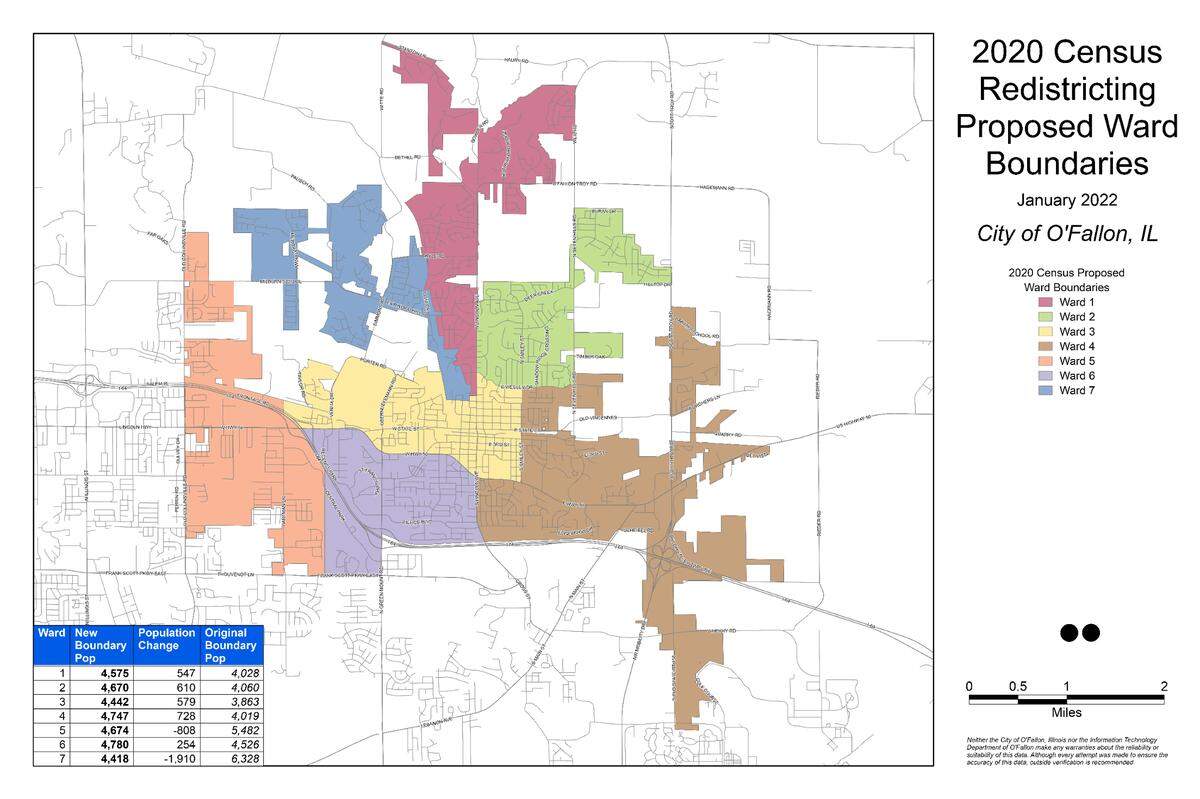
The proposed ward redistricting presents two major changes, to Ward 1 and Ward 7.
Assistant City Administrator Grant Litteken said the existing Ward 7 is too large now because of continued residential growth, so that ward and Ward 1 have been adjusted to meet current requirements as well as prepare for future growth.
Mayor Herb Roach said the staff took a “common sense approach” to readjusting the wards according to the new data.
“It wasn’t for political purposes and was as concise as possible,” Roach said.
Litteken said the Information Technology department worked hard to preserve the wards so that current aldermen would not be affected, be forced out of the territory that they serve.
The IT team includes Geographic Information Systems and mapping. The GIS Group provides accurate location-based information and analysis to departments through the city, and to the public. The GIS team has created a variety of online maps, charts and reports that can be viewed on the city’s website.
Litteken introduced IT manager Dan Gentry and said GIS Coordinator Chad Quinn had worked on three previous ward map adjustments.
Alderman Kevin Hagarty complimented the staff.
“This was very time consuming, and they did a good job,” he said.
Ward 7 grew to 6,328, so the proposal deducts 1,910 people to make it 4,418 total. Ward 1 is proposed to add 547 for 4,575, instead of its previous 4,028.
Ward 1’s southern boundary will no longer include the residential area near the O’Fallon Family Sports Park, which now has been moved into Ward 3.
Ward 3 will add 578 people, to be 4,442 instead of its previous 3,853 total.
Other new figures include Ward 2 at 4,670, an increase of 610, from 4,060; Ward 4, an increase of 728, from 4,019 to 4,747; Ward 5, a decrease of 808, from 5,482 to 4,674; and Ward 6, 254 added, from 4,526 to 4,780.
Primary considerations and requirements from the state document state:
- Wards should be closely and neatly bounded, avoid sprawl and ‘dangle’ areas. They must be self-contained, no disconnected ward “bubbles.”
- For best practices, it recommends preserving racial composition of communities in new ward boundaries for fairness.
- And avoid splitting blocks. In the 2020 census, block boundaries are the most granular level of population data released by the census.
- Follow major roads and understood boundaries and preserve existing legislators in ward and existing ward boundaries as much as practicable.
For the current map, visit: https://ofallon.maps.arcgis.com/home/webmap/viewer.html?webmap=3bf535e5c0444be3be3a959346fd56af
Ward maps are located in City Administrator Walter Denton’s office or people can view one online.
Messages to all aldermen and the mayor can be sent to the City Administrator’s Office at city hall (255 S. Lincoln) and can be contacted at 618-624-4500. Individual emails are listed on the city’s website, www.ofallon.org.
O’Fallon Growth Figures
The city was founded in 1854, and by 1870, its population was 1,117. One hundred years later, it had grown to 7,868.
O’Fallon experienced rapid growth in the 1980s, with its westward expansion, and had 12,173 at the start of the decade. In 1990, the population grew to 16,073. With Interstate 64’s expansion, the city counted 21,910 people by 2000.
Mayor Herb Roach credits “smart growth” as a main reason why O’Fallon has seen the greatest surge in population numbers in Southern Illinois, adding 4,008 residents.
“This is a credit to those of us currently involved in city leadership and management,” he said. “O’Fallon has been a resilient city for many years, as evidenced by the consistent residential and commercial growth we’ve seen over the past 25 years, even during the Great Recession of 2008, and now during the COVID-19 pandemic.”
Special Census in 2017
O’Fallon conducted a special census in early 2017 that took four weeks to complete showed an increase from 28,281 in 2010 to 30,440 and netted an additional $247,324 per year for the next three years.
“We felt that we had seen a considerable growth in our population that wasn’t reflected by the 2010 Census numbers,” Roach said.
“We needed the state revenues to provide essential services. It was well worth the city’s time and energy,” he said after results were revealed in July 2017.
Finance Director Sandy Evans said even with subtracting the cost of $130,000, it resulted in $610,000 in extra revenue.
New Census Figures Add Revenue
State revenue distributed to municipalities by population includes:
Local Government Distributive Fund, a designated portion of state income tax revenues received by cities and counties on a per capita basis.
Motor Fuel Tax is collected from drivers operating motor vehicles upon public highways and operating recreational watercraft. It is based on motor fuel purchases, and a portion is given to cities.
State Use Tax is imposed on any item of tangible personal property purchased retail and a portion is received.
Cannabis Tax is 8% of tax collected to the LGDF to fund crime prevention programs, training, enforcing, and preventing efforts related to the illegal cannabis market and driving under the influence of cannabis.
This was reflected in the city’s FY2022 budget and will be in the FY2023 budget that is currently in the works.