How an East St. Louis native became one of music’s most popular hitmakers
READ MORE
More Coverage on Black Music Month
Read all of the BND’s articles that celebrate Black Music Month
Expand All
First of a four-part series. This story originally was published in 2021
It’s likely that Chuck Harmony has produced or written for your favorite artist. Rihanna? Yup. Janet Jackson? Of course. Celine Dion? You bet.
For over a decade, the singer-songwriter and producer has made contributions for some of the biggest names in music. And he wants to continue making transformative changes in the industry.
Harmony is one half of the genre-bending duo Louis York, with which he wants to create music of substance, music that’s the antithesis to the strictly R&B mold that the music industry often pigeonholes for Black artists. Harmony and his frequent songwriting partner Claude Kelly formed Louis York in 2015. The group’s name is homage to their respective hometowns (Harmony from East St. Louis and Kelly from New York City)
Louis York’s 2019 debut album “American Griots” sounds like a luminous exploration into the origins of American music—a bit of jazz, gospel, pop and a whole lot of soul. It’s that type of music that Harmony, along with Kelly, hopes to inspire with their Nashville-based production company Weirdo Workshop, with which they’re focused on developing new talent. He’s also working on a new podcast titled “State of Black Music,” with the National Museum of African-American Music.
But Harmony’s introduction to music and what he can create with it started in East St. Louis.
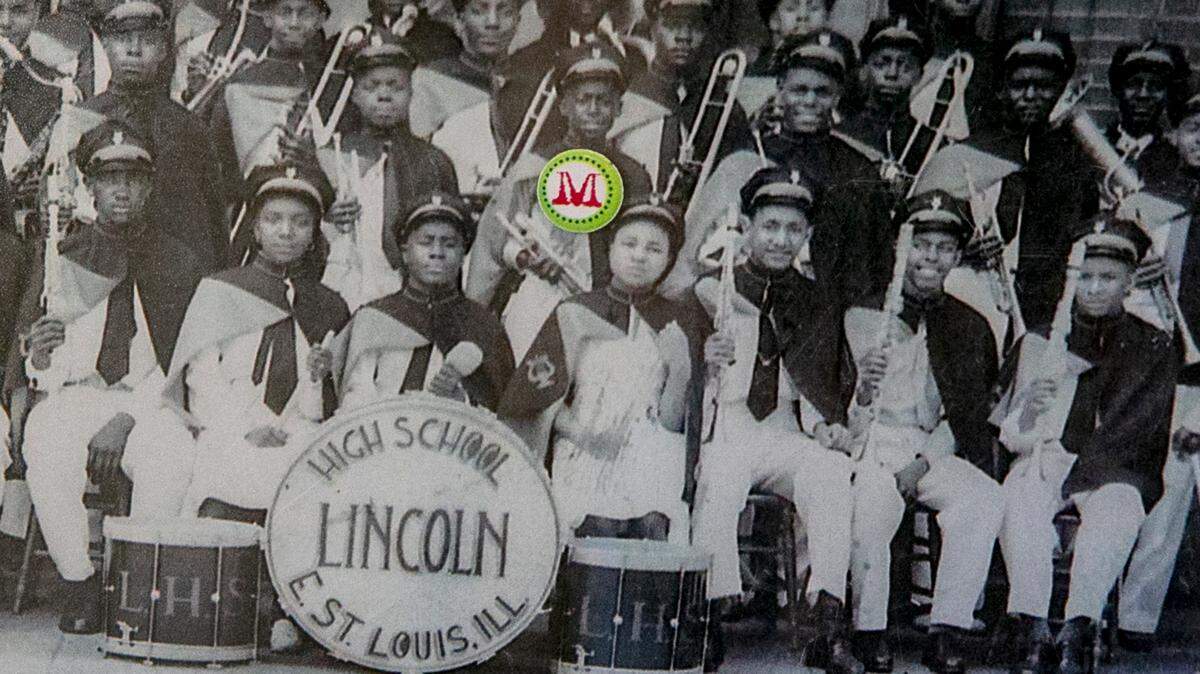
The East St. Louis native found his love for music while performing at his childhood church: Centreville Church of Christ in nearby Cahokia Heights (formerly Alorton). He also attributes his career to his time performing at East St. Louis Lincoln High School’s (currently East St. Louis Senior High School) esteemed jazz band.
But he mainly credits the city’s strong community for the success he’s had today. According to him, East St. Louis is an “unkept secret in the music business”. It’s why he says he loves talking about the city in any interview.
“It’s really important to me that people understand that there is a history in this city,” Harmony said. “There is a musical legacy. There’s a legacy of greatness, and so I’m happy to be a part of that conversation if I can.”
For the first installment of ESTL Voices, The Belleville News-Democrat talked to Harmony about his childhood in East St. Louis and his career:
Tell me about your upbringing in East St. Louis
“It was a good place to grow up for me, particularly because I was a little guy with big dreams, and so what East St. Louis did for me was it grounded me in a way to where I knew that this was home base and I could grow from that point. The funny part about East St. Louis is that a lot of the street knowledge that actually propelled me to get into these rooms where I was able to do, I was able to get from East St. Louis not because I was a street guy, but because I was observant. I was kind of the quiet guy that was just at the bus stop with the tuba and the trombone with just everybody laughing at him. I was that guy.”
“But it allowed me to understand the realness to some degree of life, and so I’m always appreciative of East St. Louis for how it grounded me to be able to live.”
How did your passion for music grow while living in the city?
“East St. Louis Lincoln Jazz Band has a real, real impact on what I perceived as music. Even now, my music is so jazz-based, but I never really studied jazz. All I knew was Miles Davis and Lincoln Jazz Band the whole time. I grew up in a Christian household, so we didn’t really listen to outside music, so the jazz band was literally my first taste of secular music to some degree where I can just delve into it outside of Christian music, so I made that the basis of how I create music even to this day….. It was the music education that I got from East St. Louis, not even knowing how fertile that soil was. Like I didn’t know that Lincoln Jazz Band was known nationally and internationally. I didn’t know that. I just knew that it sounded good and it caught my attention, and it shaped the way I saw music”
“Like I said, I was a church boy. I didn’t do much of nothing. My mom didn’t allow me to have many friends outside of church. Because East St. Louis can be a dangerous place, she kind of shielded me in that regard, so my dreams came from the educational system of East St. Louis and seeing the do’s and dont’s of that.”
How did the city nurture your talent?
Harmony said his introduction to Miles Davis’ music sticks with him. Harmony, who lived on 73rd Street in East St. Louis, attended Lucas Elementary School (the school closed in 2018). He remembers kids from Miles Davis Elementary School riding the bus with him on the way to school.
“For some reason, I didn’t even know who Miles Davis was, but the name Miles was like who is that? I remember literally going to my father, who was an avid music lover, and asked him about Miles Davis who played me some of his songs.”
“Having somebody that great to identify with the place you’re from, you can’t help but find a common denominator in that greatness, if music is your thing, and so music was definitely my thing. I was singing in church since I was three or four years old, so having that let me know that there was a possibility to expand out of East St. Louis….I’ve met so many like-minded people…... It’s a community of musicians between Miles Davis, Lincoln Jazz Band and all of these other programs. And even Jackie Joyner-Kersee, that was another one that kind of shaped that narrative that there’s a fertile ground there to go off and do great things.”
You went to Alabama State University and wanted to be a jazz pianist and music teacher. What made you want to take a different route and pursue the work you’re doing now?
“I majored in music education. Joan Brown from Lincoln High School Choir, she got me a scholarship to Alabama State. I was getting scholarships to other places, but that was the only one that was a full ride. Growing up when you have a single mom, you need all the advantages you can get, and so that was a way for me to be able to go to school for free.
“The journey was I went from wanting to be a music teacher to wanting to be in a singing group, and that’s what started my journey of understanding that the music business is a thing because I didn’t really know what the music business was until I got to Alabama State. And in choir, I met these couple of guys that wanted to start this group...and we made demos. I went into the studio for the first time. I wrote a song that was recorded for the first time, so that’s what really piqued my interest. Growing up, I knew I wanted to do music, but I didn’t know how that was going to materialize, so music education was not necessarily my passion, it was just my way out.”
How did you get immersed in the space of songwriting?
Harmony said he mainly followed his gut, which led him to the right people. Grammy-winning singer-songwriter Ne-Yo (think: Beyoncés “Irreplaceable”, Rihanna’s “Unfaithful” and many others) was one of them. He worked on Ne-Yo’s critically-acclaimed 2008 album “Year of the Gentleman”. Harmony said he was working several music gigs in Atlanta before collaborating with Ne-Yo.
“This guy came to me and just asked me for a track like, ‘Yo I got this artist coming to town, and I just need a track. I heard you do programming,’ and so I did it. Some kind of way he claimed it was his track and he got it to Ne-Yo, and so it was just this whole little debacle street thing that happened and then I got to meet Ne-Yo and he saw I was the real deal. He saw that I was the one that actually did the song, and we developed a friendship first before we started a music collaboration.”
“All of my musical experiences have been just by chance. It’s no real pathway. It’s not like I was saying I’m going to get to this point to here. I wasn’t strategic. I wish I can say that I was, but I’m not. I’m a guy that follows my heart, and my heart just led me to certain people and certain places that allowed me to expand.”
You’ve worked with music’s biggest stars. Is there any experience that you can say was the most rewarding for you as an artist?
Harmony said he’ll never forget his first time working with R&B songstress Chrisette Michele. He served as a producer on most of the songs from Michele’s third album “Epiphany,” which was released in 2009. It was Harmony’s first time working heavily on a project. The album debuted at no. 1 on the Billboard 200.
“When the first album that we worked on, Epiphany, went No. 1, it was really the confidence that I needed to know that I belong here. Not just I met Ne-Yo, and so I got the shot because I met this guy. It’s like no, I did the whole thing. It was outside of Ne-Yo. Ne-Yo did some songs. Claude Kelly did some songs, but it was mine to manhandle. That gave me the confidence that I needed. If that had not been the case, I don’t know where I would’ve ended up.”
“For some reason, and I don’t know, sometimes I think that my Christian upbringing had a lot to do with it, but I felt so bad about doing secular music when I first got in the music, and it kind of shaped the way I felt about myself even in the game. (I was) this super successful guy, and I had all of these tentacles where I could make money, but in my heart, I felt so bad. Chrisette Michele actually helped me put things into perspective, like no, this is God’s thing too.”
Have you done any work in gospel music?
“I’ve done a lot. Sometimes my name gets lost, but I did all kinds of stuff. Like (I did work for) Le’Andria Johnson. I don’t work with a lot of people in gospel. It feels so familiar to do gospel because that’s where my heart is. My heart has always been with God. It’ll always be with God, so it feels so good to be able to use my talent in my arena.”
You had a talent show in East St. Louis about 10 years ago? How was that?
“My whole desire has been to find the next Chuck Harmony, find that little kid with a tuba and his trombone with his shirt out just trying to make it, trying to figure out life, quiet and unassuming. All of those things, and I wanted to find that person because I wanted to give them the tool that I never had. That was part of me coming back to East St. Louis to do a talent search.I was able to meet some people, but I wasn’t able to find the talent that I was looking for, and that’s no fault to East St. Louis. It’s just like it’s a million reasons why the right person didn’t come out that day.
“It was such an amazing experience, man. I met some people who didn’t even know who I was. They just heard a song that I did, and I got to connect with people.”
The formation of Louis York was partially based on you all feeling disgruntled with the music industry at the time. Can you speak a bit about that and do you still feel that there is a lack of substance in today’s music?
“What I can say is part of my downfall as a musician was that I was a music purist, meaning that I only cared about the best. If it’s the NBA, I only cared about (Le)Bron and Steph .I didn’t care about the number six man or the number seven man. I’m a music purist like that. The only reason why I say it’s a negative (thing) because there are people who are making history and are able to do great things. That doesn’t necessarily mean that I love their music, but it could mean that they’re putting music in a great place.”
“For instance, HER, she’s the queen right now…. Like she won Song of the Year (at the Grammy’s), and years ago we were fighting about Black people not winning those kinds of categories. She was able to win an Oscar, and just a few years ago we were complaining, #OscarsSoWhite was a hashtag. So when I think of Black music today, I think it’s effective. I think it’s effective and opening doors for people.”
What should people know about the music culture in East St. Louis?
“I want people to know that, first of all, it’s a predominantly Black city, and so you have these people from these predominantly Black cities that’s able to go all over the world. My music talent then took me to New Zealand, Australia, London and Switzerland...If my breeding ground is from a predominantly Black city, then that says something about the Black culture. That says something about the fact that there is a way for us to highlight the positivity that comes from Black culture and not make everything this kind of push button topic.”
Miles Davis, the next installment of ESTL Voices., will be published next Sunday.
BEHIND THE STORY
MOREWho are our stars?
Help us tell more stories about people from the metro-east making an impact on the arts and culture scene in our region and beyond. Who are the emerging creative artists shaping the future of music, dance, the theater, film, sculpture, television, writing, photography and other arts? Tell us your ideas by completing this survey or contacting DeAsia Paige via email or phone 618-239-2624
This story was originally published June 6, 2021 at 6:00 AM.