This is the East St. Louis that shaped Miles Davis’ ‘cool’
READ MORE
More Coverage on Black Music Month
Read all of the BND’s articles that celebrate Black Music Month
Expand All
Second of a four-part series. This series was originally published in 2021
On his 2016 album “Everything’s Beautiful,” Robert Glasper, the Grammy-winning pianist and arranger who’s been praised for his seamless ability to fuse jazz with other genres, reimagined the music of East St. Louis’ Miles Davis.
Coupling samples of Davis’ songs with talent from Glasper’s frequent collaborators (e.g. Erykah Badu, Bilal, Ledisi), Glasper adds his own flavor to Miles Davis classics.
Take “Maiysha (So Long)”, which samples Davis’ song of the same name, for example. Glasper, with the help of fellow Texas native Erykah Badu, revamps Davis’ jazz gem into a soothing bossa nova track that both expounds upon and honors the original. The song, a highlight on the album, features hypnotic samba beats, Badu’s signature bluesy voice and Davis’ trumpet that instantly lures listeners in and makes them stay for the entirety of the over-seven-minute-long song.
Davis’ original operates in the same way. “Maiysha”, from Davis’ 1974 album “Get Up With It”, is just nine seconds shy of being 15 minutes long. But it’s the song’s Latin grooves and Davis’ mesmerizing trumpet solo that can easily make one forget about the song’s length.
Glasper said, like “Maiysha (So Long)”, he wanted the rest of the songs on the album not to be remixes of Miles Davis songs, but an extension of Davis’ pioneering sound.
“The whole project is based on Miles, but it is based on Miles’ vision, it’s based on Miles’ trumpet, it’s based on Miles’ voice, it’s based on Miles’ composition, it’s based on Miles’ influence, it’s based on Miles’ swag,” Glasper said about the album.
Miles Davis’ swag, or his essence of cool, that continues to inspire artists today was formed in East St. Louis. And that should be remembered for Black Music Month.
Lauren Parks, the president of the House of Miles in East St. Louis, said everything about Miles Davis, even his stance while playing the trumpet, personified cool. The House of Miles, which opened in 2018, is located at Davis’ childhood home on Kansas Avenue. It operates as a Miles Davis museum while also offering enrichment programs for kids in the area, with activities ranging from art to gardening. Parks said her organization’s work with youth is based on its own version of COOL (Constantly Operating on Love).
“Miles defined himself, and so he exuded that, “ Parks, an East St. Louis native, said. “We would like to take those variables of how people saw Miles and how Miles helped to make them feel. Even to this day, if you talk to music historians or music lovers or Miles lovers and things of that nature, you can see how passionate they were and the impact he had on them.”
The Birth of Miles Davis’ Cool
Born in Alton in 1926, Miles Davis moved to East St. Louis with his family the year after he was born. The East St. Louis where he grew up wasn’t exactly the nearly all-Black community that the city is known as today.
Davis was born nearly a decade after the 1917 race massacre in East St. Louis, when white people attacked and killed Black people and burned their property. And during that time, the city had a flourishing industry-based economy. It also had a majority-white population. Pre-white flight East St. Louis was Davis’ formative years considering that he left for New York City in the 1940s, a decade before about 12,000 white people moved away from the city when its economy started declining.
The East St. Louis that raised Miles Davis was peak Jim Crow America.
“East St. Louis and St. Louis were country towns full of country people, especially the white people from around there, really country and racist to the bone,” Davis (voiced by Carl Lumbly) says in the 2019 documentary “ Miles Davis: Birth of the Cool”.
But the city’s tight-knit Black community, mainly formed because of segregation, is also the East St. Louis that raised Miles Davis.
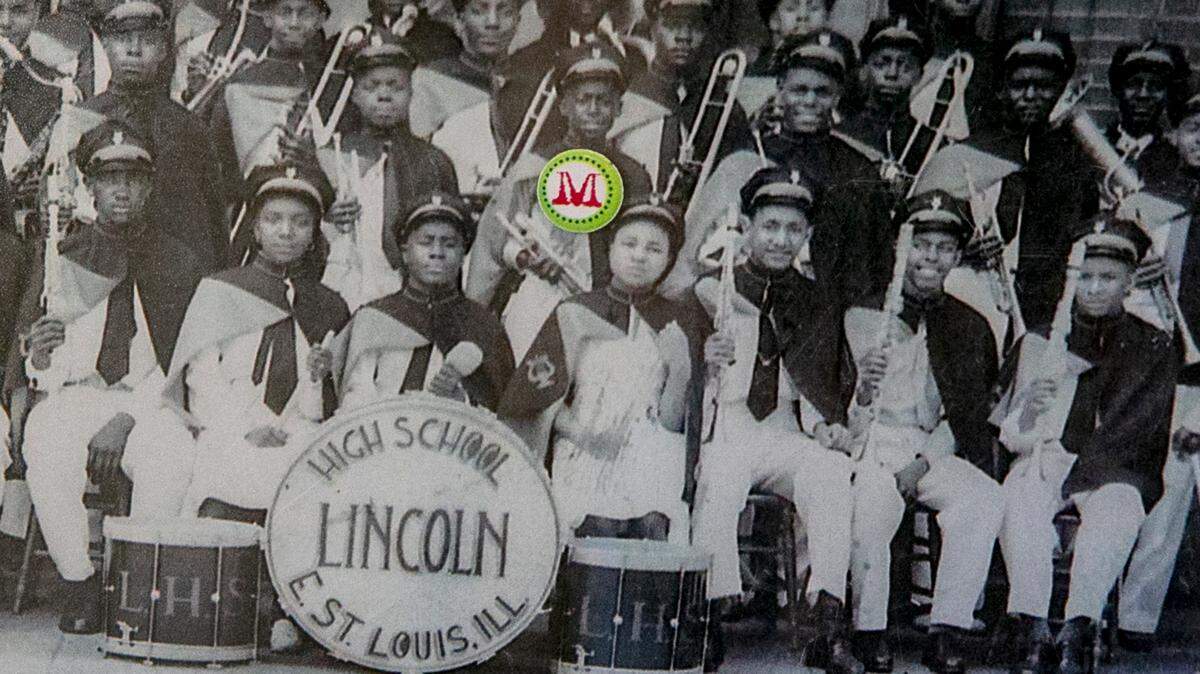
He attended East St. Louis Lincoln High School (which closed in 1998) and played in the school’s jazz band. He was mentored by the band’s director, Elwood Buchanan. Davis also started his first high school band in the basement of his childhood home.
East St. Louis poet laureate Eugene Redmond said he knew Davis’ family and, as a child, delivered newspapers to the dental office of Davis’ father.
“Miles was in an environment that was very supportive, when you talk about upbringing. He had that support in school as well as in private lessons,” said Redmond, 83. “And at home, in school, in church, in social life, in a band, in private lessons, and finally, when he started to play, especially then in clubs and so on, it was a very full cultural experience that he had in his classical education in music.”
Redmond questioned if Davis would’ve become the world-renowned musician that he’s remembered as today if he hadn’t grown up in a segregated East St. Louis. Redmond referenced W.E.B. Dubois’ 1935 article “Does the Negro Need Separate Schools?” in which the famous scholar argues that Black kids will be more successful learning from people who look like them and who believe in their work.
“He said that without segregation, i.e. racism, there would be no jazz in America,” Redmond said. “There would be no blues in America. There would be no Alvin Ailey or Katherine Dunham, who came from East St. Louis, and her time here overlapped the living days of Miles Davis…..That’s part of it. The kind of teachers you had, the kind of subjects that you were taught. Had this culture been fully integrated, would there be Black music, would there be Black dance, would there be a boogaloo, would there be a jerk?”
Would there be a Miles Davis? Maybe not, Redmond wonders.
Legacy
September will mark 30 years since Miles Davis’ death. Lauren Parks said East St. Louis should always be in the conversation when talking about Davis’ legacy. She said it’s where he got his confidence.
“It’s just pride,” Parks said. “East St. Louis has always been a city of pride. That’s just how I was raised. We were always to be proud because we had so many fabulous people here. What helps to make East St. Louis East St. Louis are the people. The people are just resilient, they’re creative, very passionate, dedicated.
“For you to go to Juliard, and tell them that you already knew what they were going to teach you, you have to have some confidence. Particularly growing up in the 40s and 50s, you have to have confidence enough to know that (you didn’t need to) learn your craft even more because I learned the theory of it in East St. Louis at Lincoln Senior High School. So when I think about his abilities, I think confidence, I think resilience.”
There’s also a dark side to Davis’ legacy - a legacy that includes domestic violence.
In the film “Birth of Cool”, Frances Taylor, former dancer and Davis’ first wife, talked about the multiple times he hit her.
“I was with Miles at Birdland one evening, and Quincy Jones was there,” Taylor said in the documentary. “When we got home that night, I just mentioned to Miles that Quincy Jones is handsome. And before I knew it, it was so fast and I saw stars, and I was on the floor. It was the most unbelievable thing that had happened to me because I had never been hit in my life. That was the first, and it wasn’t going to be the last, unfortunately.”
Davis admited to the abuse in his memoir “Miles, the Autobiography”.
“Every time I hit her, I felt bad because a lot of it really wasn’t her fault but had to do with me being temperamental and jealous,” Davis wrote.
In her 2020 memoir “Just As I Am,” Cicely Tyson, acting giant and Davis’ third wife, recounts a time when Davis punched her in the chest. But her reflections of the abuse and her time with Davis are permeated with compassion.
“His behavior sometimes disturbed me greatly, even humiliated me,” Tyson wrote. “And yet more than anger, I felt compassion, and pity for his sad state. It is possible to be at once hurt by a man and heartbroken for him.”
Parks said she’s aware of Davis abusing women. She acknowledges that he had issues, but doesn’t want that aspect of his life to overshadow his work.
“That was part of him,” Parks said. “We try not to focus on that with our youth, but he had his demons. Of course when you think of when he was beaten by the police, that didn’t help.”
She also doesn’t want people to forget about how East St. Louis shaped Miles Davis.
“This is a magical place,” Parks said. “For those of us who are from here, we know what’s here. We also know what the mainstream media says, but, for us, as East St. Louisans, we know how to tell our story, and we’re products of East St. Louis and very proud of it.
“... Even [Miles] walking down the street on his way to school and putting little rice kernels in his mouth to help his technique with the trumpet. Those are things he did here, in this city. He started boxing here and he learned to develop that into something that would help better his technique in his craft. All of those things he got from here. That’s very important not to just smooth over that and just start (his career) in New York. No, he had to do something before he got to New York.”
An interview with Anita Wilson, the next installment of ESTL Voices, will be published next Sunday
BEHIND THE STORY
MOREWho are our stars?
Help us tell more stories about people from the metro-east making an impact on the arts and culture scene in our region and beyond. Who are the emerging creative artists shaping the future of music, dance, the theater, film, sculpture, television, writing, photography and other arts? Tell us your ideas by completing this survey or contacting DeAsia Paige via email or phone 618-239-2624
This story was originally published June 13, 2021 at 6:00 AM.