
Shiloh honors past, present at Freedom Rock and hopes to build a better future
Two significant additions to Shiloh — the Freedom Rock honoring those who serve in the military and a tribute to local heritage recognizing the contributions of German farmers — are now on display at a new village park under development.
The stunning mural — the first Freedom Rock in the state — was unveiled recently during a dedication ceremony as was St. Clair County Historical Society’s interpretive sign spotlighting what is referred to as the “Latin farmers.”
“It was a fabulous turnout. We’ve had a lot of positive feedback,” Shiloh Mayor Robert Weilmuenster said. “We’ve seen a lot of cars there. We still have work to do (on the park).”
On hand were village officials, mayors from Belleville, Lebanon and Waterloo, guests, and residents at the new space at the intersection of South Main Street and Shiloh Station Road.
“The village hopes that the Freedom Rock stands for generations in honor of all those who served and sacrificed to keep our great nation free,” Village Clerk Brenda Kern said.
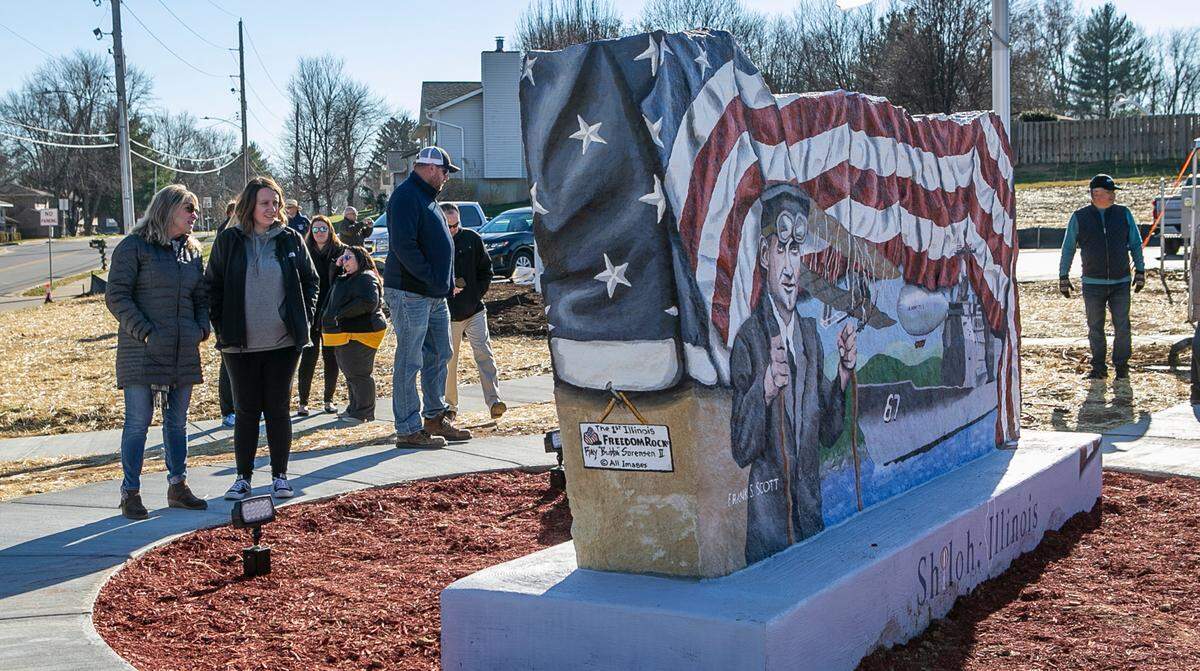
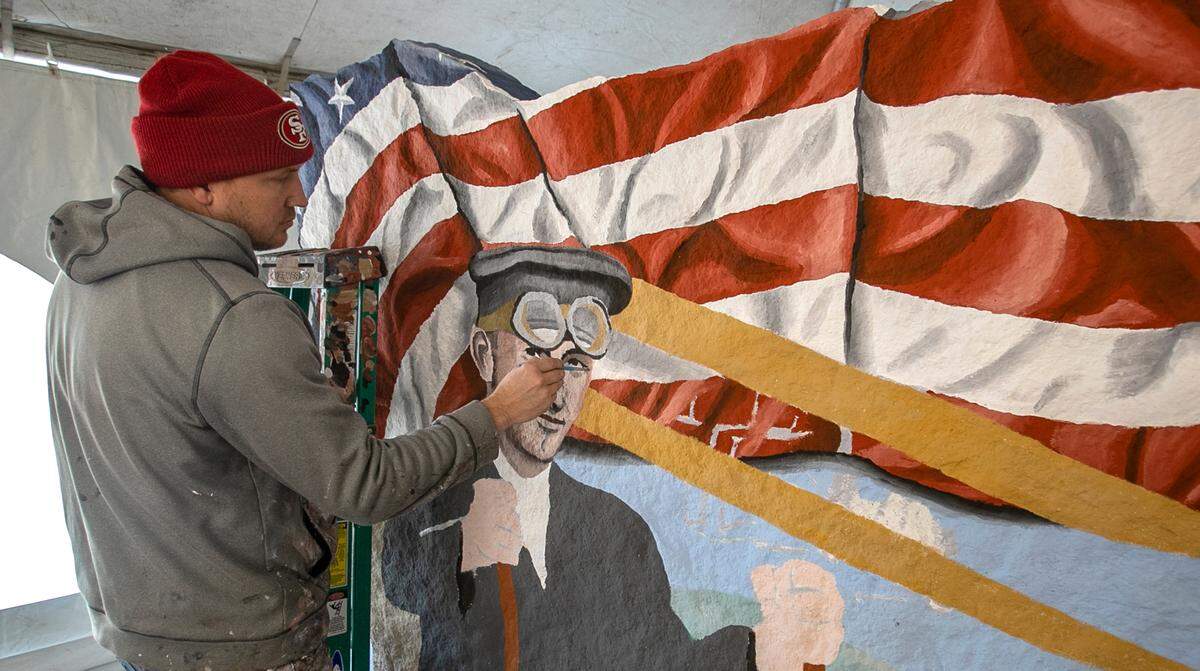
Artist Ray “Bubba” Sorensen created the unique mural on a 10-ton rock. It is his newest addition to the 50-state Freedom Rock Tour. He began doing artwork to honor veterans 23 years ago — in his home state of Iowa — and now has 99 on view there. He has begun traveling to other states — next up is Ohio and Oklahoma. Four are already in Missouri.
“The purpose is to thank veterans and show appreciation for their sacrifices and service — one rock at a time,” Sorensen said.
While in Shiloh for about 10 days prior to Thanksgiving, Sorensen painted the rock in a heated tent.
“The mayor and council members and volunteers were welcoming and helpful throughout, and even had a nice dinner with some Iowans who’ve relocated and started a successful business in the Shiloh area,” he said.
Weilmuenster visited the one near Fort Leonard Wood to get the bigger picture regarding the monument.
Sorensen, who also serves as a state house representative in Iowa, has been a mural artist since college. He decided to devote time to honoring veterans after he saw the movie “Saving Private Ryan.”
Dana and Angie Steffey of Shiloh, who own Data Technologies in O’Fallon, presented the idea of locating a Freedom Rock to the Shiloh Village Board, which approved the project and offered to contribute financing.
“The artist cost $10,000, and the Steffeys paid more than half the cost,” Weilmuenster said, noting the village had already received grant money for the park.
“We own the ground. We just made it more special with the additions of the monument and heritage sign,” he said.
Historical Marker
Angie Steffey said she was thrilled with the support from city officials and area residents. At the unveiling, she was as impressed as everyone else with Sorensen’s handiwork, particularly what he included to represent the area.
The marker recognizes the “Latin Farmers” who weren’t Latin — they were German — and only a few were farmers. The immigrants were wealthy, independent, and conscientious, the historical society stated.
“After escaping German political repression, they wanted to live in a community with free speech and other democratic ideals. They brought books from Germany, some in Latin, and purchased acres of land to farm or divide into lots — thus the nickname. They became engineers, doctors, lawyers, teachers, merchants, and politicians. Friedrich Engelmann, 25, led the group of about 20 Latin Farmers to St. Clair County’s Shiloh Valley. They left a great legacy for the Shiloh/Belleville area,” Weilmuenster said.
“Sharing our history with you is our honor and our privilege,” St. Clair County Historical Society stated on its Facebook page.
Shiloh Freedom Rock Inspirations
The location was significant, he added, because the area is home to many veterans as Scott Air Force Base sits right next to it. He added Frank Scott — the base’s namesake — to the mural.
“Scott is the only base named for an enlisted person,” he said, noting it started as Scott Field and was instrumental in the early days of flight capability for the military.
Sorensen explained the symbolism behind who is represented on the rock. He always starts with a large American flag over the top to represent all those who have served
“During World War I, Secretary of War Newton Baker advocated an expanded role for aviation. Business and political leaders on both sides of the Mississippi River wanted the Midwest to be chosen as a site for one of the new ‘flying fields. Aerial expert Albert Bond Lambert joined the St. Louis Chamber of Commerce and directors of the Greater Belleville Board of Trade to negotiate a lease agreement for nearly 624 acres of land,” he said.
Sorenson’s research
“The layout of Scott Field was typical of aviation fields built during World War I. Construction began in June 1917 and well was underway when the government announced, on July 20, 1917, that it would name the new field after Corporal Frank S. Scott, the first enlisted service member killed in an aviation crash. Scott died after an unexpected engine failure had brought down the aircraft that Lt. Lewis Rockwell had been giving him an orientation flight in at College Park, Md., on Sept. 28, 1912,” he said.
While doing his research, he came across history on Army blimps and how they were instrumental in offering information about enemy locations and weather. Beginning in 1908 and lasting until 1937, the U.S. Army established a program to operate airships. These airships were used primarily for search and patrol operations in support of coastal fortifications and border patrol. During the 1920s, the Army operated many more blimps than the U.S. Navy.
“They were also used because they were not seen as ‘threats,’” he said.
The rock depicts the USS Shiloh, a Navy Ticonderoga-class guided missile cruiser, named in remembrance of the Civil War battle.
“They invited all communities with the name of Shiloh to the christening,” Sorensen said. “With her guided missiles and rapid-fire cannons, she can face and defeat threats in the air, on or under the sea, and ashore. She also carries two Seahawk LAMPS multi-purpose helicopters, mainly for anti-submarine warfare.”
More about Freedom Rock
On the back of the rock, he referenced the Civil War era and local history. He said in 1862, in the basement of the Shiloh Methodist Church — painted on the rock as well, Gen. Ulysses S. Grant recruited for the Co. 1, 117th Regiment, Illinois Volunteer Infantry.
Adolf Engelmann, a lieutenant colonel of the 43rd Illinois Volunteer Infantry Regiment, is also shown.
“He participated with his regiment in garrisoning Fort Donelson after its capture by the Union Army under Brigadier General Ulysses S. Grant. As commander of the regiment, he fought at the Battle of Shiloh. He was promoted to colonel on April 12, 1862,” he said.
He was promoted to brevet brigadier general of volunteers four years later for faithful and meritorious service. He died Oct. 5, 1890, in Shiloh and is buried in the Engelmann family cemetery.
‘Thank you to all who’ve served our country’
He included Medal of Honor recipient Wilbur F Moore, born 1840 in Lebanon, who served with Company C 117th Illinois Infantry during the Civil War. He was awarded the medal for capturing the flag of a Confederate battery while far in advance of the Union lines.
Sorensen likes to include all military branches on his rock murals. Because the Marines weren’t specifically represented, he hid a “flag-raising” on the flag for them.
In all artwork, he paints the initials MIML, which are for his wife, Mari,a and their three children — Independence, Michael, and Liberty.
“Thank you to all who’ve served our country. Hope the Freedom Rockers enjoy this addition to the tour,” he said.
For more information, visit: https://www.thefreedomrock.com.
Sorensen is also selling 2022 calendars at his online store.
This story was originally published December 21, 2021 at 3:53 PM.